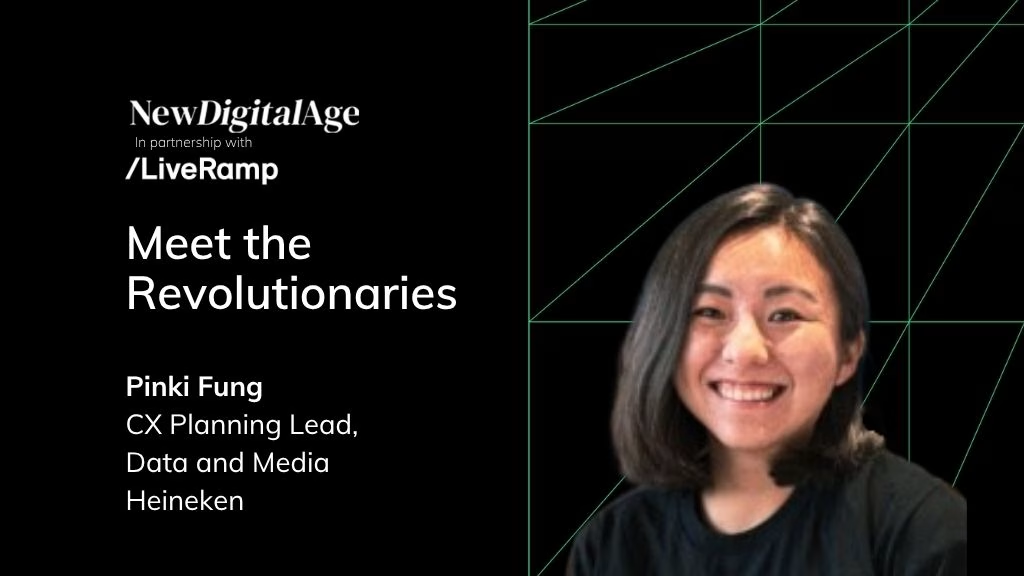
New Digital Age (NDA) in association with LiveRamp is spotlighting the men and women championing a data-led revolution in the marketing industry. The ‘Meet the Revolutionaries’ interviews focus on the efforts of the industry executives helping to drive digital marketing forward into a new era of data collaboration.
As brands move into a new era of data collaboration, the ability to connect consumer, retail and media data safely has become a defining competitive advantage. For Pinki Fung, CX Planning Lead, Data and Media, Heineken, the challenge is not only technical but organisational, aligning teams, partners and infrastructure to unlock growth while maintaining strict compliance.
Justin Pearse, NDA Editor in Chief, spoke to Fung about data collaboration, innovation inside regulated industries, and why starting small is often the fastest way to transform.
What does your role involve, and how does it connect data to consumer experience?
My role focuses on connecting different types of data, including consumer data, retail data and our own brand data, into our media and activation platforms. The goal is to ensure our brands show up in the right place and improve consumer experience while also driving business growth.
It is about making sure we are not working in silos, but instead using connected data to understand how consumers interact with our brands and how media investment can be optimised. When those data points come together, we can deliver more relevant experiences and create measurable business value.
Can you share an example of a project that demonstrates innovation through data collaboration?
One of the biggest examples was a project we started around two and a half years ago, connecting a media platform with retailer data and our own brand data. It created a triangular relationship between partners, which had not really been done before in that way.
The scoping process was long because it involved consumer data and strict GDPR requirements, so compliance was central from the start.
The objective was to combine those datasets in a compliant way while improving targeting in a traditional mass marketing channel and driving incremental retail sales. By working closely with partners and respecting the regulatory framework, we were able to unlock better targeting efficiency and measurable commercial impact.
It showed that innovation is possible even in sensitive areas, as long as you approach it carefully and collaboratively.
What are the biggest barriers to innovation, and how do you bring stakeholders with you?
One of the biggest barriers is maintaining clarity around the objective.
Innovation is not business as usual, so it requires extra effort from teams who already have full workloads. It is easy for people to lose focus or see it as additional complexity rather than an opportunity.
Keeping stakeholders aligned is critical. You need to consistently remind everyone what the project is trying to achieve and how their contribution supports the outcome. When people feel involved and understand the impact, they are more motivated to support the work. It becomes a shared journey rather than an isolated initiative.
What advice would you give to marketers trying to drive innovation within their organisations?
Start with a real business problem and focus on a small, achievable use case.
It is important not to be too ambitious at the beginning. Smaller projects allow you to demonstrate value more quickly and build confidence across the organisation. Once you have proven success, it becomes easier to scale and secure further investment.
Innovation does not need to begin with large scale transformation. A quick win can create momentum and help shift internal perception, making future innovation easier to implement.
What trends are shaping the future of digital media and data?
One of the biggest trends is the increasing capability for data integration across partners. Many media platforms now provide infrastructure that allows brands to connect datasets more effectively and safely.
I see it as a kind of sharing economy of data, where different partners contribute their datasets to achieve better outcomes collectively.
This approach helps improve conversion performance and ensures that media investment delivers stronger returns. Instead of relying on isolated datasets, brands can combine insights from multiple sources to create a more complete view of the consumer.
How have attitudes towards consumer data evolved, both internally and externally?
Consumers have become much more aware of how their data is used, and many are comfortable sharing it when there is a clear benefit, such as more relevant advertising or improved experiences. In Europe especially, people are now more familiar with the value exchange involved.
Internally, however, there is still strong caution, particularly in regulated industries like alcohol where age gating and legal compliance are essential.
There is a constant need to ensure that data is handled responsibly. The shift is that data collaboration is now seen as an opportunity, but it must always be balanced with governance and consumer protection.
How is data collaboration between brands and partners evolving?
Data collaboration is becoming much more common, particularly with the growth of clean room technologies and privacy safe matching solutions. Many platforms now offer secure environments where partners can collaborate without exposing individual level data.
This opens opportunities not only for media partnerships but also for collaboration between brands themselves.
These kinds of partnerships would have been difficult to imagine before, but they now offer new ways to drive growth and improve targeting while maintaining privacy standards.
What internal challenges must organisations overcome to enable this?
Legal and compliance is always the first hurdle. Organisations need to work closely with legal teams and data protection officers to ensure everything meets regulatory requirements. Over time, those relationships become stronger and enable faster progress.
Technology infrastructure is often an even bigger challenge. You need the right systems and data pipelines to ensure data flows efficiently and securely.
That requires investment and close collaboration between marketing, technology and data teams to build the right foundation.
How do you measure the success of innovation and secure continued investment?
Measurement needs to connect back to business outcomes, such as ROI, conversion uplift, or incremental performance. In some cases, exact ROI can be difficult to isolate, so conversion uplift or audience performance improvements provide clear signals of success.
Testing and learning is essential.
Running multiple tests and refining audiences allows us to identify what works best. Sharing those results internally helps build confidence and creates a cycle where successful innovation leads to further investment in data and infrastructure.
What innovation has had the biggest impact on you personally?
QR codes remain one of my favourite innovations because they connect offline and digital experiences so easily.
They are simple, accessible and widely adopted, which is what makes them powerful. Anyone can use them, and they remove friction from everyday interactions.
The best innovations are not always the most complex, but the ones that achieve mass adoption and genuinely improve how people interact with technology. QR codes are a perfect example of that.