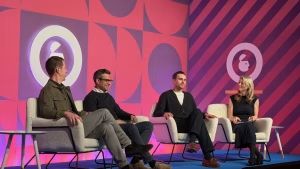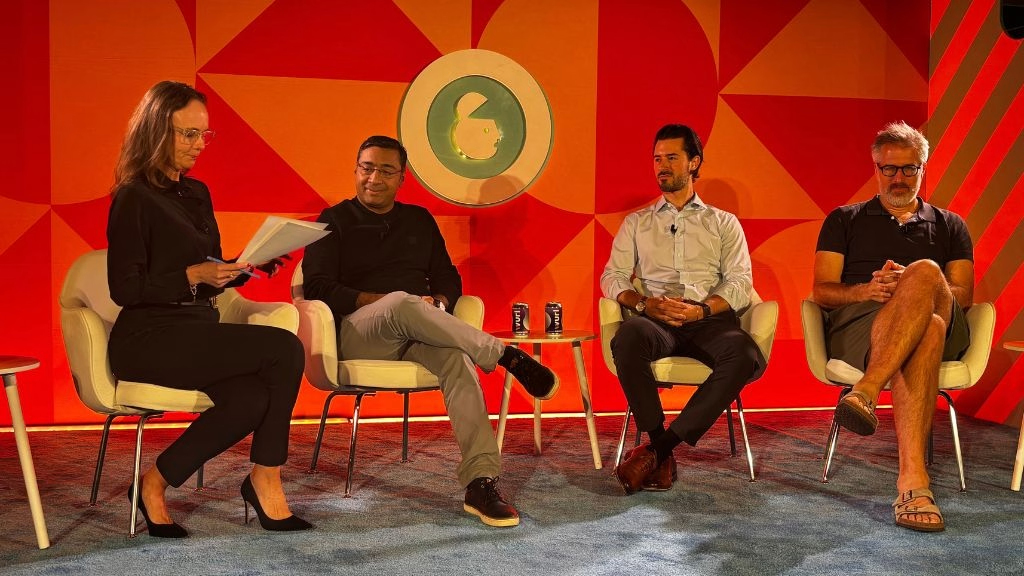
That was the central question posed to a panel of industry leaders at Advertising Week New York. Moderated by Katie Ingram, Director of AWEurope, the session brought together Abhay Singhal, Co-Founder of InMobi and CEO of InMobi Advertising; Dane Kunkel, SVP of Performance & Transformation at Horizon Media; and Brian O’Kelley, CEO and Co-Founder of Apostra. The discussion moved straight past the usual AI hype to confront the realities of building scalable, intelligent systems in modern marketing.
AI may be optimising bids, creative, and media plans at staggering speeds, but the panel made one thing clear: capability alone does not equal intelligence.
Opening the debate, Abhay Singhal challenged the notion that modern artificial intelligence is inherently “smart.”
“My high school professor told me that AI is very-carefully-crafted engineering,” Singhal said. “It’s not really intelligence, but it’s engineering. And one thing that we are probably not doing enough with the AI is concentrating on the core engineering effort that goes in making it smarter.”
Singhal argued that the industry needs to step back from treating AI as a magical solution and return to baseline data engineering and structural discipline.
“Some of the old-world principles like is your data correct, is your infrastructure correct, have you really thought about all the decision loops, have we put the decision loops in the process, and so on. I think we have to go back to the basics of advertising and bring that in a loop form to be able to make the advertising really smarter.”
Dane Kunkel agreed that while organisational readiness for AI is accelerating, true cognitive growth across teams remains a work in progress.
“You ask, ‘Is it making us smarter?’ Yes and no,” Kunkel explained. “I think cognitively, we’re losing a bit of ability in our younger generation that’s coming up in the ranks of the advertising world to understand why they’re doing something.”
However, Kunkel said that from a capability standpoint, AI provides undeniable leverage: “It’s pushing us into a new realm where we’re able to do things that historically would take a very long time in a much shorter amount of time. So I think from that capability standpoint, it’s making us smarter and more efficient.”
He stressed, however, that without strong fundamentals in platform connectivity and data readiness, organisations simply risk generating bad outputs faster.
The danger of compounding errors
A recurring theme was the risk of assembling complex AI workflows without perfecting the individual components. Singhal highlighted how small inaccuracies compound across multi-step systems.
“When creating multi-orchestration agentic systems, each of the steps of the process has to be 99 or 99.9% predictable,” Singhal cautioned. “And if they are even 90% predictable, then you put them in a composite process and your outcome ends up being little better than a coin toss. And who wants a system that is little better than a coin toss?”
He urged companies to focus on making small, individual processes great before stringing them together into automated loops.
“If each one of them has an error of 10%, and you have five processes that need to get to an ultimate outcome, your ultimate outcome is going to be little better than a coin toss. My only recommendation to people that I meet today is to think about how you’re setting up these systems with these inherent self-improvement loops.”
Reinventing the agency’s competitive advantage
With powerful large language models becoming universally accessible, where does competitive differentiation lie for agencies?
Brian O’Kelley turned the room’s perspective on its head by pointing out how vastly the industry underestimates the power of evaluation and self-improving agentic loops, or “evals”.
“Pro tip: I was in Silicon Valley last week, and the head of growth for Anthropic gave a lightning talk. He said the number one lesson they’ve learned is that everything they do, they basically test. Instead of saying ‘let’s do something and we evaluate it,’ they build an agent that checks to see if something works or not,” O’Kelley said.
Illustrating this with a story about his 16-year-old daughter making ads for books, O’Kelley described instructing her not just to ask ChatGPT to design an ad, but to build an automated feedback loop where one prompt writes the ads, feeds them into Meta, pulls performance reports, and iterates until target results are met.
“She said, ‘Dad, that’s cheating.’ It’s not cheating, it’s the whole point!” O’Kelley said. “Think about your AI usage in terms of: how do I make it achieve my goal? If you’re meta-prompting, you’re running eval loops. We’re all thinking too small.”
Addressing what this shift means for agency structures, Kunkel emphasised that agencies must transition from execution houses to orchestrators and consultative growth partners.
“The agency is in an interesting spot where it goes back to having that subject matter expertise and the ability to be strategists on behalf of our clients,” Kunkel said. “Bringing an extra set of eyes to understand how data is working, how the strategy can go into market, and providing orchestration, how do you connect everything?”
Singhal took the concept of orchestration even further, invoking a new industry buzzword: Forward Deployed Engineers (FDEs).
“The term ‘agency’ is fundamentally about representation,” Singhal said. “Why is it so hard for us to imagine that agencies can ultimately orchestrate AI agents on behalf of the customer? Agencies are ideally suited to become the forward-deployed technical experts for the marketing world.”
O’Kelley offered a slight pushback on relabelling standard planners as engineers, pointing to the immense talent war and financial gap between tech giants and traditional holding companies.
“No, no, no! Don’t call yourself an engineer,” O’Kelley pushed back. “We have actual engineers that are forward deployed into clients, and they’re extremely expensive. These are software architect-level people who have been building software systems and AI systems for a long time. You can’t just ask a media planner to go build database integrations with a bunch of internal systems and think about security and scale and everything else.”
O’Kelley pointed to the massive talent gap and financial disparity between tech giants and traditional agency groups as the main barrier.
He highlighted how difficult it is for agencies to recruit top-tier technical capability when competing against AI powerhouses.
“If you want to be great at technology these days, how can you compete when Meta is hiring people for $100 million a year,” O’Kelley pointed out. “You can’t compete with Meta. They’ll pay almost anything.”
He advised agencies to specialise deeply: “You have to be a specialist. It would be better to be the best at one little thing with agents that help you do it really well, than be a generalist.”
As the session drew to a close, the panelists urged the audience to reject basic “automation” and rethink entire operational systems.
“I actually hate the word automation,” Singhal said. “If anybody is using AI to automate anything, I think it’s a wrong word to start with. That’s an automation path, and it’s not an intelligence path.”
Kunkel concluded by encouraging organisations to challenge why they do things before handing tasks over to AI.
“Why are we replicating the current systems if we know they’re hard to do, we struggle with them, instead of making a new system that AI can do which we might not know about yet?” Kunkel asked. “It comes down to discovery. Ask yourself 15 times ‘why’ to get to the real answer, then go build a new system with the tools you have available to you now.”