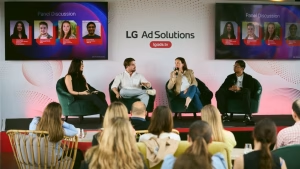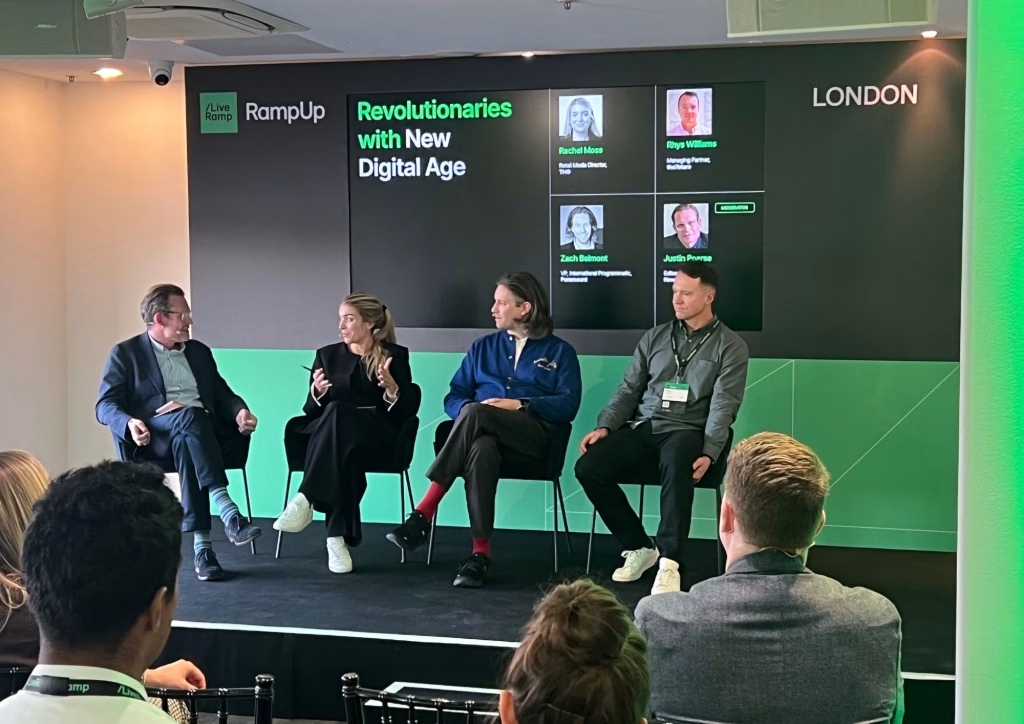
The final panel of LiveRamp’s RampUp London event, Revolutionaries with New Digital Age, brought together three marketing leaders driving the data revolution within their businesses. Moderated by New Digital Age Editor-in-Chief Justin Pearse, the discussion explored how data collaboration, internal transformation, and emerging technologies like AI and CTV are redefining the way brands connect with consumers.
Participants were Rachel Moss, Retail Media Director, THG; Zach Belmont, VP, International Programmatic, Paramount; and Rhys Williams, Managing Partner, the7stars.
To open the discussion, Justin Pearse asked the panel what data-driven marketing means to them. For Rachel Moss, it is about connection and clarity. “For me, data-driven marketing is about creating a connected ecosystem and measurement, and we all need to work together in harmony,” she said.
At THG, she explained, the business leverages rich customer data to inform every stage of retail media planning. “We use insights from our customer purchasing data to form the basis of our retail media campaigns. That data is crucial to ensure that what we activate with our brand partners is truly relevant for our customer audience.”
For Zach Belmont of Paramount, the focus is on how data enhances addressability and audience understanding across the company’s streaming platforms, from Paramount+, 5 Streaming and PlutoTV
“For Paramount, data means addressability. It means better, high-fidelity signalling for our buyers,” he said. “We’re using data to make our inventory more addressable and our relationships with advertisers more effective.”
Rhys Williams of the7stars added that the role of data now permeates every layer of marketing. “Almost everything we do is driven by some sort of data point,” he said. “Whether that’s audience understanding, search, or activation, the data is what turns insight into action.”
Breaking down silos
One of the biggest barriers brands often face is how to break down internal silos to create a genuinely unified data strategy.
For Moss, transformation must begin with mindset, not just technology. “Data transformation isn’t just about the tools we have available. It’s about the mindset within the business,” she said. “We’ve had to go through that journey with our existing team, ensuring everyone becomes digitally and data literate.”
That shift requires a structured approach. “Our three focus areas are insights, activation and measurement,” Moss continued. “Within those, we now have experts who support upskilling the wider team, helping everyone articulate our strategic vision from a data perspective.”
Williams agreed that the challenge lies in changing thinking across large organisations. “Getting people to think differently, and to respond differently, takes time,” he said. “You need to bring people on the journey, helping them understand why you’re moving in this direction, not just telling them that you are.”
At Paramount, Belmont said the process has been long and meticulous, but essential. “Our journey has been unfolding in recent years,” he explained. “It’s about overhauling everything from consent management to data transfers, ensuring we’re collecting and activating data in a privacy-compliant way. That’s the foundation you need before anything else.”
Building talent for a data-first future
Discussion turned to one of the biggest pain points in the industry, finding and developing the right talent.
Moss said that in retail media, the evolution of martech has made hiring even more complex. “Sometimes you’re not actually sure what you’re looking for because the roles are evolving so fast,” she said. “We’ve learned that having people who understand both retail media and martech integration is absolutely fundamental, but that skill set can be hard to find.”
Belmont described how Paramount is prioritising talent with cross-functional expertise across ad tech, data activation, and streaming advertising. “We’ve been building teams of specialists who manage our programmatic streaming business,” he said. “We’re working with talent that bridges ad tech and commercial with expertise in data integration, activation tools, and ad tech ecosystems, guiding our clients through tech-enabled, data-driven activations.”
Williams noted that the industry’s new tools and technologies have opened up opportunities for talent to move fluidly across disciplines. “You’re seeing people move from traditional TV to CTV, from search to programmatic,” he said. “It’s becoming easier for people to shift between channels because the underlying technology is converging.”
The power of partnership and trust
The conversation turned to how data collaboration underpins relationships between media owners, brands and agencies.
“For us, the data supports our partnerships with brands,” said Moss. “We work with them on the problems they’re facing, whether that’s a retention issue or new customer acquisition, and use data to create the foundation of what we’re trying to achieve together. Without that, we couldn’t build plans that truly solve client problems.”
Belmont emphasised that the aim extends beyond simply achieving reach. By leveraging richer data and collaborative tech solutions, brands can drive meaningful outcomes and create more effective, results-driven campaigns.
“Advertisers are increasingly seeking to activate campaigns with their own first-party and CRM data,” he said. “Unlocking these insights relies on carefully selected technology partners and data providers who can help address gaps in audience understanding and enrich targeting capabilities.”
Williams said that at the agency level, data collaboration is essential to make campaigns meaningful and measurable. “Being able to join up those data points from the client side and media side allows us to see what’s working, what’s not, and optimise in real time,” he explained.
Driving impact with data
When asked for real-world examples of data in action, Moss pointed to the integration of THG’s retail intelligence dashboards.
“We use insights from both customer and sales standpoints to shape campaign briefs and activations,” she said. “That carries through to measurement, where we connect with media partners like Uber, Netflix and Meta to prove the impact of our work and feed those insights back to our partners.”
Belmont cited Paramount’s ongoing commitment to providing interoperable, privacy-centric identity and data signals that empower advertisers to deliver stronger outcomes. “Across the EU, we’re enabling buyers to activate with programmatic identity solutions and rich data signals, offering them the flexibility to bid using their own data or to leverage household-level insights in the DSP,” he explained. “Our focus is on building beyond contextual targeting to ensure advertisers can achieve meaningful and measurable outcomes”
Williams highlighted a campaign for a client with limited budgets that used data creatively to compete with larger advertisers. “We took the data, activated it smartly across the right channels, and proved that precision could outperform spend,” he said. “That’s where data really shows its value.”
AI, commerce media and CTV, the converging future
The panel closed with a discussion of Marketing Week’s prediction that AI, commerce media and CTV will define the next year in marketing.
For Moss, commerce media is set to take centre stage. “It’s the fact that we can connect brand storytelling to real-time customer purchases that’s so powerful,” she said. “AI will definitely support that evolution, particularly in optimising our media propositions.”
Williams said the three forces are converging rapidly. “Commerce media, AI and CTV are all massive growth areas,” he said. “CTV is becoming the new normal in how people access content, while AI connects across everything, changing workflows, processes and how we collaborate.”
Belmont agreed that artificial intelligence is rapidly redefining both content production and advertising operations at Paramount. “AI-powered insights, algorithmic ad decisioning, and data-driven buying are now integral to every aspect of our business,” he said. “Having invested in these technologies for some time, we are seeing transformative effects from production workflows to the way we manage strategic partnerships, and it is reshaping our industry approach in profound ways.”
The consensus from the panel was clear: success in modern marketing depends on how well organisations can integrate, understand and activate their data, and how effectively they can empower their people to make that data meaningful.
“Data collaboration isn’t a buzzword anymore,” said Pearse in closing. “It’s the foundation of better marketing, better creativity and better outcomes for everyone, from the brands to the consumers themselves.”