For the past three years, New Digital Age in partnership with LiveRamp has published a series of interviews profiling some of the most innovative and forward-thinking marketers in the world. Each Meet The Revolutionaries interview focuses on the impact of an individual in driving innovation forward, as well as offering tips and insights into making change happen and exploring real-world examples of data collaboration.
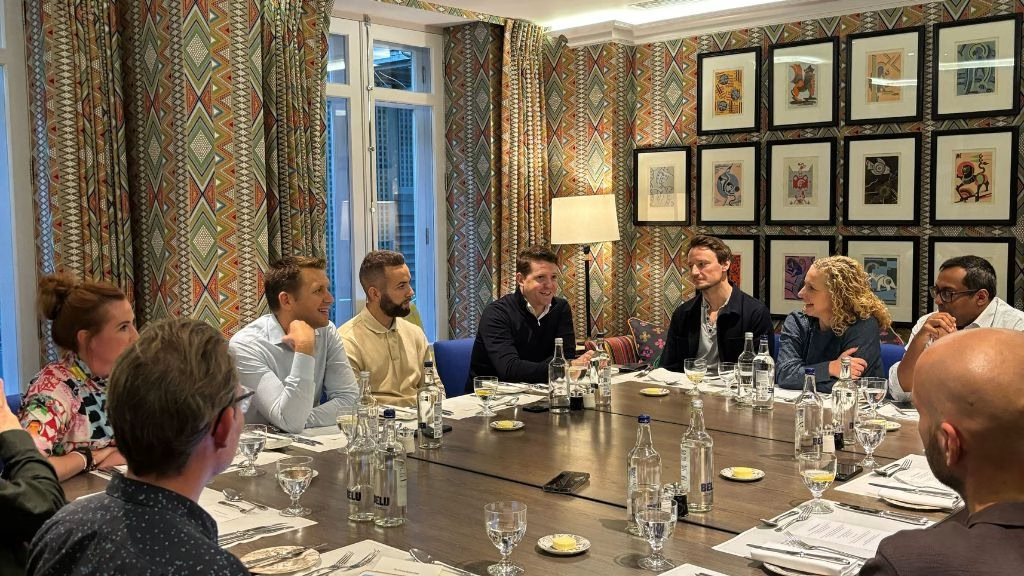
We recently hosted a special gathering of our ‘Revolutionaries’ for a roundtable discussion covering hot topics for marketers including data-driven marketing, the rise of AI, how to nurture a culture of innovation and more. Chaired by NDA Editor-in-Chief Justin Pearse, the event brought together representatives from brands, agencies, publishers and technology partners.
In attendance were: Lena Arbery, Director of Destinations, Travel and Growth, EMEA at Tripadvisor; Richard Bettinson, Senior Director of Media and Insights at Hilton Hotels; Paul Wright, Director and Head of EMEA at Uber Advertising; Alexia Nakad, Vice President of Brands, UK and Middle East at LiveRamp; Sarah Robertson, Chief Product Officer at Experian; Indranill Datta, Head of Technology Services and Omni Customisation at Annalect; Charles Crotty, Managing Partner at Digitas, Publicis Groupe; Mario Lamaa, Managing Director of Data and Revenue Operations at Immediate Media; Luke Fenney, SVP of Publishers and Platforms, International at LiveRamp; James Reynolds, Customer Success at LiveRamp; Sam Eads, Head of Ad Sales and Operations at Trainline; and Travis Clinger, Chief Connectivity & Ecosystem Officer and GM, International at LiveRamp.
New complexity
Data-driven marketing has become a standard industry term, yet what it actually means in practice continues to evolve. As technologies mature, privacy regulations tighten and consumer expectations rise, the phrase now carries new weight and new complexity.
For Richard Bettinson, Senior Director of Media and Insights at Hilton Hotels, “data-driven marketing” is as much philosophical as practical: “At Hilton we use data to connect better with customers,” he said, “but we’re also asking whether one-to-one targeting is always the right thing to do.”
That sentiment captured the tone of the conversation. Data’s power is undiminished, but its application is being reconsidered. Charles Crotty, Managing Partner at Digitas (Publicis Groupe), put it succinctly: “We’ve always used data in this industry, but the job now is to make it better, cleaner and more validated. It’s more complicated than ever with new regulations and technologies coming at us all the time.”
While agencies focus on refinement, publishers are rethinking purpose. Mario Lamaa, Managing Director of Data and Revenue Operations at Immediate Media, said his company is “trying to move away from being purely data-driven towards being user-driven,” explaining that “KPI obsession can sometimes lead us to optimise the wrong thing. We’re trying to use data to empower user understanding, not drown in noise.”
From the platform side, Sam Eads, Head of Ad Sales and Operations at Trainline, described the balancing act between abundance and clarity. “We have vast amounts of data,” he said, “but the real challenge is translating that into meaningful outcomes. We have to prove value with each activation, because as a relatively new vendor, we often only get one chance.”
The personalisation paradox
Personalisation has long been marketing’s holy grail, yet it is becoming increasingly complex. Travis Clinger, Senior Vice President of Addressability and Ecosystem at LiveRamp, noted that clients face intense pressure from CFOs to prove the efficiency of every pound spent. “Budgets are static, expectations are rising and consumers want hyper-personalised experiences,” he said. “The trick is doing it responsibly and measurably.”
That tension between relevance and restraint is now central to how brands operate. Sarah Robertson, Chief Product Officer at Experian, argued that “second-party data is a great bridge. It allows for personalisation within trusted relationships, rather than through opaque data-sharing that can feel invasive.”
Luke Fenney, SVP of Publishers and Platforms, International at LiveRamp, argued that the next stage is repetition. “We’ve shown the value of data collaboration,” he said. “The challenge now is to templatise it, to make it repeatable, scalable and safe.”
Lena Arbery, Director of Destinations, Travel and Growth, EMEA at Tripadvisor, agreed. “At Tripadvisor we don’t treat collaborations as one-offs,” she said. “Each partnership should make the next easier and more valuable for travellers.”
Paul Wright, Director and Head of EMEA at Uber Advertising, took a similar view. “The trust principle is everything for us,” he said. “If an ad appears when you arrive at an airport saying ‘Welcome to Boston’, it works because it feels contextual, not creepy. It’s adding to the experience, not interrupting it.”
The group agreed that consumers’ definition of value has changed. Bettinson said Hilton is moving from a loyalty-scheme mindset to a membership model where the value exchange is explicit. “It’s about relevance and respect,” he said. “When people know what they’re getting in return, they’re comfortable with the data relationship.”
Innovation in context
The conversation inevitably turned to AI, and the consensus was that while AI is transforming marketing, it is not the whole story.
“AI is an accelerator of innovation, not innovation itself,” said Alexia Nakad, Vice President of Brands, UK and Middle East at LiveRamp. “We’re still at the early stage of real data collaboration between retailers, publishers and brands, and that’s just as innovative as AI.”
At Uber, Wright said AI supports the wider business but does not replace human strategy. “Data is still the driver,” he said. “AI enhances our ability to act on it faster.”
For Indranill Datta, Head of Technology Services and Omni Customisation at Annalect, the real shift is cultural. “AI has democratised innovation,” he said. “It’s not just data scientists experimenting now. People across organisations are building their own tools, bringing ideas to life that once needed technical teams. That’s a massive acceleration in creativity.”
Lena Arbery, Director of Destinations, Travel and Growth, EMEA at Tripadvisor, who described herself as “an AI lover, not a hater,” agreed. “AI is an enabler of other innovations,” she said. “It will become the bedrock of everything, but we’re still in the early chapters.”
Balancing control and creativity
For all its promise, AI also brings new risks. Bettinson highlighted brand safety and control as key concerns. “If you use AI to generate creative, you risk losing oversight,” he said. “You need to know how outputs are formed and whether they’re consistent with your brand.”
Eads pointed to Tesco’s use of AI for retail media creative as an experiment worth watching. “It removes friction, but human oversight remains crucial,” she said.
James Reynolds, Customer Success at LiveRamp, envisioned a solution in brand-voice AI agents that act as safeguards, ensuring outputs remain consistent and compliant.
Crotty offered a strategic caution. “The real risk isn’t just misuse, it’s moving too slowly,” he said. “Every CEO wants to know their company’s plan for AI. The organisations that overcome these concerns quickly will gain an edge.”
Arbery added that Tripadvisor moves fast but with structure. “We build internal guardrails to maintain trust and tone,” she said. “AI should accelerate creativity, not dilute it.”
Datta broadened the point. “The question isn’t just whether AI is ready for prime time,” he said. “It’s whether brands are ready to use it responsibly. History shows people gravitate to quality and authenticity. AI won’t change that, it’ll amplify it.”
The disappearing brand
Another anxiety running through the discussion was whether brands could lose visibility in an AI-first world. Luke Fenney, SVP of Publishers and Platforms, International at LiveRamp, observed that “younger audiences are buying directly through social platforms like TikTok without caring who the brand is.”
Clinger warned of potential disintermediation. “If consumers find everything through ChatGPT or Perplexity, those platforms become the new gatekeepers,” he said. “Brands have to make sure they show up inside those environments, not just on traditional search or social.”
For publishers, the challenge is turning that disruption into opportunity. “User-generated content dominates LLM results,” said Lamaa, “so we’re focusing on bringing the personalities behind our editorial brands to the forefront, creating content that works in short form, on social, and eventually in AI environments too.”
Authenticity, many agreed, may be the last true differentiator. As Arbery put it, “AI can’t replace human truth. It can enhance it, but it can’t fake it forever.”