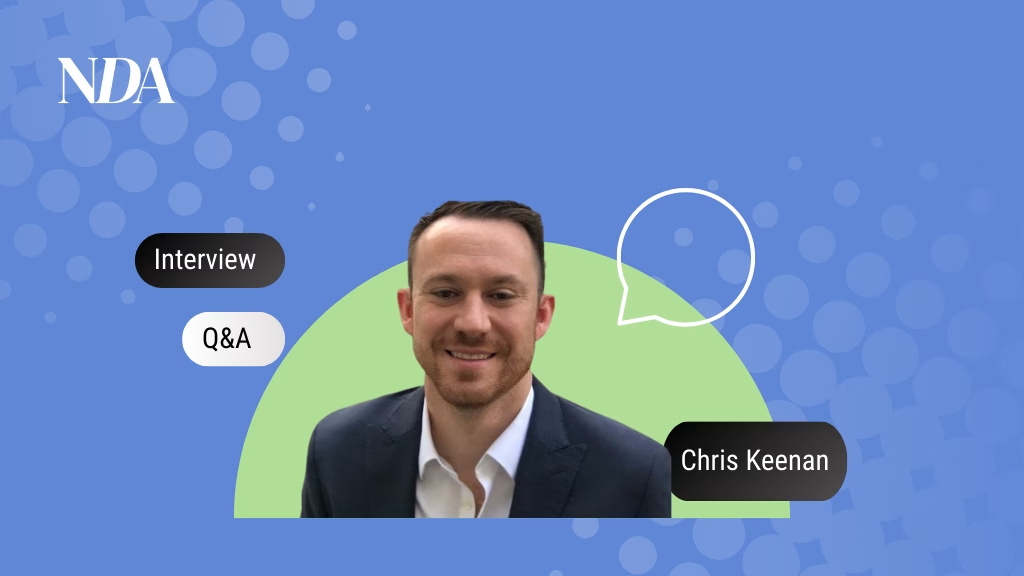
Justin Pearse, Editor-in-Chief of New Digital Age, speaks to Chris Keenan, Head of Agency Development at StackAdapt, about why the platform has taken a different path to growth, how agencies are evolving into technology businesses, and why outcomes, not channels, will define the next phase of the industry.
Why StackAdapt, and what drew you to the business at this point in your career?
I spent around a decade at MediaMath, which gave me an incredible grounding in independent adtech. I worked across product management, solutions engineering and sales, travelled extensively, and was trusted to take on new challenges.
MediaMath gave people space to grow and experiment, and that shaped how I think about programmatic.
One of the lessons from that time was that we were sometimes too far ahead of the market. The technology was there, custom algorithms, custom bidding, but the industry was not always ready for it.
When I started looking at StackAdapt, what stood out was that it had been around for a similar length of time, more than 14 years, but had taken a very different approach to growth.
How has StackAdapt approached the market differently from many other platforms?
StackAdapt has focused relentlessly on the mid market, particularly small to medium sized independent agencies and brands that had historically been underserved.
Many of those brands defaulted to Google or Meta because programmatic felt complex and resource intensive.
The platform was built to make programmatic accessible, but crucially it also wrapped strong service around that technology. Over the last two to three years, we realised that large enterprise brands face many of the same pressures, doing more with less, driving efficiency, and proving performance.
The tools we built for the mid market actually serve those enterprise needs extremely well.
What does your role involve, and why was a global agency development team needed?
Historically, StackAdapt had strong enterprise sales teams focused on brand-level challenges. What was missing was a function dedicated to agency leadership and agency specific problems.
My role is about helping agencies amplify their own strategies rather than telling them what their strategy should be.
Agency differentiation today is very real. Holding companies are making very different bets around data, addressability and proprietary platforms. Our job is to support those strategies, helping agencies use StackAdapt’s capabilities to accelerate what makes them different, not just act as a conduit for media spend.
What has surprised you most when speaking to large agencies and networks in this role?
One of the biggest shifts is that agencies are increasingly acting as technology platforms themselves. Instead of integrating their tech stack into a DSP, they want DSP capabilities brought into their own proprietary environments.
That reduces risk, gives them more control, and allows them to manage planning, activation, optimisation and reporting end to end.
For us, that means clearly articulating the specific value we bring and making it easy to integrate into those agency platforms, rather than asking agencies to change how they work.
Does StackAdapt’s vertical focus resonate with agencies?
No holding company needs another generic DSP, they already have several. What cuts through is specialism.
StackAdapt sits between point solutions and fully-agnostic platforms by building deep vertical expertise.
We have dedicated teams for B2B, travel, healthcare, political and more, focused on the KPIs and measurement challenges unique to those sectors.
In travel, for example, understanding the economic impact of tourism campaigns is critical, yet those metrics often do not exist in other platforms. By building those capabilities directly into the platform, we remove complexity and deliver something genuinely useful.
How do you navigate complex holding company relationships in practice?
You cannot rely on a single champion. Decision making in large networks involves multiple stakeholders across investment, programmatic leadership, client teams and partnerships.
Each group has different goals, and you need to show how you solve problems for all of them.
That makes the process thorough and sometimes slow, but it is necessary. Independent agencies can often move faster because decision making is simpler, but even there, people move roles frequently, so breadth of relationships is still critical.
Looking ahead, what themes will define the next phase of the industry?
If curation was the defining word of 2025, outcomes will define 2026.
Brands are increasingly pushing for performance based remuneration and stronger alignment between agency success and business performance.
There is a clear move away from cost plus and fixed-fee models towards shared accountability.
Agencies are investing heavily in intelligence, data and AI within their own platforms to guarantee outcomes with more certainty. Our role is to support that shift and give agencies the confidence to forecast and deliver real business results.
What excites you most about StackAdapt’s product direction right now?
We are much more than a traditional DSP. StackAdapt is a marketing orchestration platform that brings owned and paid channels together in one place. Email is built directly into the platform, alongside programmatic media, and we have also launched programmatic direct mail.
Brands can use signals from email engagement to influence creative and media decisions across other channels, creating a more intelligent and cost effective approach to frequency and touch points.
When you combine that with deep vertical insights and analytics, it gives agencies and brands real power to adapt, and that is what excites me most about where we are heading.