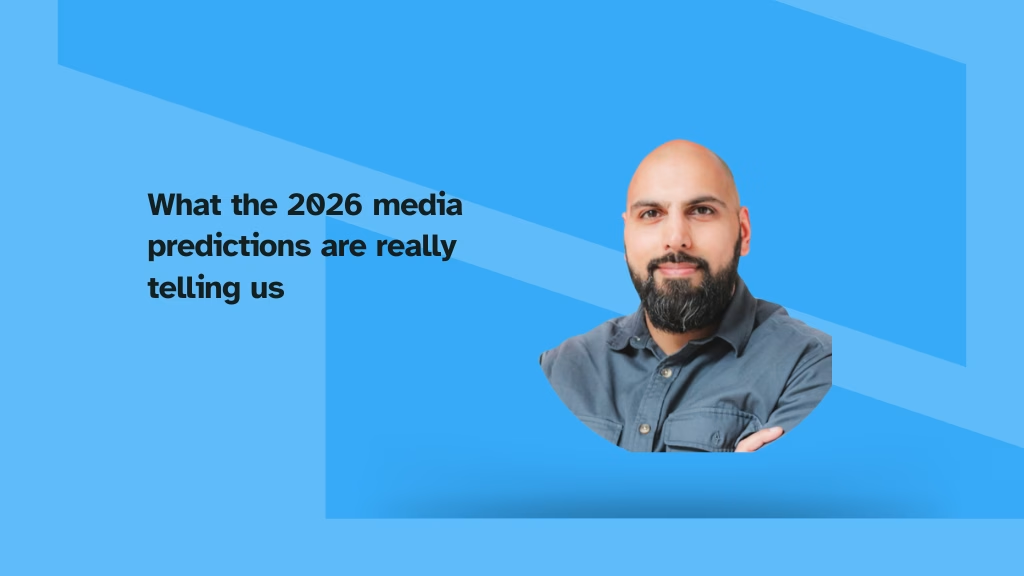
By Shez Iqbal, our regular NDA columnist
The start of 2026 has arrived with a familiar ritual in the marketing and media industry: a wave of predictions, outlooks and trend reports attempting to explain what the year ahead will hold. Read enough of them and a common set of themes quickly appears. AI is everywhere. CTV continues to grow. Creators are becoming more central. Retail media is maturing. Measurement remains complicated. Trust, meanwhile, feels increasingly fragile.
At first glance, this can feel like a long list of disconnected shifts. But step back and a clearer pattern begins to emerge. This is not really a story about new channels or formats. It is a story about how marketing organisations themselves are being rewired.
The most important changes in 2026 are unlikely to come from new platforms. They will come from new operating models.
AI is no longer a tool. It is becoming the operating layer.
We have moved beyond the phase where AI is simply about productivity or automation. In 2026, it is being embedded into planning, creative development, optimisation, measurement and even discovery itself.
Search behaviour is changing. Creative development is changing. Media planning is changing.
A meaningful gap is opening up between companies that are building genuine AI infrastructure and those that are simply “using AI features” inside existing tools. That gap increasingly looks structural rather than incremental.
This year, AI will not feel like a competitive advantage. It will feel much more like the cost of entry.
CTV is no longer optional.
The old idea of “TV versus streaming” now feels outdated.
BVOD, SVOD, FAST and YouTube on the big screen are collapsing into a single, fast-growing and somewhat messy video ecosystem. Audiences are already there. Budgets are following. Ongoing consolidation in the content and studio world is only likely to accelerate this trend.
2026 will also be a significant political advertising year in several key markets, which will act as a real-world stress test for premium video and CTV in particular — from supply and pricing to measurement, brand safety and performance. Political cycles rarely create structural change, but they often accelerate it, and this one is likely to do exactly that for streaming and cross-screen video.
Any strategy that still treats CTV as experimental is already behind where the market has moved.
Social, creators and the new shape of television.
Another theme running through many recent forecasts is the changing role of social. It is no longer simply a distribution channel. Increasingly, it acts as the strategy engine.
The most sophisticated brands are no longer using social to amplify campaigns, but to create them. Social now sets the creative language, the cultural signals and the testing framework, with TV, OOH and retail acting as scale layers for what has already proven itself in-feed.
At the same time, creators have stopped being media placements and started becoming media owners. They control distribution, shape narrative and, most importantly, hold audience trust. The most interesting partnerships are no longer about borrowing reach, but about shared authorship.
What is changing now is where this content ultimately lives. More creator-led formats are moving from the phone to the biggest screen in the house, evolving into longer-form, lean-back viewing that increasingly resembles the next generation of television. Planning is slowly shifting away from buying posts and placements towards building audiences across screens.
In a low-trust, increasingly automated media environment, creator-led, audience-first CTV may become one of the most powerful routes to long-term brand building.
Commerce, retail and brand spend are being pulled into one planning layer.
Another consistent signal in recent industry commentary is the breakdown of old budget silos.
CMOs are increasingly tired of treating retail media, direct-to-consumer and so-called “upper funnel” brand investment as separate worlds. In reality, they influence the same outcomes and increasingly need to be planned together.
This is creating real pressure for agencies and technology stacks that were built for a more fragmented era. The future is likely to belong to models that can connect brand, performance and commerce into one coherent system.
There is a quiet recalibration away from noise, outrage and forgettable advertising.
For years, much of the industry has optimised relentlessly for impressions, clicks and short-term performance metrics. In doing so, it has also trained consumers to forget a large proportion of what they see.
Outrage may work for algorithms, but it is corrosive for trust.
In 2026, live experiences, real-world moments, stronger storytelling and more emotionally resonant creative are starting to regain importance; not as nostalgia, but as a rational response to an attention economy that is showing clear signs of fatigue.
The question more brands are beginning to ask again is not simply, “Did it get seen?” but, “Did it actually leave a mark?”
We are still underestimating “older” audiences.
One of the most persistent blind spots in modern marketing remains demographic.
The over-50s hold the majority of disposable income and are now heavy users of CTV, YouTube and social platforms. Yet many media strategies still skew young by default.
This is not just a missed opportunity. It is one of the largest and most expensive misconceptions in the market.
The real battle in 2026 is meaningful attention.
In a world of infinite content and growing automation, the scarce resource is no longer access. It is meaning.
Time spent, not just impressions. Impact, not just reach. Memory, not just visibility.
The bigger picture.
Media is becoming more automated, more fragmented and more AI-driven at exactly the same time as brands are being forced to rediscover humanity, trust and genuine effectiveness.
That tension is likely to define 2026.
The winners will not be those who chase the most new channels. They will be the ones who build operating models that are genuinely fit for how media, technology and people now actually behave.