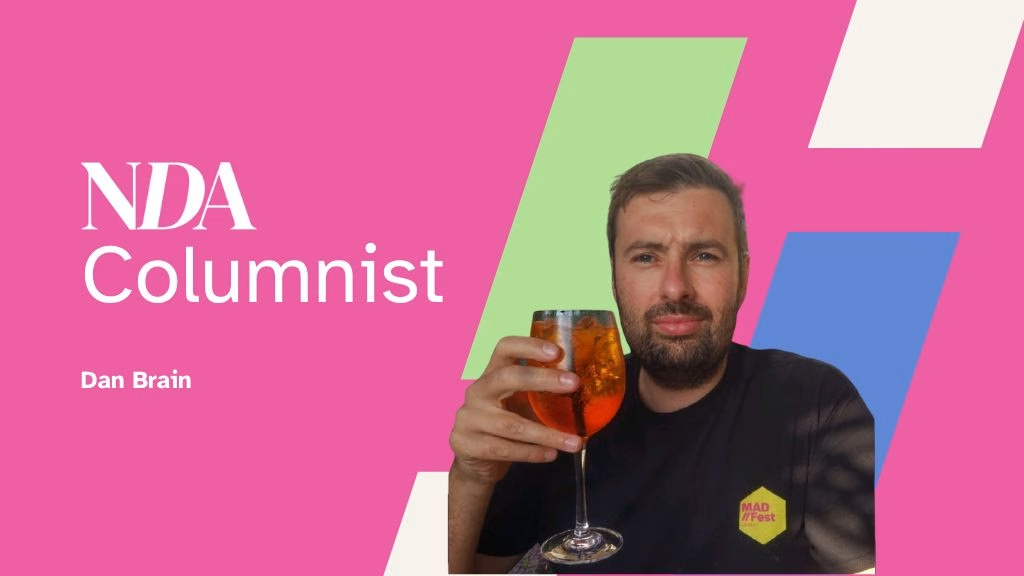
By now you’re bored of people saying things like ‘2026 will be the year of AI’ and such like (you don’t need me to tell you which way the wind is blowing like the Michael Fish of Media).
So for my debut NDA column, rather than make a series of outlandish predictions that may or may not be true, what I’m about to say is more of a no-nonsense personal survival guide for a time when the ecosystem feels about as stable as Man United’s boardroom.
Of course some of this might be off the mark. Maybe you totally disagree. Don’t forget that the opposite of a good idea can be another good idea, as our friend Rory Sutherland frequently reminds us.
But I’m sticking to my guns based on my experience of building the MAD//Fest brand over the last eight years and our relationships across the industry. These commitments to humanity are within my grasp and ultimately I think they’ll serve us well as the action hots up in 2026.
Brand and storytelling
As author and entrepreneur Alex Hormozi now famously said, “brand allows you to play capitalism on cheat mode”. There was a time when B2B brands were almost exclusively dull, dry and drab, using corporate copy devoid of any charisma. Event brands were some of the worst offenders – God forbid anyone deviate from copy clichés or display any kind of distinctive tone, colour or personality (because people always make completely rational purchase decisions, right?).
In the early days, as a bootstrapped start-up, MAD//Fest didn’t really have any other way of standing out from the crowd other than to create a lairy brand, distinctive tone and to present a very human story. I still have MAD//Fest’s 2019 ‘Dare to be Different’ artwork framed on the walls at home and it serves as a good reminder of the need to be distinctive and differentiate.
Fast forward to 2026 and a juicy sub-plot is emerging alongside the “AI is going to take over the world” narrative. A recent WSJ article regaled how the ‘storyteller’ has become America’s hottest job (as well as one of the oldest) and the big moves businesses are making to ensure that good storytelling provides the antidote to AI slop. Meanwhile, Forbes declared 2026 to be the year when storytelling becomes the CMO’s most profitable skill.
One brand that continues to impress when it comes to storytelling is Dishoom. I recently met with CMO Lucy Milne at Dishoom’s Shoreditch flagship and was once again immersed in a compelling narrative. Dishoom has an individual myth for each restaurant.
From the menus to the music, the entire Dishoom story is crafted with meticulous attention to detail. I love the ‘Chai Per Charcha’ meets (bringing the South Asian ‘conversation over chai’ concept into Dishoom’s restaurants). The ‘Dishoom Loves Market’ last November and its celebration of South Asian talent was a masterstroke. This creative storytelling (supported by a good PR agency) is an inspiration for the CMO who wants to make storytelling their most valuable ability.
As competitors vie for attention in a noisy and uncertain market in 2026, we’ll double down on our brand, leverage it in everything we do, and tell a good tale about our products, community and brand. Who knows, maybe we’ll even unlock that fabled cheat code for capitalism.
So if you’re an established business, value, protect and grow your brand in a measured and considered way. If you’re looking to take on the big guns, be bold, be different, and tell a damn good story. Now is not the time for vanilla.
Trust and honesty
Heavily linked to brand, trust is even more important when the world gets a bit wobbly and people are naturally protective of their precious marketing pounds and pennies.
Can you be trusted to deliver what you promise? Are you at risk of triggering ultra sensitive BS detectors? Are you bold enough to call a spade a spade and admit it when things don’t quite go to plan?
As a geriatric millennial, I’m part of a generation that is obsessed with the pursuit of authenticity as well as avocados (even if the former does apparently make Gen Z cringe). Sadly, I’m not down with the kids enough to really know WTF is going on in a Gen Alpha’s head when they use catchphrases like ”6-7” and “skibadee”.
But when I see Gen Z – some of whom are now reaching 30 years old – referred to as the ‘Honesty Generation’ and young marketers landing increasingly big jobs, it does hammer home the need to be straight with people, whoever they are, whatever the circumstances, whenever it may be.
And it seems like I’m not alone. Responding to the sustained decline in trust in brands in recent years, MAD//Fest regular, Beavertown Marketing Director Tom Rainsford sums it up beautifully and calls for “slower and more truthful brand building” in this recent LBB article.
In my opinion, honesty is always the best policy.
Human relationships and community
In a world where people can get married to AIs and having a conversation with a brand that isn’t a chatbot is about as likely as Nigel Farage landing a new job at the UN, it might seem paradoxical that now feels like the right time to invest in human relationships. But it really isn’t odd when you think about it. Scarcity drives demand. We’re psychologically hard-wired to value what’s hard to get.
Whether it’s MAD//Fest or having a pint with peers down the pub, our industry’s insatiable appetite for building human relationships and feeling part of a community only grows stronger in the era of automation.
I think this is perfectly encapsulated by MAD//Fest’s 2026 theme, ‘The Human Touch’, which will serve as a timely reminder to value human creativity, intelligence and endeavour alongside things like AI. My personal goal is to get out more, meet more people, and dial into our community’s conversation more frequently by getting out of my comfort zone.
Partnerships
You’ve probably read enough Mark Ritson by now to know that the right partnerships are “as good as marketing gets”. Back in 2018, I was unenlightened on this theory but instinctively felt that as a newcomer, MAD//Fest should partner with pretty much every food and drink brand I knew.
On reflection, partnerships made our untested proposition look more credible. They enabled us to puff out our feathers and look a bit bigger than we were at the time.
Now, whether it’s building bars and experiences with Diageo, Havana Club or Heineken, serving food from restaurants like Dishoom, Sticks N Sushi and Lina Stores, promoting social mobility with DigiLearning, running awards with the Alliance of Independent Agencies or launching MAD//Sports with the Sports Industry Group, partnerships underpin a large part of the MAD//Fest experience.
Rather than try to do it all ourselves, I think of MAD//Fest as a platform for like-minded organisations to craft collaborative experiences at a ‘moment’ when the industry gets together off Brick Lane.
The strategy is pretty simple – partner with credible brands and use the combined leverage and communities to drive awareness and deliver a distinctive experience.
Ethics
Call me an optimist, but I think deep down, people really do value those who are bold enough to do the right thing. I’ve found myself saying “just because you can, doesn’t mean you should” a lot lately, particularly in relation to AI.
Times of uncertainty, dwindling trust, rapid technological change, AI slop and misinformation call for businesses to act with purpose, compassion, honesty, transparency and accountability, both internally and externally.
As an industry and society, I think we need to ask whether the relentless pursuit of efficiency or creative shortcuts is in our long-term interest (I’m sure the additional 4,000 people who are being laid off thanks to the AI-driven Omnicom-IPG merger would have a few choice words to say).
So my promise is to value people, not to succumb to the temptation of short-term gains at the expense of longer-term health, and to act with integrity at all times. Let’s cut the crap and be straight with people, even if it’s an uncomfortable truth or not exactly what people want to hear at the time.
This isn’t puritanical – humans are complicated and inconsistent beings. Ethics can be subjective as well as objective. But if we want to build trust and loyalty with colleagues and clients, we need to make an effort to do the right thing.
So there you have it – five human-centric commitments I’ll aim to live up to in 2026 and zero desire to build an AI capable of imitating our human qualities.
We say it every year, but 2026 is likely to have more plot twists than an episode of ‘The Traitors’. Unlike Michael Fish back in 1987, I wouldn’t rule out a hurricane driven by AI, the headwinds of the economy and accelerated market shifts, but I’m nonetheless optimistic that we can reassert the value of human qualities like creativity, trust and community in 2026.
It really is in our interest.