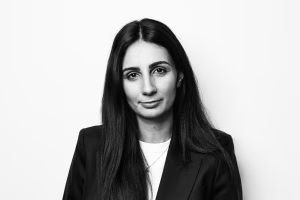
In NDA’s Interviewing the Interviewers series, we catch up with some of the best interviewers in our industry, turning the tables to find out what makes them tick. Next up is Jack Benjamin, reporter at The Media Leader.
What is your biggest hope and your biggest fear for the media and marketing industry in 2026?
My biggest hope is that advertisers and their agencies reinvest in media that is verifiably effective, trusted and valued by consumers, measured by independent third parties, and that supports a more tolerant society.
Money has moved away from “traditional” media sources and coalesced in US-based tech platforms that, while absolutely providing scale, remarkable targeting capabilities, and exceptional ease of use, also mark their own homework and provide worsening (if not downright harmful) consumer experiences.
A market correction would likely not only improve outcomes for advertisers, but also improve the ethical pride of this industry.
My biggest fear is that none of that will happen, that advertisers will continue to blindly waste their money in less effective or outright fraudulent ad environments, that tech platforms will continue to monopolise the media industry despite failing to address serious online harms.
And that, as a result, the industry will see more consolidation, mass job losses, eroding consumer experiences, and the business cases for journalism, cinema, and legacy television companies, institutions that provide trusted information and high-quality entertainment, continues to decline.
Who was the most inspirational person you interviewed in 2025 and why?
I had the absolute pleasure of sitting down with Alan Rusbridger to discuss his views on the news industry last year.
Alan is rightfully considered a contemporary legend in journalism, and I have great admiration for his leadership during his time at The Guardian and Prospect. It was a privilege to hear his thoughts on AI, the continued importance of long reads in a time of short-form video, and how news business models must adapt to continue supporting impactful journalism that holds the powerful to account.
He is thoughtful, considered, and someone I hope to emulate throughout my career.
What one technology are you most excited about this year and why?
I get most excited by tech that actually has a clear, immediate use case, is modular or otherwise made to last, and works to meet mass demand at a time when our increasingly K-shaped economy means that many are being priced out of the latest innovations.
The coolest new tech to me isn’t necessarily that flashy. It’s Apple debuting its Neo laptop for £600. It’s Clicks launching the Communicator, a phone that is purpose-built to be used just for messaging and not for infinitely scrolling on social media. It’s Bluesky letting me create my own news feeds rather than defaulting me into algorithmic recommendation I have no control over.
I’ll tell you what I’m not excited about: smart glasses that can be used by authoritarian governments to spy on citizens, or by users to take pictures of unwitting people and then upload those photos to Grok to nudify them.
What was your favourite ad or media experience of 2025?
Paul Thomas Anderson’s One Battle After Another was the high-water mark for mass media in 2025 for me. A relevant, darkly funny, rich work of art that everyone should see.
What is the buzzword or phrase you’d like to ban forever and why?
Authenticity.
Let’s stop pretending that social media influencers, famously some of the most outrageous, attention-obsessed and inauthentic people, are actually down to earth, especially when they’re being paid to promote whatever it is a brand is trying to sell through them.
Crafting one’s appearance to come across as “authentic” is not the same thing as being authentic.
Who’s the one industry figure you’d most like to interview you yet haven’t?
Any broligarch.
How could someone persuade you to interview them and what would put you off completely?
Everyone is interesting, but not everyone is the right fit for our audience. I’m always open to a pitch, but every interview needs its raison d’être, be it a unique perspective, a punchy argument, a fascinating personal background, or simply someone sitting in a leadership role.
I’m only ever truly put off by pitches if they come from someone who very clearly has not read The Media Leader or conducted a baseline level of research to understand our remit.