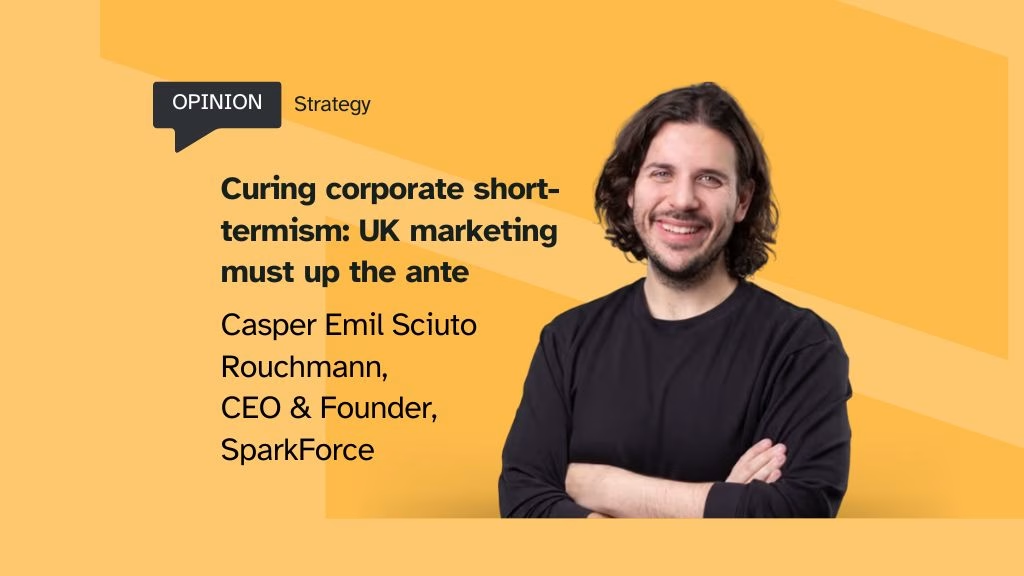
By Casper Emil Sciuto Rouchmann, CEO & Founder of SparkForce
Over at least the past decade, short-term performance metrics have replaced long-term strategic growth as the dominant language of marketing. Dashboards have multiplied, attribution models have grown ever more complex and automation – increasingly powered by AI – has made tactical optimisation faster than ever. Yet the industry’s influence has not grown with it. Quite the opposite.
In British boardrooms, marketing increasingly suffers from a credibility problem of its own making.
A growing body of evidence suggests an uncomfortable truth: in many organisations, marketing is now perceived primarily as a cost-centre and a tactical execution layer rather than a strategic growth-driver.
Recent industry surveys suggest that close to 9 out of 10 UK marketing professionals fear layoffs or structural downsizing. This reflects how vulnerable the discipline has become. When marketing is mainly about optimisation or execution, it becomes easier for CFOs to question why the function exists at all.
That should be a wake-up call to all!
Because the problem is not simply that companies are too focused on short-term results. The deeper issue is that marketers have allowed themselves to be defined by those metrics.
The evidence against short-termism is overwhelming
For years, research in marketing effectiveness has demonstrated that long-term brand investment significantly outperforms purely short-term activation strategies.
Work by Les Binet and Peter Field – analysing hundreds of IPA effectiveness cases – shows that campaigns balancing long- and short-term investment (roughly 60/40) generate substantially stronger profit growth and market share gains than short-term performance campaigns alone.
Similarly, research from WARC consistently shows that brands investing in long-term brand equity achieve higher pricing power, stronger margins and more resilient demand during downturns.
In other words, the data is clear: long-term, strategic marketing works. Still, many organisations continue to double down on short-term metrics. And why is that?
Because short-term numbers are easier to explain in the next quarterly earnings-call. And because too many marketers have stopped challenging the financial logic behind those demands.
Marketing’s real problem: lost strategic authority
So, corporate short-termism is not simply a CFO problem. It is a marketing leadership problem.
If marketing wants to reclaim strategic influence, it must speak the language of business (again): capital allocation, growth models and long-term value.
This is where a generational shift is starting to happen in some markets. In my home country of Denmark, for instance, a growing number of marketing leaders have begun actively educating their CFOs and executive teams about the long-term financial impact of brand investment.
According to the ‘2025 CMO Trend Analysis’ by the Danish Marketing Association, the number of Danish CMOs prioritising long-term strategic marketing initiatives has grown by roughly 16% year-on-year.
That shift did not happen because CFOs suddenly became romantic about brand building. It happened because marketers started presenting marketing not as spend – but as capital investment.
The difference matters. Spend is something you cut. Investment is something you grow.
British marketing must be more ambitious
The UK has one of the most sophisticated marketing industries in the world. Yet too much of the conversation is about optimising media efficiency instead of maximising business impact.
That is not a strategy. It is a maintenance exercise.
For this reason, British marketers could stand to learn from their Danish counterparts in order to answer these key questions:
- How does marketing drive long-term enterprise value?
- How does brand equity translate into financial resilience?
- How does marketing influence pricing power, growth, and competitive advantage?
If those questions are not answered at a boardroom level, marketing will remain stuck defending quarterly budgets instead of shaping business strategy. And corporate short-termism will persist.
This generation must step up
If marketing is to regain strategic influence, this generation of marketers must step up and prove that they can combine creativity with commercial literacy – and have the courage to challenge the status quo.
They must be able to translate marketing strategy into outcomes, the CEO understands. They must be willing to push back against instant results demand at the expense of sustainable growth. And they must dare to explain to the CFO, why cutting brand investment today destroys shareholder value tomorrow.
In other words, UK marketers need to stop behaving like campaign managers and start behaving like business leaders. Because curing corporate short-termism will not come from another attribution tool or optimisation algorithm. It will come when marketers raise the bar for what marketing can be and do.
The UK marketing industry does not lack talent. What it needs now is more ambition – and a willingness to up the ante in order prove that marketing deserves its place in the boardroom again.