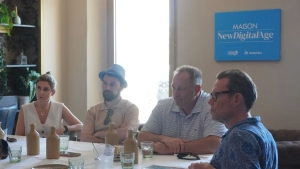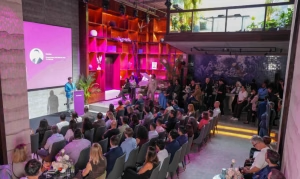
Industry leaders from across the MENA media and marketing ecosystem gathered for a New Digital Age virtual roundtable to discuss resilience, growth, talent and the evolving regulatory landscape across a region that is, by most measures, only just getting started.
The conversation brought together James Dutton, Chief Product Officer at UM MENAT; Richard Fitzgerald, CEO and founder of Augustus Media; Sherry Mansour, Managing Director of Seedtag MENA; Angeline Lodhia Shalabi, co-founder, Semantic Pulse; Wissam Najjar, Chief Operating Officer at Omnicom Media MENA; Nick Walsh, founder and CEO of Migrate Group; Terry Kane, managing director for the Middle East, Turkey and Africa at The Trade Desk; and Ian Manning, Executive Director of IAB Middle East & North Africa. The breadth of experience around the table, spanning agencies, publishers, adtech, independent networks and industry bodies, gave the discussion real depth.
Resilience in the face of disruption
The roundtable opened with the question that has been on everyone’s minds: how has the industry coped with the geopolitical pressures of recent months, and how is it positioning itself to emerge stronger? The response was one of measured but genuine optimism.
Lodhia Shalabi pointed to the structural advantages that Dubai and the broader UAE have consistently demonstrated. “The government here has made it and is making it even easier now, given the current climate of conflict, to allow more people to enter, to have a fair playing field, whether that comes with tax benefits, visas. They’re very much aware that they need to keep their talent here, and they’re providing the infrastructure to maintain that.”
Mansour drew on the region’s track record of bouncing back. “We’ve passed through multiple phases across several years: recession, covid, now this. And every time, with the processes they put in place, we come back stronger. Covid is one example. The country came back stronger than ever, and I think it’s going to be like that later on.”
Dutton described how agencies had to move quickly from shock to strategy. Within days of the situation escalating, his team began building what he called a confidence index, pulling signals from search intent, consumer sentiment and measured media spend across GCC markets, since extended to global comparators.
Some clients pulled back immediately; others spotted opportunity. “We’re already starting to see briefs coming in from clients prepping for launching global campaigns to talk about the strength of regional markets,” he said. “When we talk about a comeback and a rebound, it’s going to be very strong, and we’re already starting to see the budgets flow into what comes next.”
Fitzgerald added the publisher perspective, saying that while the events sector and some print revenue took a hit in Q2, digital advertising proved more resilient, with ecommerce and insurance filling the gap left by categories such as food and beverage and real estate.
He also observed something less tangible but arguably more significant: a coming-together of media. “The media united, definitely came together, across emerging media and legacy incumbent media,” he said. “There was a unification around supporting local brands, and it felt like there was more of a leadership in editorial stance from independent media as well as government.”
Growth beyond Dubai
Turning to the future, the group was clear that the growth story of MENA is being misread if it is told only through a Dubai lens.
Manning framed it directly: “We’re starting to see some quite interesting movements in North Africa, from a very small base. Markets like Morocco are starting to show significant growth.
We’re seeing stabilisation of currency in Egypt, which has always been a huge opportunity market but never leveraged as much as the GCC.”
He was equally clear about Saudi Arabia, arguing that its experience of the recent period differed materially from the UAE’s and that growth, though somewhat moderated from extraordinary peaks, remains substantial.
The wider point, he said, is that the region needs to be understood as a multi-market opportunity rather than a single destination.
Najjar put the scale in context. “When you start talking about MENA as a region of more than 500 million people, you get an idea of the scale and the opportunity. The UAE has a very different demographic and economic model to Saudi Arabia, where domestic demand remains strong and long-term investment continues at speed. .
Egypt has been doing amazingly well despite all the challenges, and markets like Qatar remain a major player. Then you have four major tourism boards investing heavily in growth , which continues to drive confidence across the region.”
Walsh identified a structural gap that the growth story must address: the shortage of deep specialists.
“For a long time the industry has been made up of generalists who can do a bit of everything. We’ve mapped the entire ecosystem of independent agencies, and there are big gaps,” he said. “That’s why you still see brands going outside the region for specialist expertise. The future will be world class capability in the region, covering areas like CX, commerce, sponsorship, and then the really big growth sectors: sports, entertainment, education.”
Several participants highlighted specific channels where demand is outpacing supply. Mansour pointed to agentic AI as a category where government ambition is setting the pace, referencing a decree from Sheikh Mohammed signalling that 50% of government operations could be AI-led within two years.
Kane spoke with conviction about connected TV, digital out-of-home, audio and gaming as the channels set to define the next phase of media growth in the region.
“Programmatic out of home is going to see explosive growth in the next couple of years. If you look at markets like Australia, where 73% of outdoor is programmatic, the region has a long way to catch up, but it’s scaling very quickly,” said Dutton.
Fitzgerald added a consumption-first framing. Smart TV penetration in the region still lags far behind the US, he noted, which means the streaming and subscription boom is still in its early stages.
“What we usually see is that consumption leads and then ad spend follows. So all these areas are going to grow ad spend, but consumption itself still has a long way to grow.”
Entering the market: what companies get wrong
With the region continuing to attract international brands and businesses, the group was candid about the mistakes that are made repeatedly.
Kane, drawing on his experience opening multiple tech companies including both Meta and The Trade Desk in the region, said: “The most important thing when approaching this market is the reality that it is not one place. Dubai is not Riyadh and neither are Cairo, and the ways of doing business in each of these markets differs greatly.
Humility is a key word. At the end of the day, we’re all doing business with people, and a people-first approach versus a solutions-first approach is what has helped me in these markets.”
Manning pushed back on the widely repeated framing of MENA as a relationship-based market, arguing that the real issue is trust.
“A lot of companies come with the notion that there’s so much growth, if we just turn up we’ll get it. They rock up, they think it’s easy, they don’t understand the nuances, they fail, they leave.
It’s not really about relationships. It’s about building long-term trust and investment and commitment. People can see through dabbling.”
Najjar raised a point that drew strong agreement around the table: the chronic underestimation of Ramadan as a strategic priority.
“International brands are still running English-language digital campaigns in markets where 60 to 70% of the most commercially valuable content consumption is in Arabic.
Ramadan requires a dedicated strategy, not a repurposed global asset. Brands that refuse to invest in quality Arabic content will risk missing huge growth opportunities in this region.”
Fitzgerald brought a publisher’s perspective to the localisation debate, arguing that the pan-Arab media model has largely failed. His own business, which publishes Lovin’ across more than 30 cities in the region, is built on hyper-local teams, local licences and locally produced content.
“There are 22 Arab League countries, but there are many dialects and many different stories to tell. Publishers like Huffington Post and Vice tried a pan-Arab approach and didn’t know who they were speaking to.
If you go to Lovin Amman or Lovin Cairo or Lovin Baghdad, everything is localised, and advertisers know who they’re speaking to.”
Part two of this writeup follows tomorrrow, focussing on talent, regulation and the future of the region.