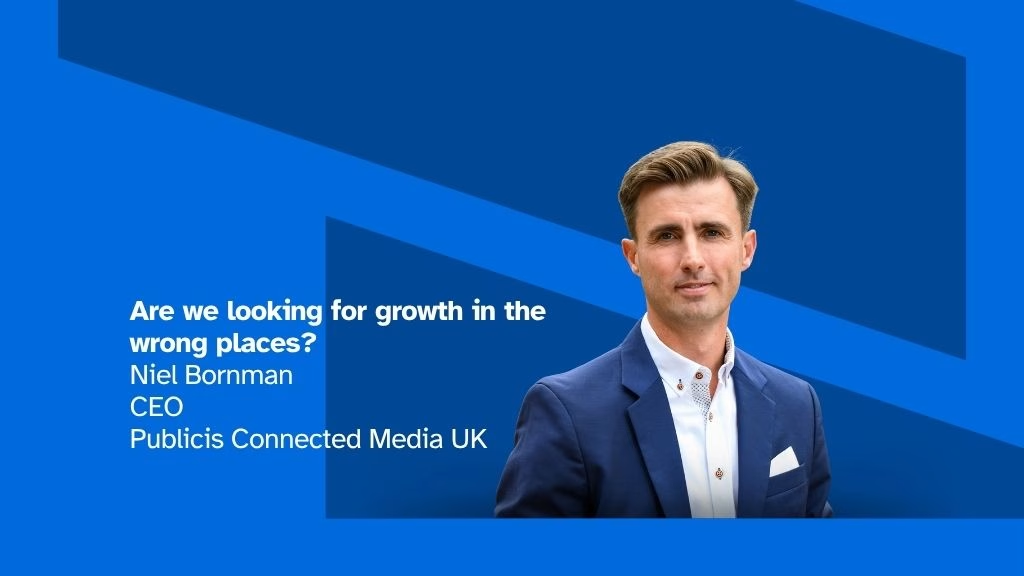
By Niel Bornman, CEO of Publicis Connected Media UK,
There is plenty of growth around.
That might sound odd when so much of the conversation about business is dominated by sluggish economies, nervous consumers and pressure on household finances. But look at the results of many of the world’s biggest companies and the picture is rather less gloomy.
Across consumer goods, technology, financial services and plenty of other sectors, large businesses are still finding ways to grow. Some are doing so at a pace that seems difficult to reconcile with the economic story we’ve become accustomed to hearing.
Understanding what’s behind those results can tell us a great deal about where the next opportunities lie.
New customers are part of it, of course. But growth can also come from an existing customer buying for a different occasion, a community discovering a product for an entirely different reason, or a change in behaviour that creates demand where a brand hadn’t previously thought to look.
Seeing those opportunities requires a much more detailed understanding of how people actually behave.
We now have an extraordinary amount of evidence to work with. Purchases, searches, creator interactions, community participation and media consumption all leave signals about interests, motivations and decisions. Connecting those signals gives us a richer picture of where demand exists and where it might move next.
Consider something as mundane as buying a drink.
You might see it in a creator’s video. A few days later, you search for it. Perhaps you ask an AI assistant whether it’s any good. Then you’re standing in a supermarket, phone in hand, checking the price against another shop.
Each of those interactions can influence the eventual decision, and each tells us something different about the person making it. Being able to connect them gives us a much better understanding of what is driving that decision and how, where and when brands can best connect with shoppers.
Personalisation has become one of those marketing words that can mean almost anything.
At one end, CRM is a one-to-one experience. At the other, we’re constantly improving the way people interact with products and brands through more relevant experiences.
Connecting owned, earned, shared and paid media is how advances in Identity deliver meaningful growth. Advances in Identity mean we can get considerably closer to understanding individual behaviour across the different environments in which people spend their time.
Interactions that once appeared unrelated can increasingly be understood as part of the same journey. AI also gives us the capacity to work with a quantity of behavioural information that no planning team could reasonably process themselves.
I call this connected relevance: bringing those signals together to understand what matters to someone at a particular point in their journey and using that understanding to inform how a brand engages with them.
This becomes particularly important as brands put social closer to the centre of their marketing.
Creators and communities shape what people discover, talk about and buy. Their influence also travels well beyond the environment in which that first interaction happens.
Someone who discovers a product through a creator may later search for it, encounter advertising elsewhere, visit a retailer and eventually buy it in-store. Similarly, the communities somebody participates in can tell us a great deal about their interests and motivations in other contexts.
We saw this with Redken around Sabrina Carpenter’s UK tour. Fans were already recreating her signature hair as part of the ritual around her concerts. That behaviour helped Redken identify an audience that wanted to participate in the cultural moment and shaped the media strategy around them.
Creator-led content, fan Glamstations at The O2, socially connected OOH and TikTok amplification gave that community ways to recreate and share the look themselves. The insight came from understanding what the community was already doing and using that behaviour to inform how the brand showed up.
The commercial value of all this comes down to what it allows a business to see.
There may be a community buying your product for a reason you hadn’t considered. An existing customer may be entering the category on an occasion you aren’t serving. Someone you considered loyal may be surprisingly easy to persuade at the point of purchase.
These are all potential sources of incremental growth.
There is more at stake here than better targeting or more sophisticated personalisation. When we understand demand with greater precision, connected media are able to identify opportunities for growth that businesses haven’t seen yet.
That changes the standard we should hold ourselves to.
A media plan that efficiently reaches the audience it was given may be doing its job perfectly.
But what if the biggest growth opportunity sits outside that audience? That’s when we need identity and all the connected data signals, unlocked by smart people using AI grounded in truth, curating connected relevance.