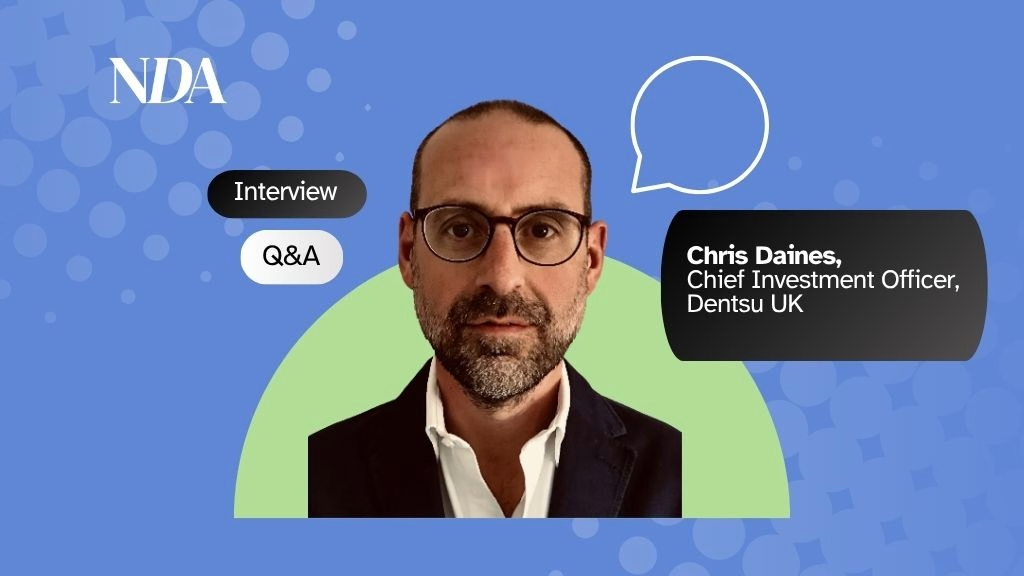
Ahead of New Digital Age’s ‘Spotlight’ focus on TV and Video next month, Chris Daines, Chief Investment Officer at Dentsu UK, talks about the increasing complexity of the TV and video marketplace, the shift from linear to on-demand viewing, and how advertisers (and broadcasters) are navigating a fragmented media landscape…
How would you describe your role at Dentsu?
I’m part of the media leadership team at Dentsu. We have a division called Amplify, which houses all of the planning and buying teams across media for every channel. It also has a team that focuses on our strategic partnerships with media suppliers, as well as a commercial and trading team responsible for the commercial relationships and trading deals we do with suppliers across the market.
Most of my time is spent on the media partner side – the strategic relationships and trading – as well as running the overall team.
We have four core capabilities: Total Social, Total Addressable, which is largely programmatic buying across digital, Total AV and Total Search. Around those, we have specialist capabilities and smaller teams. Those four core capabilities comprise about 1,000 people who are experts in planning and buying.
There are lots of different terms being used to describe the evolving TV and video marketplace. How are you approaching that terminology?
I started out as a TV buyer, so I’ve always kept pace with everything that’s going on in the TV space and how it has evolved. The reality is that it’s just got more and more complicated.
Part of what we’re trying to do for our clients is, while the market has become more fragmented and there are lots of different formats and types, simplify that as much as possible. We’ve brought that together under what we call total video.
As the market has expanded, we’ve got all of these acronyms and an ever-expanding list of things. We’re trying to bring it all together under the umbrella of total video.
Within that, obviously, you’ve got everything from linear TV, BVOD and SVOD to CTV and all the other formats. Our proposition is always evolving as new things come to market.
Does that reflect the way consumers actually consume video?
Consumers don’t think in terms of all this segmentation. They don’t sit down and say, “I think I’ll watch a bit of linear now and tomorrow I’m going to drop into a bit of BVOD.”
We’re trying to join all of it up. The way to do that is through combining datasets – whether that’s client first-party data or audience data – with signals that show where an outcome is being achieved.
That might be a classic media metric such as reach or attention, or it could be a business outcome for a client, such as increased sales, transactions or footfall.
We’re taking a holistic view of all the different video formats and types, rather than planning them on a very siloed linear TV, BVOD or CTV basis. It’s about bringing everything together into one overall plan.
That’s getting more advanced and easier to do as measurement data and measurement itself becomes more advanced. For example, deduplication of reach across multiple platforms and screens isn’t absolutely perfect yet, but it’s getting better.
What does that mean for formats such as podcasts, particularly as audio content increasingly appears on video platforms?
Podcasts are increasingly popular, and one of the things we always wrestle with on the agency side is: who’s going to buy that? Who’s going to plan and buy it?
What clients need from us is not another set of faces to talk to about a particular part of their plan. No one’s really got time for that.
Most agencies have brought together audio and TV teams into AV. We are trying to look at all video formats, what they deliver in terms of audience, and where we can see signals that show some kind of action is being taken by consumers, whether that’s purchase intent or something else.
We’ve created a team of video specialists with the ability to plan and buy across linear, BVOD, CTV and so on, but with programmatic expertise injected into that as well. At the moment, you still have TV or AV buyers working much more closely with programmatic specialists. Eventually, over time, those skill sets fuse, and you have people who can activate across all aspects.
What are the key trends you’re seeing in viewing behaviour?
Clients are very aware of the general shift from linear to on-demand, which has been well documented for quite a few years. We’re seeing streaming platforms growing significantly, and consumers are increasingly getting access to them through ad-supported models.
That means the price point for consumers is more accessible, so there is a whole plethora of opportunities.
We’re also seeing some amazing content available across multiple platforms. You have major shows on Netflix and Paramount+, Bake Off on Channel 4, the Premier League on Sky, and content such as Chicken Shop Date on YouTube.
All of these platforms are able to do significant promotion around those pieces of content. There is a general connection across all of them: people want to be part of the cultural moments that surround that content.
That hasn’t changed over a long time. People might choose to watch at slightly different times, but they still want to be part of the conversation with colleagues, friends and family about what they’re watching.
How are advertisers responding to the rapid evolution of the marketplace?
There has been a gradual shift out of linear into on-demand formats. At the same time, we’ve seen consolidation in response to the growing environment where platforms such as Google and YouTube, Amazon and Prime, and Netflix have grown rapidly.
Clients are increasingly interested in the capabilities of those platforms, what they deliver in the short term in terms of ROI, and the competitive pricing of those opportunities.
It depends on the client’s objectives, but in the current economic environment, where growth is hard to come by, clients’ heads are turned by opportunities where great content is available at very cost-effective price points.
One of the things we focus on is making sure we’re optimising in that world, so that where we’re spending clients’ money across video to reach certain audiences, it’s effective in terms of short-term ROI.
We also spend a lot of time talking to clients about not forgetting the longer-term importance of branding – investing in trusted, safe content that drives attention and has measurable outcomes.
We talk about having gone from the broadcast era into the precision era, from brand to performance. Now we’re in an algorithmic era, where it’s possible to harvest a lot more data. That gives us reassurance about investing in the right places because you can see where audiences are moving across different types of video platforms, but also where they’re buying something on the back of what they’ve seen.
There is a tension between making sure all the money doesn’t just go into one place because it’s relatively cheap and delivers short-term return, and making sure clients understand the importance of investing in brand as well. We can measure that through brand uplift studies and demonstrate that there is a positive effect from investing in brand.
Are there areas of the media market that you think are currently under-invested?
It depends who you talk to. With the growth of platforms such as Meta, Google and Amazon, there are quite a few players in the market. At the same time, particularly among broadcasters, we’ve seen declines in revenue.
There is a desire and need from their perspective to keep driving the message that it’s worth investing in trusted content that will drive longer-term benefit from a branding perspective.
What is driving consolidation among broadcasters and media suppliers?
I think it’s both scale and simplification. The market has become more fragmented and complex, and everyone is wrestling with that – not just in terms of understanding what works best for an advertiser’s investment, but also from an operational perspective.
It’s quite a heavy lift, particularly for smaller broadcasters or players in the market who don’t necessarily have the scale and size to have fully fledged operational teams selling and doing all the backroom work.
The Channel 4 and Paramount situation is interesting from the point of view of bringing two PSBs together. I think it makes sense for Channel 4, particularly given what they’ve announced around having to make cuts to the workforce.
It’s important to protect content investment in the UK. The proposed Sky-ITV acquisition is also helping to future-proof investment in the UK around content.
Consolidation is helping to make it simpler for us to navigate in terms of trading and buying, because there’s a lot that goes into planning across multiple platforms and suppliers.
Is there a concern that consolidation could lead to higher prices for advertisers?
One of the things that came up around all of the consolidation taking place was what happens to pricing.
If you think about the total video marketplace now, it’s huge when you bring in Meta and Google, so Instagram and YouTube. I think one of the fears around price rises is interesting, but given how competitive the market is now, increasing prices could potentially lead to lower investment quite quickly.
Advertisers have so much more choice around different channels, different formats and the cost of those formats.
Ultimately, I think both of those kinds of mergers are positive because they help to safeguard quality, trusted content.
What are clients looking for from agencies as AI and other technologies add further complexity to the market?
A huge part of our role is understanding the changes taking place and communicating the impact they might have on audiences. We need to continue to navigate and understand how audiences are changing, and get that across to clients in a meaningful, easily understood narrative.
One of the key things is understanding how effective all these new players in the market are and what they actually add to a client’s plan.
What does it mean in terms of the cost of reach? How can we deduplicate and make sure we’re actually reaching incremental audiences?
A lot of that comes down to understanding and working with data and creating the right measurement framework, whether that’s proprietary measurement solutions we build within Dentsu or partners we work with in the market, to continue to demonstrate that clients are getting the best value from their investment.
Are we getting closer to understanding how different channels amplify each other within an omnichannel campaign?
We’ve done a lot of work around the incrementality of combinations. TV and search is one that’s been explored quite a lot. We’ve also done quite a bit of work around out-of-home and social – people on the move, mobile search and social.
Another big thing in the industry is business outcomes. Clients are looking for actual change in the return they’re getting to their business in terms of sales.
We’ve developed, particularly in the CTV and programmatic display space, opportunities for clients to buy based on guaranteed outcomes. That helps them, particularly from a planning perspective, to know exactly what outcome they’re going to get.
That gives them more certainty around budget allocation, because audiences fluctuate, particularly in programmatic in terms of impressions.
Those kinds of developments are helping clients navigate uncertain times from an economic point of view.