Britain’s digital advertising sector could contribute £242 billion to the UK economy by 2035 and create an additional 1.2 million jobs, according to new research revealing the scale of the economic prize from backing one of the country’s fastest-growing industries.
The report, commissioned by IAB UK from research consultancy Public First, finds that this growth could be achieved under a policy environment that supports innovation, investment and skills – as AI and emerging digital technologies create new opportunities for businesses across the country.
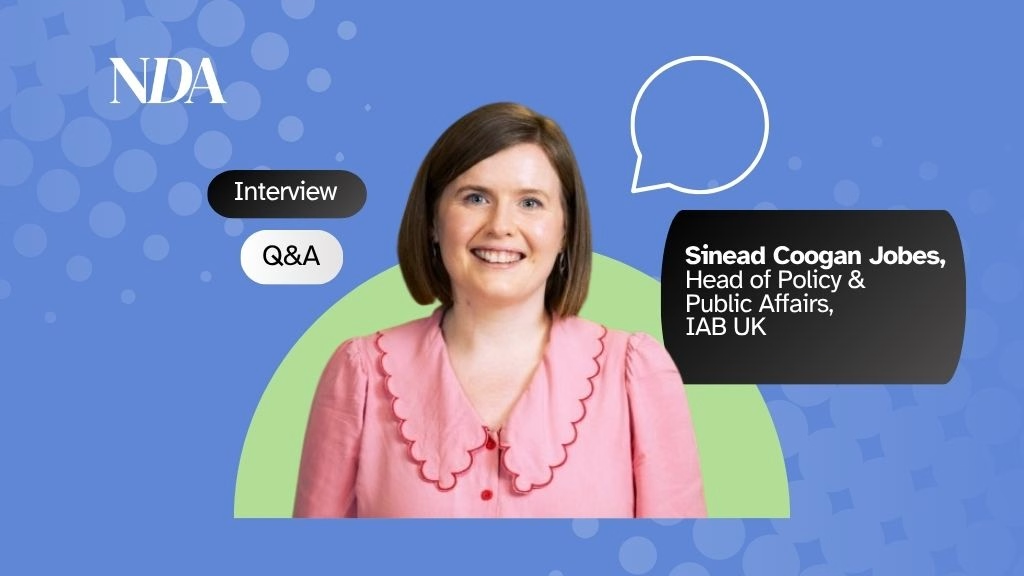
New Digital Age spoke with Sinead Coogan Jobes, Head of Policy and Public Affairs at IAB UK, to find out more…
Why did IAB UK commission this latest research?
We originally did a study with Public First back in 2023, which looked at the scale of digital advertising’s contribution to the UK economy. We wanted to show how big that contribution was.
That report was really a snapshot in time, so it only showed you what was happening at that moment. Since then, obviously, there’s been a lot of change in the digital advertising space, with the rise of new technologies like AI, new and emerging channels like retail media and creator marketing, and TV+.
There’s also been a change in government and a big focus on how to stimulate growth and productivity across the UK. We thought it was the right time to look again at those numbers and update some of the big ones, so that we could show how those changes in the digital advertising space have contributed to growth in the UK economy.
What we did differently with this report was also to project into the future and see what the growth potential of the sector is and where it could go with the right policy conditions and the right environment in the UK.
We did some scenario planning with Public First, looking at the next decade and trying to map out what that could look like based on the kind of policy landscape our members would like to see.
What were the standout findings?
The big headline finding was that growth has continued to happen in the digital advertising space, and it’s happening at a rate and scale that I think we were shocked and pleased with.
When we did the study in 2023, it showed that the overall economic contribution of digital advertising was £129 billion, and that has gone up to £175 billion in this report, which is a massive amount of growth over a four-year or five-year period.
That is growth comparable to the size of a city like Liverpool over a four-year period. Adding that into the economy, particularly at a time when there’s quite a lot of discussion about slow growth and slow productivity across certain parts of the economy, is amazing.
We’ve also looked at what that meant for jobs supported by digital advertising, which has seen growth from two million when we did the last report to 2.6 million. Again, that’s a very big increase at a time when there’s a lot of conversation about where the new jobs of the future are going to be. Digital advertising is clearly one of those sectors.
The other thing that’s combined in that big number is sales growth – how digital advertising isn’t just supporting the businesses that work in digital advertising, but how it is allowing businesses of all kinds and all sizes to grow their customer base.
We show that there’s been £118 billion of growth in sales, and £53 billion of that is for small and medium-sized businesses. We’ve always said at the IAB that SMEs are one of the bigger beneficiaries of digital advertising because when you’re at that small stage and you’re trying to scale, digital advertising is a really great way to get to the customers that you need.
Does the research suggest AI will create jobs rather than reduce them?
The research was able to show us that the change in the industry has been driven a lot by new technologies, and AI is one of them. The industry is already a very strong adopter of AI technologies compared to the rest of the UK businesses that are thinking about what they do with technology.
We surveyed a number of businesses that utilise digital advertising as part of the research, and they said they believe they could go even further with adopting AI – doing things like improving productivity, creating new jobs and making sure that people are doing those more creative, higher-skilled jobs in their businesses if they have the confidence to invest more in AI.
A lot of the ability of businesses to invest in things like new technologies is down to whether the UK feels like a place where they can do business in a stable way that allows them to have the confidence to put the money into new technologies, new jobs and try new things.
A lot of those levers are held by government.
What would a more supportive policy environment look like?
Probably the most important thing is having a more stable regulatory environment in the UK. We’ve seen a lot of change, particularly in tech regulation, over the last few years.
While some of that is absolutely needed to tackle where there are harms, the pace of the change in regulation does sometimes leave businesses confused as to where they are able to invest and what they’re able to invest in.
We would love to see a more stable regulatory environment that is proportionate and targeted at the highest areas of harm, rather than looking at new technologies and immediately rushing to regulation as a way to fix those problems. We don’t always think that’s the right thing to do. Look at where there is actual intervention that’s needed, and then allow that to happen in a stable way.
We’ve also said that the government should embed growth and innovation into the way that they are planning how to conduct regulation. We know that there’s a big push from this government on better regulation and regulatory reform, so we would be very supportive of that, and just encourage them to actually live their ideals on that and make sure that regulators are thinking about growth and innovation.
What role should digital advertising have in discussions around AI and technology regulation?
For us as the IAB and for our members, it’s really important that digital advertising is seen as part of the tech future of the UK.
We want to be seen as part of the conversation around what happens with AI regulation and regulation of new technologies. So make sure that digital advertising has a seat around the table for those big conversations, and that the views of our sector are represented in those discussions.
I think sometimes advertising is still seen by government as something that is more traditional and creative, when actually there is a lot of tech innovation happening in our sector. We have very valuable insight into how regulation will actually impact the way the technology can be used.
What are members asking IAB UK for help with?
A lot of our members are trying to understand how to apply existing rules and guidance around things like data privacy, or how to apply rules around advertising to some of these new technologies.
We play a role in helping them understand that, and also making the case to regulators like the ICO that it would be great if we had clearer guidance around how to use some of these new technologies, so that again businesses have the confidence to use them and invest in them.
There are also areas where we’re working with members and the government where we think regulation could be adapted or changed to support more growth and innovation in the sector.
What changes would you like to see around cookie consent?
At the IAB, we’ve long called for some limited and targeted exemptions to the Privacy and Electronic Communications Regulations (PECR), which would allow things like ad measurement, fraud prevention and ad performance – those kinds of metrics that currently advertisers have to ask for consent for, but which don’t actually use people’s personal data and are more functional things that allow digital advertising to operate.
We would like to see them come out of the PECR consent regime, and the government is due to consult on that shortly. That’s a really good example of where regulation can help businesses go a bit further and do things faster and in a more innovative way.
Are there other areas where regulation could better support the sector?
Another example is the Less Healthy Food regulations, which came in at the start of the year. That was quite a long process with industry about how to make those work, and I think industry has largely responded very well to them and adhered pretty well to the rules, with the ASA upholding those rules well.
The government is now looking to change a core part of those regulations by updating the nutrient profile model that sits behind the less healthy food regulations and governs which foods are in and out of those regulations. They want to update that profile model to include more foods in that less healthy food bracket, and that would be a massive change to the way that regime works. The government wants to bring that in within a 12-month period.
We’re saying that that change is happening too quickly, and that the government should look at that again and look at a more phased way of bringing in that new profile model. If they do it in the way that they’re suggesting now, the potential downside is that more money will come out of the digital advertising sector because people won’t feel confident to invest in it.