A new marketing consultancy, Committed Citizens, has launched, with a mission to fix the machinery that makes marketing actually work.
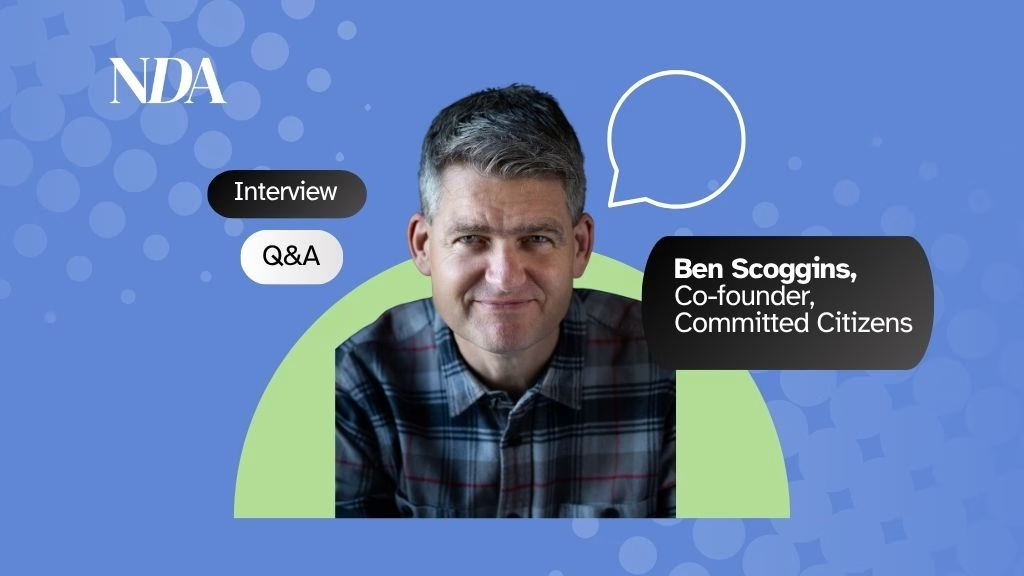
Co-founded by Ben Scoggins, former CEO of digital agency Organic, and Tim Burley, a senior agency leader with 25 years of marketing and strategy experience, the consultancy will work with CMOs to close the gap between marketing strategy and marketing execution by removing what it calls ‘operational drag’ – the accumulation of slow workflows, underused technology, misaligned teams and broken processes that silently erodes marketing’s ability to perform.
New Digital Age spoke with Ben Scoggins, co-founder of Committed Citizens, to find out more…
What led you to co-found the new agency, and how did your career lead you here?
I started my career with large London ad agencies, so I had a fairly traditional beginning. I always liked the idea of working in business, but I didn’t want to do something too stuffy. The ad industry offered the chance to combine creativity and marketing, and that has always been a good mix for me.
Later in my career I moved to Devon, but there wasn’t much of an ad industry presence down here. I found a 30-people digital agency, where the founder wanted to take a sort of step to one side, to work on creating SaaS digital products, so I took over.
It was during that time, while working with brands and building digital products and being properly centred in the world of digital, I noticed that, actually, the biggest blocker to getting things done, was often the fact that the marketing function on the client side was in a real mess, and getting worse all the time.
As more technology was added to the growing stack, you had more people confused about their own roles, working in silos, being blocked from progressing projects, or working on projects that would ultimately be spiked further up the chain. We call it ‘operational drag’ but basically it’s all the internal issues, conflicts and systems that get in the way. Technology should be making things easier, and it’s not: it’s making things more complicated. Marketers tell me, “We’ve got all these dashboards, but I can’t really tell what’s true and what’s not.”
That’s what led to us founding Committed Citizens.
How is Committed Citizens trying to do things differently?
The central idea is not just making the work, but making the work ‘work,’ if you like.
It’s all about people and empowering people. We have a saying that we use, which is, everybody gets a jet pack. The tech tools should be aiding you, but ultimately it’s about you. You’re the one that’s going to fly.
I’ve spent the last nine months talking to CMOs and marketing directors about it, so they’ve helped inform the proposition, actually. It’s about how organisations operate internally and how they sometimes get in their own way.
The type of clients that it works best for is where there is an amount of complexity. The more complexity, the more we can actually have an impact. It doesn’t necessarily need to be in a massive marketing team, but there does need to be that element of complexity there for whatever reason; either there are lots of channels, or a lot of people that need to interface internally, lots of stakeholders.
Technology is important, but it’s not what we’re leading with. Most of the time the blocker isn’t the tech or its technical efficiency; the real issue is usually how people adopt the available tech and use it. That’s where things tend to fall down.
How has the market responded so far?
The reaction has been really good. Any marketing leader who’s worked in the space for a while recognises the issues we’re talking about. Most of them have their own anecdotes to tell.
One of the main things for us is making sure that we can help clients understand the impact of their marketing efforts. We have a framework that we’ve created to allow brands to do that much more accurately.
That, in turn, makes it easier for marketers to talk to and work with other parts of their own organisations. The finance people that I’ve spoken to are very much behind our idea of: ‘Show me how it works’. They want to know where money can be saved or where you’re going to generate more demand as a result of the work that the marketing team is doing.
Given how fast the landscape is evolving, especially with AI, what’s your advice to marketers right now?
The main message is “don’t panic!”
That said, there is a real shift happening. In my 25 years, this feels like the most significant time of change the marketing industry has experienced. So we do need to learn, to adapt, to educate ourselves, and not stick our heads in the sand.
At the moment, there are two extremes. One group is saying, “If you haven’t already adopted AI, you’re too late.” Then, another is saying, “It’s irrelevant, human creativity is all that matters.”
The truth is somewhere in between, so the key thing is not to panic about either of those positions.
Where did the name “Committed Citizens” come from?
It comes from a quote by the social anthropologist Margaret Mead. She argued that change doesn’t come from a CEO or from technology, but rather from a group of committed citizens.
That really resonated with us.
Finally, what does success look like for you over the next year?
The focus for the next six to twelve months is to show real value. Pick the right clients, work with them properly, and demonstrate impact. If we can come out of that with strong case studies and clear examples of the value this approach delivers, that will be a successful year for us.