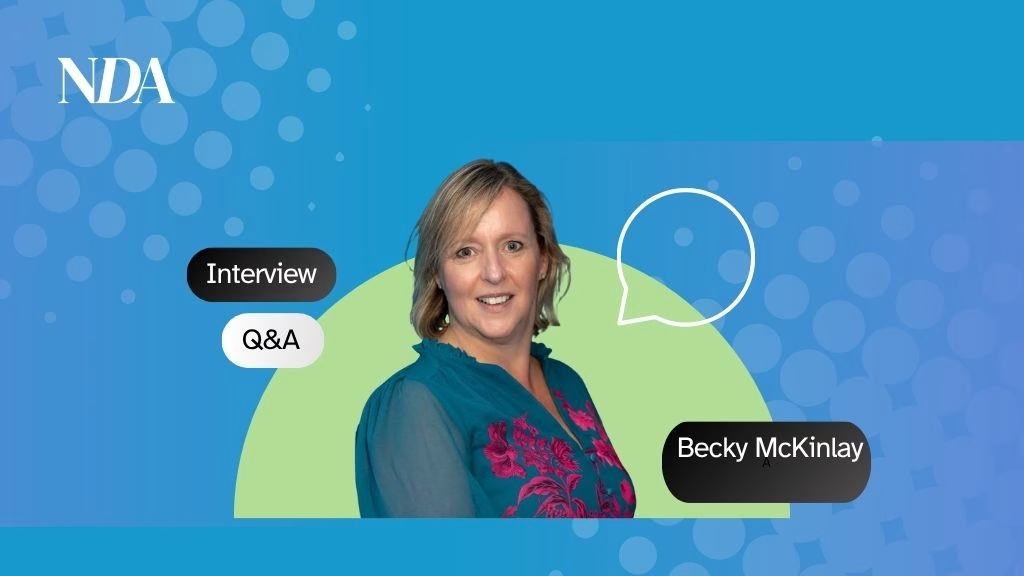
Becky McKinlay is managing director of Oystercatchers, the independent marketing consultancy that advises brands on agency relationships, marketing transformation and organisational change. With experience spanning client-side, agency-side and in-house roles, including leading studio teams at The Economist and the Financial Times, she brings a unique perspective on how brands and agencies can build more effective partnerships.
Following a management buyout last year, Oystercatchers is now an independent consultancy focused on providing unbiased advice to brands. New Digital Age sat down with her to discuss the evolution of brand-agency partnerships, the necessity of transparent consultancy models, and strategies for navigating marketing transformation.
You’ve had a career across clients, agencies and in-house teams. How did you come to be running Oystercatchers?
I would love to say it was some big grand plan, but it absolutely wasn’t. My career has been a mix of client-side, agency-side and in-house roles. In the six years before joining Oystercatchers, I was running in-house studios at The Economist and the FT.
There was a change in leadership at Oystercatchers. Suki Thompson, who founded the business, sadly became very ill and subsequently passed away, and the people leading the business decided to leave at the same time. I received a call from a headhunter asking if I would consider taking on a three-month interim MD role.
I started the next day.
The reason it made sense was that I had experienced the relationship from every perspective: client, agency, independent agency and in-house. That combination of experience is incredibly relevant when you are sitting at the heart of those relationships and helping brands understand what they need.
I joined for three months, then took on the role permanently, and last year led a buyout of Oystercatchers. Becoming independent felt like the right ownership structure for a business that is built around being agnostic and unbiased.
For those who know the Oystercatchers name, how would you describe what the business does today?
Oystercatchers has evolved from where it started. It was originally known primarily as a search and selection business, helping brands find the right agency partners. That remains an important part of what we do, but we are much broader than that now.
We are advisers to brands on how they achieve the best marketing outcomes. Sometimes the answer is finding a new agency partner, but sometimes it isn’t.
A challenge we often put back to clients is: what problem are you actually trying to solve, and is changing agencies really going to fix it?
Everyone at Oystercatchers has worked client-side and agency-side, so we understand both perspectives. We advise on agency relationships, ways of working, rosters, capability models, transformation, in-housing decisions, media, digital, social, customer experience and UX.
Our role is helping brands make better decisions about their marketing ecosystems.
The word “intermediary” has sometimes become controversial. Why do you think that is?
I think there has been some poor practice in parts of the intermediary market. The biggest issue is transparency around remuneration.
We believe we should be funded entirely by the brand because we are acting on their behalf. There are models where intermediaries are paid by clients but also receive payments from agencies, and if that is not clear to the client it creates potential conflicts of interest.
It is similar to a headhunter. If someone is representing you to find the right person for your business, they should not then be charging the candidate without that being transparent.
Our model is simple: brands pay us for our consultancy, and agencies win work based on the quality of their thinking and their ability to deliver.
What is keeping you busiest at the moment?
A lot of the demand is around transformation. Clients are looking for external validation and benchmarking. They are asking questions around how their marketing functions should be structured, what capabilities they should build internally and what they should outsource.
We are not cost consultants and we are not about driving a race to the bottom. We help organisations understand how to create models that deliver effectiveness.
The market is also incredibly volatile. We can think we will be focused on one area and then receive a call from a client who needs support immediately.
Increasingly, those conversations are not about running a pitch, they are about helping leadership teams work through complex decisions and navigate change.
How are you seeing marketing teams change?
The pressure to do more with less is a huge factor. At the same time, I think there is renewed interest in the long-term role of brand marketing.
Many businesses have optimised performance marketing extensively and are now asking where their next growth opportunities will come from.
That means looking at new audiences, long-term effectiveness and the value of sustained investment.
There is also a need for greater clarity around measurement. With the rush towards AI, technology and data, organisations can sometimes end up with too much information. Having a clear vision and understanding which metrics genuinely matter is critical.
How has the client-agency relationship changed?
It is still under pressure, and I think it always will be. There is ongoing debate around in-house capabilities, but agencies and internal teams play different roles.
Agencies are usually charged with growth, while in-house teams are often focused on efficiency or activation. At their best, agencies are trusted advisers who help clients see around corners.
What we have seen recently, particularly with changes across holding companies, is clients looking for stability. They want partners who can provide continuity, strategic thinking and trusted advice over time.
When teams disappear and relationships are disrupted, that trust can disappear too. Often the real value of an agency is not just the output, it is the experience, judgement and perspective they bring.
What advice would you give for building better client-agency relationships?
First, there needs to be absolute clarity on commercial priorities. Agencies need to understand the business reasons behind the work so everyone is working towards the same goal.
Second, give agencies time to think. The best ideas come from space and collaboration. I used to say: do you want my best ideas or my first ideas?
And finally, pay agencies properly.
Short-term savings do not necessarily create better relationships. When I was a client, I wanted to be the client everyone wanted to work with, because I paid people properly, treated them professionally and valued their contribution.
How has procurement’s role evolved?
Marketing procurement has become much more professionalised. The days of someone moving between completely different procurement categories and suddenly managing agency services are largely gone.
Good marketing procurement teams are brilliant allies. They understand their role, they bring commercial discipline and they help create stronger relationships between clients and agencies.
The relationship between procurement, marketing and agencies is much more collaborative than it was in the past.
At Oystercatchers, our focus is on providing clarity and stability in a world of constant transformation. Our model is deliberately consultative rather than tactical.
We want to help brands make better decisions, build the right ecosystems and create the conditions for long-term marketing effectiveness.