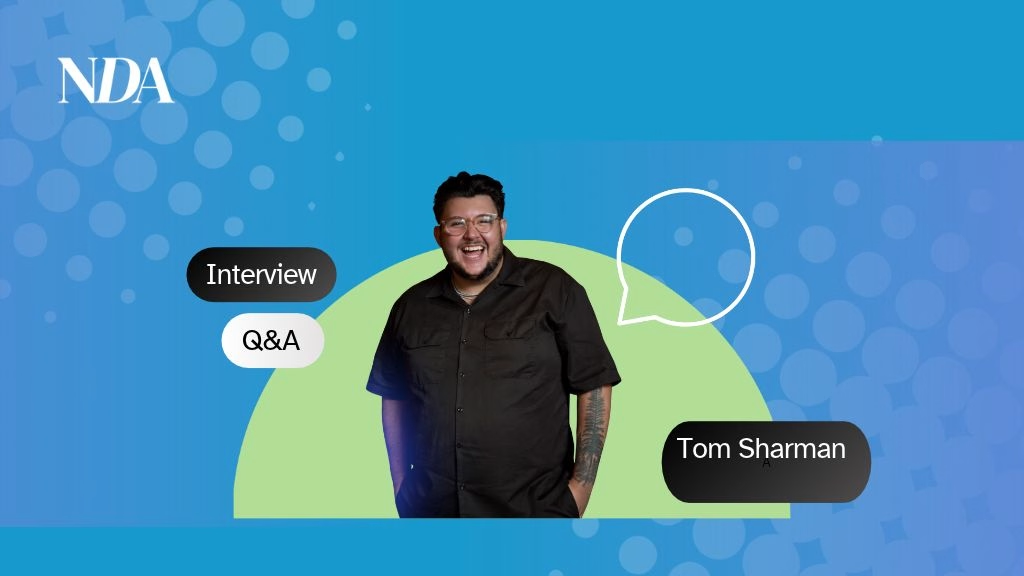
Tom Sharman is a veteran digital production creator with over 12 years’ experience building content teams, scaling YouTube operations, and bridging the gap between online creators and commercial brands. Having spearheaded early creator initiatives such as Rebel FC and Waves, he has produced viral, studio-grade content for top UK talent including Niko Omilana and The Burnt Chip, generating hundreds of millions of views.
How did you first break into the creator economy, and what did the landscape look like back then?
I have been working professionally in the creator space for around 12 years, long before anyone was using the phrase “creator economy”. Truth be told, I have been making money from YouTube since I was 13 years old, selling YouTube channel backgrounds that do not even exist anymore so I could afford an iMac to start editing videos.
My first major industry break came while I was at university. In 2015, I accidentally ended up running Social Media Week at 18 years old after the organisers stepped back. That put me in direct contact with senior executives at Google, Facebook, and BuzzFeed, many of whom were running six-figure side projects and startups on the side.
At the same time, I knew incredibly talented university students who could not land work. I bridged that gap, built an agency around it, and eventually got incubated by Ogilvy in 2016 as part of their Rough Diamonds initiative to bring unconventional creative talent into WPP.
You were an early pioneer in turning individual creators into full media businesses. How did that transition happen?
Around 2017, my business partner and I worked with YouTuber Calfreezy and Brave Bison to launch Rebel FC, a YouTube-first football club. It was essentially a group of creators playing in a fictional league with real rivalries, sponsored by major brands like Under Armour, traveling to train with Anthony Joshua and visit Ajax.
That was really the first moment where YouTube content started shifting from a solo endeavor into a real media business. Brave Bison invested £350,000 into it, we had a full production team, and we were building real intellectual property.
In the UK back then, creators were strictly solo operators who might hire a freelance editor. The US was five to seven years ahead of us with massive acquisitions like Disney buying Maker Studios, but the UK was still just kids in bedrooms. Rebel FC proved that online creators could build multi-faceted media brands.
How did the pandemic change the trajectory of creator production?
When Covid hit in 2020, creators suddenly had massive attention, higher CPMs, and more capital than ever before because everyone was stuck inside consuming digital content. However, Covid also served as a huge blocker because creators could no longer step outside to shoot their standard videos.
To solve that, we launched Clash of Creators, a charity event that drew 2,500 people in person and over 330,000 live viewers online. Off the back of that momentum, my partner Sam Hilton and I co-founded a YouTube production business called Waves. Creators wanted to execute much bigger, TV-level ideas, and brand investment was readily available.
We started producing massive, studio-grade productions for creators like Niko Omilana and Chunkz. For Niko, our average video budget was $30,000 to $50,000. We put a 30-person circus outside Downing Street during election season and pulled off a prank on a KKK leader that generated 47 million long-form views.
We also took four top YouTubers on a two-week tuk-tuk race across Sri Lanka sponsored by Revolut, styled like a classic Top Gear special. We essentially acted as the production bridge turning individual talent into scalable media operations.
Why was there historical friction between creators and traditional media infrastructure?
Historically, YouTubers were terrified of hiring teams or being seen as a “media brand” because YouTube’s core promise was “Broadcast Yourself”. Audiences wanted authenticity, not corporate polish. In the early 2010s, someone like Zoella could pull millions of views with a low-production vlog because it felt like a friend talking to you.
When creators first started hiring, it was done almost secretly. I remember back in 2016 or 2017, hiring an editor was a massive public risk for a creator because audiences might feel cheated. Editors would burn out working 19-hour days trying to meet arbitrary upload schedules.
When we stepped in with Niko, we restructured the entire operation. Instead of burning out on one video at a time, we built a proper production pipeline with dedicated motion designers, editors, and producers working on multiple projects simultaneously.
Now, looking at groups like the Sidemen with over 100 staff or MrBeast running a 500-person company, the stigma is completely gone. Creators are expected to be media companies.
Where do traditional advertising agencies still fall short when working with the creator space?
Traditional ad agencies have been super slow to adapt. Back in 2016 at Ogilvy, there was literally one guy who held the title of Director of Influencer. Even as the industry grew, agencies treated social and creators as an afterthought, an add-on line item at the end of a campaign pitch rather than the core strategic driver.
Today, creators are outperforming traditional television. Traditional TV networks are scrambling to put YouTubers on air just to attract young viewers, or licensing creator IP.
The Sidemen are producing Netflix reality shows, and MrBeast is shooting Prime Video shows on budgets and cameras that surpass traditional television. Creators already own the audience and the distribution.
Agencies and brands that fail to treat creators as primary media partners, rather than just digital billboard space, will simply be left behind.