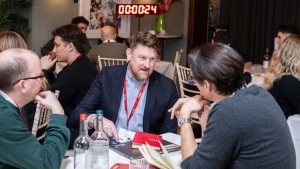
The inaugural PitchLab event, held by New Digital Age (NDA) at The Century Club in London, was a day dedicated to fostering collaboration between the UK’s most innovative technology companies and the thriving independent agency sector.
Hosted by NDA Editor-in-Chief Justin Pearse, the Dragons’-Den-style contest aimed to help build high-value relationships between indie agencies and some of our industry’s leading tech companies.
The judges for PitchLab were: James Shoreland, CEO at VCCP; Charlotte Oliver, Business Director at Smithfield; Nick Smith, CDO at JAA Media; Charlotte Mullan, MD at Walk-In Media; Simi Gill, Head of Digital at The Kite Factory; Erfan Djami, CDO at Mediahub; Michelle Sarpong, Head of Activation at the7stars; Paul Spokes, Board Director at AMS; Aaron Green, Communications Strategy Director at Mother; Zoe Hayward, Managing Partner at Bountiful Cow; and Dan Shepherd, Managing Partner at Good Stuff.
“Our Soho Sessions have always been one of my highlights,and our new PitchLab events build on their success” said Justin Pearse. “It’s such a joy to bring together our industry’s most innovative tech companies with the agencies that deliver such amazing work for clients. And I couldn’t be happier that the inaugural judging panel is drawn from indie agencies, a sector that has seen such stellar growth over the last few years”.
The day began with a series of fast-paced 7-minute‘lightning pitches’ by each contestant to the entire judging panel, followed by individual ‘deep-dive’ sessions with each judge. These intimate follow-ups allowed agency leaders to grill the contestants and take a proper look under the hood of their technology.
Ten tech companies participated in the inaugural event: AudienceQ, Nano Interactive, RAAS LAB, Uber, Lotame, Outra, Avid, Smartframe, Quantcast, and Equativ.
Lightning speed and distilled value
For the judges, the efficiency of the seven-minute lightning pitch proved to be one of the most effective elements of the day. Erfan Djazmi, Chief Digital Officer at Mediahub, described the short format as “quite liberating”. He noted that “we don’t need an hour every time,” and that the speed “shows that you can get to the crux of a positioning and a proposition and some of the benefits in a short time.”
Nick Smith, CDO at JAA, agreed that the time pressure forced a higher level of clarity. “It really gets the tech company to focus in on what’s most important,” he said. “It absolutely distills the proposition into the core bare bones of what’s important and the opportunity. The industry is obviously riddled with jargon and technology, and so this kind of just bypasses that.”
The sentiment was echoed by Michelle Sarpong, Head of Activation at the7stars, who found that the format cut through the usual sales noise. “It forces partners to be really clear on their USP,” she said, adding that “sometimes when you’re having meetings or just emails, there’s a lot of waffle.”
Zoe Hayward, Managing Partner at Bountiful Cow, went as far as suggesting that the format should become the new industry standard.
“I really do think that maybe all pitches should be seven minutes long,” she said, noting that she “quite enjoyed the format” because it allowed contestants to “get what you need to do and the rest leave it up to questions.”
Discovery in a saturated market
The challenge of discovering truly innovative partners amongst a sea of similar-sounding tech offerings was a recurring theme for the indie leaders.
Simmy Gill, Head of Digital at The Kite Factory, highlighted the difficulty of differentiation in 2026. “Everyone kind of can claim to do the same thing,” she said. “So it’s differentiating actually what is valuable because as indies, we don’t always have the budgets to A/B test amongst lots of different partners.”
Charlotte Mullen, MD at Walk-In Media, suggested that agency leaders often struggle to find time for such discovery amidst their daily responsibilities.
“I think sometimes as media agencies we forget that we should be out there speaking to people and learning about what new technology is coming out and we just don’t take the time to be able to do that,” she said. She found that the PitchLab format was “fantastic” because it enabled leaders to “be fully engaged and hear what’s going on.”
The need for efficiency was also paramount for Paul Spokes, Board Director at AMS. “One of the hardest challenges for any agency, particularly in digital, is investing enough time to meet all of the partners, stay ahead of technology, stay ahead of innovation and also doing our day job,” he said. He added that “coming to an environment like this that is short, sharp, a lot of people in a room, getting to the point very, very quickly, I find very beneficial.”
The contestants taking center stage
Aaron Green, Communications Strategy Director at Mother, was particularly impressed by the creativity-enabling platforms. “I would say there have been a couple of partners that are more creatively driven,” Aaron Green said. He singled out Avid and RAAS LAB as being “really great, both because they help enable creativity in media and also they help indies like be able to work at scale like a big holding company might.”
Michelle Sarpong also highlighted Avid Collective as a standout. “That was probably one of the partners I’d never heard of and it’s a really interesting proposition,” Michelle Sarpong noted.
While the lightning pitches provided the initial spark, the deep-dive sessions were where the real work began. These sessions allowed agencies to explore how the technology could be applied to specific client challenges.
“The deep dive sessions were really good as they enabled us to go deeper in terms of ‘what can they do for my clients and for my agency?’ which is really key,” said Michelle Sarpong.
Justin Pearse closed the event by expressing his hope that these new connections would power even further growth for the indie agency sector. By providing a structured environment for agency leaders to “meet new potential tech partners, grill them and take a look under the hood”.
As the industry moves through 2026, the value of these distilled, high-impact conversations will only continue to grow. For both agencies and tech partners, the goal remains the same: finding the right tools and relationships to deliver incredible results for clients.