While the marketing press tends to focus on the activities of large network agencies and global holding companies, the reality is that it is smaller agencies, entirely independent of the big networks, that make up the vast majority of the marketplace and the value it creates.
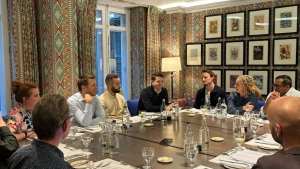
New Digital Age recently invited a selection of indie agency leaders to examine the state of play for the sector and to explore the role of strategic partnerships in helping indies compete with the networks.
The roundtable discussion was chaired by NDA’s editor-in-chief Justin Pearse, where her was joined by: Tara Grimes, Director of Media, Media by Mother; Katie Hodgkinson-Morgan, Managing Director, Smithfield Agency; Gareth Jones, Partner, the7stars; Clive Mishon, Founder Director, Alliance of Independent Agencies; Sharon Palmer, Director of Group Accounts and Client Success, IDHL; Alina Pruteanu, Digital Development Director, The Grove Media; Helen Radia, Chief Business Strategy Officer, The Kite Factory; James Shoreland, Chief Executive Officer, VCCP Media; Nick Smith, Chief Digital Officer, JAA; and Sam Zindel, Managing Director, Propellernet.
In considering the reasons why more clients than ever are seeking out independents to work with, Tara Grimes commented: “There are clients that have been burned by big networks in the past, especially when it comes to proprietary tools and trading models that no longer make sense in an attention economy. As a result, they’re turning their backs on the network agencies and asking for independent, objective opinions instead.”
James Shoreland agreed that independent agencies are “flying” right now: “It’s not about bashing networks, it’s just reality: their stakeholders are shareholders. By contrast, our stakeholders are our clients and our staff. Sometimes networks invent proprietary technology to help bump the share price – whether it actually works is often immaterial.”
In many ways, argued Alina Pruteanu, indies are simply better than network agencies. “Indies are agile, accountable, and agnostic. We can innovate and offer bespoke solutions faster than networks,” she said. “At independents, the people building the tools are the people actually using them. Partnerships can help to level the playing field, because we can hold every partner to account and build better, more bespoke solutions.”
The art of partnership
Being UK-independent means the7stars is not beholden to global tools that don’t fit the UK market, said Gareth Jones. “We build what’s right for our clients, quickly. The centre of gravity has shifted from buying and execution toward insight and analytics. That’s where independents can build far more interesting, partnership-driven offerings.”
While networks often focus on ‘what’s the most cost-effective way to get this job done?’ or ‘How many hours from how many people?’, independents can “invest more, tweak things, add strategic support” when needed, said Helen Radia. “Creating a strategic partnership is a value choice. Some partner tools will work off the shelf. Some need deeper partnership to get that extra 20% from the tool. And sometimes nothing exists — then you build from scratch.”
“We have three main kinds of partners,” commented Sam Zindel, “a flexible freelance collective; capability-extending partners, such as creative partners doing dynamic ad development; and other agencies – though, in reality, joint pitches can get complicated around relationship ownership.”
Sharon Palmer of IDHL spoke of how growth, M&A and innovation activity bring her agency into contact with “brilliant” small teams: “Often it can be teams of two or three people who live and breathe what they do. Networks have been slow to recognise the opportunity there. With smaller, entrepreneurial partners, you can influence and co-build. Any solution becomes more tailored.”
Changing attitudes
Discussing the current shifts and trends in the indie agency marketplace, Katie Hodgkinson-Morgan, who has recently returned to work following maternity leave, compared her situation to “jumping onboard a moving train”.
She said: “The breadth of what we’re being asked by clients is getting bigger. We’re looking to help and answer clients’ needs and demands as their roles are changing. For indie agencies, alongside asking what’s right for the client, we always need to be aware of what’s right for the agency? There’s a lot of movement in the marketplace to unpick right now.”
JAA’s Nick Smith noted a recent change in attitude from the leading digital platforms in relation to independent agencies: “From a partnership point of view, the big digital platforms have always struggled to know what to do with the indie sector, but they clearly identify us as an opportunity for growth. Their attitude and level of openness has shifted a lot over the last 18 months – and it’s not just about trading; it’s much deeper skill sets. I think that’s a reflection of the growing importance of the indie agency sector.”
Of course, any technology partner – big or small – has a life cycle, said Clive Mishon, and any technology can be leapfrogged quickly. “Your goals may align early on, but as the tech partner secures more funding they can quickly pivot away from the areas you align on. Any innovative tech tool generally has a 12-month life before something else overtakes it. Our role is curating opportunities across the independent sector — finding best-in-class, deciding what to bin and what to pursue.”