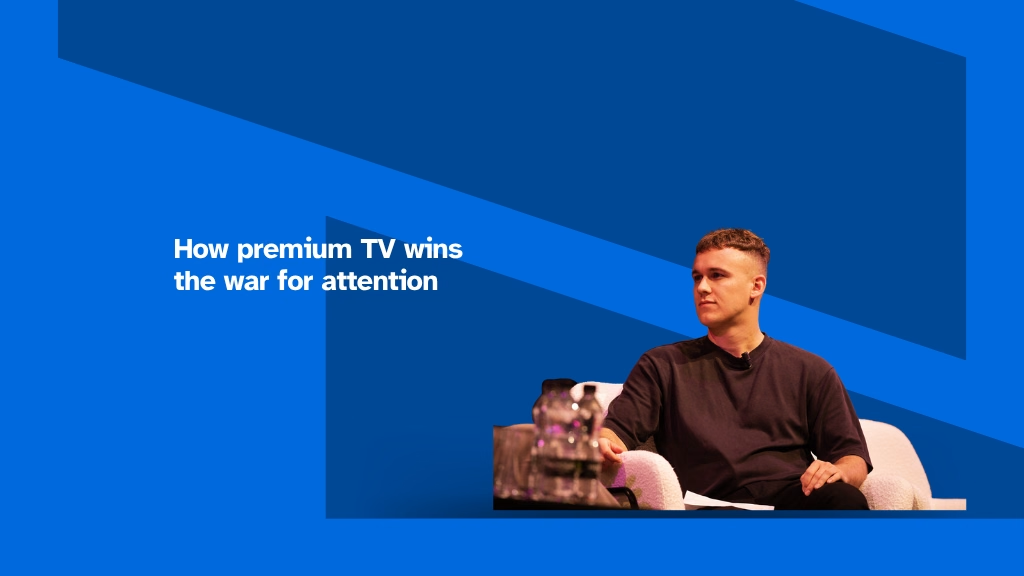
The so-called premium TV industry faces a war for attention with video-sharing platforms, social video and the creator-verse. If it loses Gen Z, it may lose the ability to bring us The Sopranos and Game of Thrones. Connected TV World Summit explores how TV keeps that demo.
The next two years will give us a strong indication of where media buyers are going to find their video-centric audiences in future, as the so-called premium TV industry faces a war for attention with video-sharing platforms, social video and the creator-verse.
This is according to the organisers of Connected TV World Summit 2027, who say Pay TV operators, broadcasters and global streamers face a potentially existential challenge: to win more time with Gen Z but do that in a way that protects premium TV economics.
“Premium TV economics is the model that rewards high-stakes investments across a supply chain spanning studios and production companies, professional film crews, directors, actors and actresses,” explains John Moulding, event researcher.
“That is a high-cost supply chain, but it is what gives us programming like The Crown, Wolf Hall, Game of Thrones and The Sopranos.
“People must make big money bets to bring premium TV projects to life. That requires downstream rewards to match.
“So, we need to know how the premium TV industry keeps the subscriptions rolling, ad sales buoyant and ad revenue shares sustainable.
“The creator-verse operates on a much lower cost model and there is no evidence yet that they are going to give us the next Harry Potter franchise, or the next The Traitors format.
“If creators take the bulk of future Gen Z video attention, and Generation Alpha follow in their wake, the legacy TV industry is in real trouble. Maybe we lose that kind of programming, certainly in current volumes.”
Sam Tidmarsh, producer of Connected TV World Summit, says a key focus for the 2027 agenda is how the premium TV industry takes a greater share of Gen Z entertainment hours.
The conference looks at how the premium TV industry can embrace creators, whether as talent in existing shows or by providing new places to distribute their content – like on FAST channels.
“Are there ways to embrace the informality, relatability, community, interactivity and agency seen with creator content? That could be one way to make established TV environments more appealing to younger demos,” Tidmarsh suggests.
The conference will demonstrate how channel owners and studios can better exploit their intellectual property across video sharing platforms and social video.
Tidmarsh says the priority for Connected TV World Summit is to demonstrate how TV companies can win Gen Z attention within their owned-and-operated streaming services and across Pay TV, free-to-air and Smart TV OS platforms.
These are the environments that have traditionally supported premium TV economics, combining wide distribution with sufficient data and revenue shares.
“How do they introduce more short-form and vertical content within existing apps and platform interfaces, and win more viewing time on mobile?” he asks.
“How do they make the big screen user experience far more personalised?”
The March conference explores how the TV industry competes with the algorithmic recommendations power of YouTube and TikTok. It looks at how content discovery can be streamlined with AI-powered conversational user interfaces and digital assistants.
It promises to show what a Gen-Z facing TV service looks like.
Moulding adds: “Two massive questions are looming into view. Is TV facing its pirate radio moment when a young generation turns its back on an established medium?
“And is the video industry going to split into a low-cost creator-verse that captures most of the attention, and a shrinking premium TV market that can afford to make super-premium programming?
“We seek the answers.”
Tidmarsh wants to know what it would take for channel owners to rely on video sharing platforms for the bulk of their distribution and monetisation for crown jewels content.
Could global video sharing platforms support the premium TV economics they need? Could these platforms ever start to replace ‘owned-and-operated’ apps or traditional distributors?
“There is little evidence for it today,” says Moulding, “but we have seen business model shifts and revolutionary pivots in the past, which is why we must explore it.”
The safe bet for the TV industry is to maintain its independent services and platforms, according to the organisers of Connected TV World Summit.
They say: “Premium TV needs to grow its attention on video sharing platforms and social video, but most of all it has to increase viewing in its traditional environments.
“Every year, this event brings together industry pioneers to share their consumer research, business strategy, product design and operational execution.
“In March they are tasked with helping TV to win the war for attention.
“This war is real, and it has profound implications for where eyeballs will be found in future.”
Connected TV World Summit 2027 has one primary purpose: to help premium TV providers win the war for attention – against video sharing platforms, social video, rival TV companies, and any other media.
Details at https://www.adwantedevents.com/ctvws27