The traditional boundary between “television” and “digital” is dissolving. As viewers migrate across screens and platforms, legacy broadcasters are undergoing a radical shift to ensure they remain relevant in an era dominated by global streamers and social media giants.
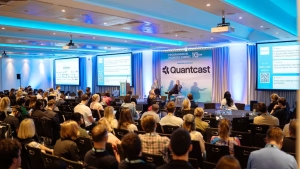
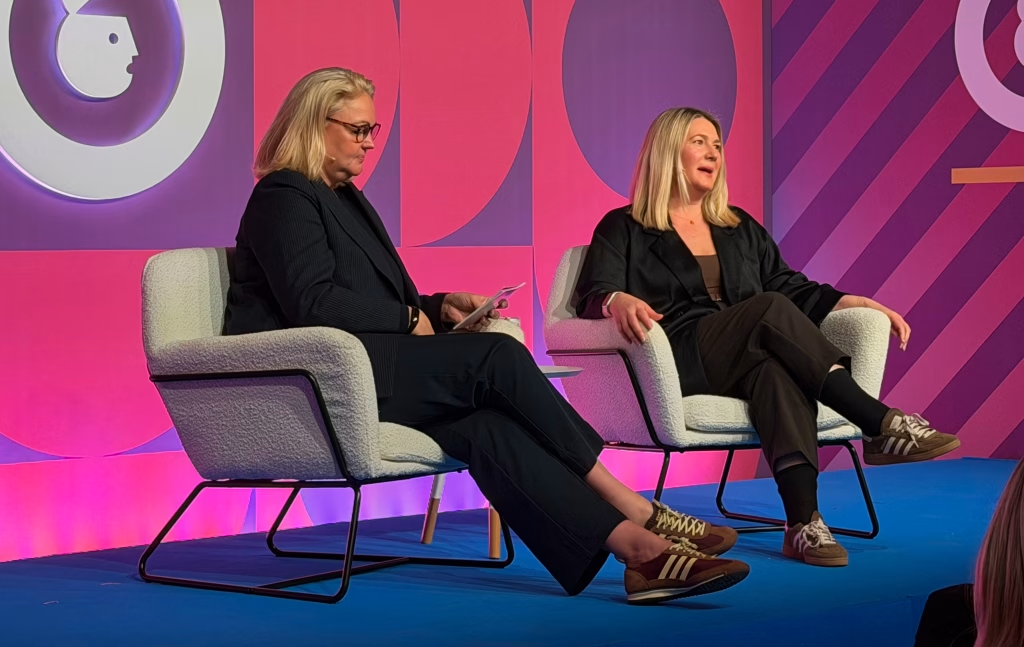
At a recent Advertising Week session, Alexandra Wright, Programmatic and Data Director at Channel 4, and Julie Selman, Senior Vice President and Head of EMEA at Magnite, sat down to discuss the realities of modernising broadcast and the ambitious road toward 2030.
Prioritising digital growth over linear ratings
Channel 4 has been a first mover in the pivot toward a digital-first future. In 2020, the broadcaster made the strategic decision to prioritise digital growth over traditional linear ratings, a move Wright described as “a really big deal” for a legacy business.
“We set ourselves a target at that point that by 2025, we wanted to be a business that was 30% driven by views and revenue to be driven by the digital side of the business,” Wright explained. Having hit that milestone early, the goalposts have moved. “By 2030, we want 50% of our revenue and views to come from the VOD side of the business, Channel 4 streaming, and 50% to come from linear.”
This transformation is not without its hurdles. As a publicly owned but privately funded entity, Channel 4 must navigate its heritage as a “legacy linear business” while adopting the agility of a tech platform. Wright noted that the biggest challenge lies in “trying to make our product available to be bought and transacted in a digital world with all those digital capabilities when you weren’t born in digital.”
From competition to collaboration
In the past, the “pie” of advertising revenue was largely shared among a few major broadcasters. Today, Netflix, Disney+, YouTube, and TikTok are all fighting for the same eyeballs. However, Wright argued that the industry must move past a purely competitive mindset.
“We also realised that collaboration and partnership was necessary if we were going to survive and to grow,” she said. This includes working with former rivals on measurement initiatives like Project Lantern, which tracks cross-device viewing habits to prove the long-term impact of TV advertising.
Perhaps most surprisingly, this spirit of collaboration extends to YouTube. Rather than viewing the video giant solely as a threat, Channel 4 has embraced it as a distribution channel for younger audiences. “We gave YouTube basically thousands of hours of long-form content so that viewers can now watch a full episode of a show,” Wright noted, adding that both parties monetise the content, allowing the broadcaster to reach viewers where they already spend their time.
Busting the programmatic myth
For many advertisers, “programmatic” still carries a stigma of remnant inventory or lack of transparency. Wright was keen to dispel these misconceptions, emphasizing that programmatic is simply an “automated way to buy and sell inventory” and does not imply a lower quality of content.
“When we sell our inventory in programmatic pipes, it’s the same as any other way of buying,” Wright clarified. “You’re accessing the same industry, you’re not getting some sort of remnant inventory.”
The shift to data-led buying has also opened doors for highly granular targeting that rivals social media. Wright cited examples of food delivery companies switching ads on or off based on bad weather in specific cities, and FMCG brands using retail loyalty card data from partners like Sainsbury’s or Boots to target specific shopping behaviours.
Crucially, this is all managed through “clean rooms” to ensure privacy compliance. “No data is passed between the partners and no side sees each other’s data,” she insisted, addressing concerns about data security in a post-cookie landscape.
Lowering the barrier to entry with AI
One of the most significant shifts in the industry is the democratisation of TV advertising. Traditionally, the “big screen in the home” was reserved for brands with massive creative and media budgets. Programmatic buying has removed the commercial barrier, but the creative barrier remains.
To solve this, Channel 4 has partnered with Streamer, an AI company owned by Magnite, to help smaller businesses enter the space. “They help us to take an advertiser’s website and turn it into the first steps of being a TV ad,” Wright explained. While human oversight remains essential to ensure ads meet broadcast standards, the technology allows digital-first businesses to move from display ads to the living room with ease.
Looking toward 2030
As the session concluded, the focus turned to the future of content and what defines a successful broadcaster. For Wright, the answer lies in a mix of technical innovation and the “comfort and cosiness” of reliable formats like The Great British Bake Off.
As the world becomes increasingly complex, Wright believes the role of the broadcaster is to provide a safe, high-quality environment for both viewers and advertisers. Whether through AI-generated creatives or sophisticated cross-platform measurement, the goal remains the same: staying at the heart of the British cultural conversation.