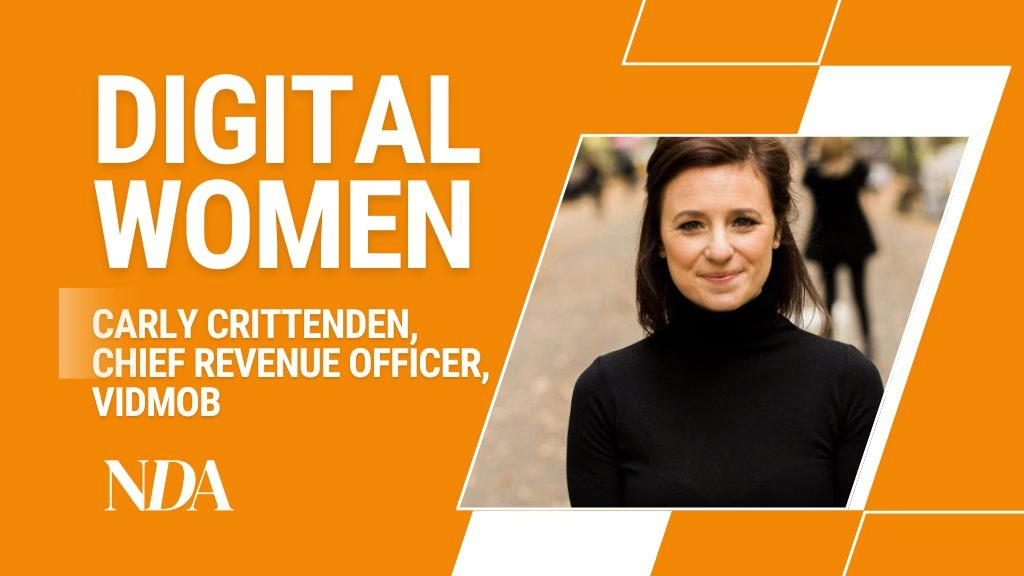
Carly Crittenden is Chief Revenue Officer at VidMob, where she leads the company’s global commercial organisation spanning Sales, Partnerships, Customer Success, and Revenue Operations. Under her commercial leadership, Vidmob has deepened partnerships with the world’s largest brands and agencies, expanding the platform’s reach as creative data becomes central to marketing performance.
With more than 15 years of experience leading commercial teams from true startups to later stage scale, she has held leadership roles at Google, Oracle, and Black Crow AI, predominantly in B2B SaaS, as well as several advisory roles.
What are the biggest opportunities for women in your sector of the digital industry right now?
I’d reframe this a bit, as it’s not just our sector creating opportunity – I think what’s actually happening is broader. Most large organizations right now are going through a significant change management moment: AI adoption, restructured go-to-market motions, new data paradigms. And that kind of organizational upheaval tends to reward a specific set of skills that women, by and large, have innately and have been developing their whole careers.
High emotional intelligence. The ability to build trust across stakeholders during uncertainty. Collaborative leadership that brings teams along rather than simply directing them. These aren’t soft skills – they’re the exact competencies needed to lead transformation, and they’re increasingly what boards and CEOs are looking for.
At Vidmob, I see this play out directly. Creative intelligence and AI are rewriting how brands think about performance, and the leaders who are thriving in this environment aren’t just the ones who understand the tech – they’re the ones who can navigate complexity, bring disparate teams into alignment, and build conviction around a new way of working. That’s an opportunity women should be running toward, not waiting to be invited into.
The door is wider than it’s ever been. Not wide enough – I’ll get to that – but the combination of organizational disruption and genuine momentum in representation means this is a moment to lead, not just participate.
What are some of the challenges that you still see for women in the industry? Any advice as to how to overcome those challenges?
The double standard around leadership style is still very real. The same behavior that gets a man called “decisive” gets a woman called “too aggressive.” I’ve seen it, experienced it, and watched it cost talented women opportunities they absolutely deserved. That hasn’t disappeared.
For women who are also mothers, there’s the added weight of the invisible workload – the mental math running in the background that doesn’t pause when you walk into a board meeting. What I’ve found is that pretending it doesn’t exist doesn’t make you more credible; it just makes you more isolated.
My honest advice:
– Stop performing palatability. The instinct to soften, hedge, or qualify to seem less threatening is understandable, but it costs you and the business. The most effective women I’ve worked with – and worked for – are direct. They own their point of view. That’s not a liability; it’s what makes people want to follow you.
– Integrate, don’t compartmentalize. I’m a mother and I’m a CRO, and my team knows both. The empathy, the prioritization under pressure, the ability to hold a lot at once – that’s not separate from my job, it’s part of what makes me good at it. Hiding the full picture doesn’t build trust; showing it does.
– Build your network before you need it. And when someone extends that to you, pay it forward immediately. Don’t wait until you have the title. I like to call this building my “bat phone.”
What support structures and organizations are most important and effective to you as a woman in the digital industry?
The most valuable thing for me has been peer relationships with other women at a similar level i.e. my “bat phone” network. This is not formal mentorship programs, but real conversations with people who are navigating the same decisions in real time. The “am I reading this situation correctly?” check-ins. The sharing of what actually worked, not the polished version.
There’s a particular kind of honesty that happens when you’re talking to someone who’s in a comparable seat and has nothing to prove. That’s different from mentorship, and in some ways more useful. You’re not looking for guidance from someone who figured it all out – you’re problem solving with someone who’s figuring it out alongside you.
I’d encourage women earlier in their careers to seek out those relationships proactively, not just the formal programs. The informal ones are often where the real playbook gets shared.
An additional piece of advice I’d share comes from a dear friend and mentor of mine, Cassie Young, partner at Primary Venture Partners. Her thesis is that the main reason women don’t make it to the C-Suite is because they work “in their business” and not “on THE business.” In order to be a highly effective leader, you have to understand how your area of the business impacts and is impacted by the other areas. A core skill I’d encourage all women to lean into is leveling up their financial acumen and P&L fluency to be able to have a solid handle on this.
What is the biggest misconception (a) about women in the digital industry, and (b) by women in the digital industry?
About women: That directness and ambition need to be softened to be effective. That there’s a palatable way to lead and an unpalatable way, and women have to find the acceptable middle. The women I most respect in this industry – and the ones who’ve had the most impact – are not performing anything. They show up exactly as they are, they’re clear about what they want, and they don’t apologize for taking up space. That’s not a liability. That’s leadership.
By women: That there’s a limited number of seats. I understand where the scarcity mindset comes from – for a long time, there really was only room for one. But operating from that belief now is both inaccurate and self-defeating. When women sponsor each other – genuinely, actively, not just rhetorically – the whole floor rises. I’ve seen it firsthand. Nominate her for the panel. Pass the RFP to the woman who’s ready for it. Put her name in the room when you can’t be there yourself. There is room. We just have to stop acting like there isn’t.
What one piece of advice would you offer a woman starting in the digital industry today?
Don’t wait until you feel ready. Readiness is mostly a myth – everyone at the table is figuring it out as they go, including the people who look the most certain. The ones who advance fastest aren’t the ones who waited for permission or preparation; they’re the ones who got in the room and learned by doing.
This industry – especially right now, with AI reshaping every workflow and creative data redefining what performance means – rewards people who move fast, stay curious, and take smart risks. Raise your hand before you have all the answers. Pitch the idea before it’s fully baked. Ask the question everyone else is thinking but not saying.
And when you get to a place where you can bring someone else along, do it. The women who put their names behind mine are a big part of why I’m sitting in this seat. That debt doesn’t get repaid upward – it gets paid forward.