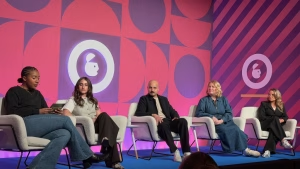
At this year’s NDA Digital Women International Women’s Day lunch, an inspiring panel discussion tackled the critical theme of “accelerating action.” Moderated by Ellie Edwards-Scott, Co-Founder of The Advisory Collective, the discussion featured: Karen Eccles, Chief Commercial Officer at The Telegraph; Felicity Dudley, Director of Marketing EMEA at DoubleVerify; Deborah Gbadamosi, Global Client Lead, Mindshare; and Carly Activille, Managing Director at AudienceQ.
The conversation explored the tangible steps needed to create lasting change for women in the digital industry, how to challenge ingrained biases, and why networks and mentorship are crucial. With diverse perspectives and experiences, the panelists painted a realistic yet hopeful picture of the progress being made and the work still required.
The need for acceleration
Kicking off the discussion, Karen Eccles emphasised that while progress is being made, it is not happening fast enough.
“As an industry we think we’re moving forward, but in reality, it feels like we’re treading water or, worse, going backwards. We need to run twice as hard to make real change,” she said.
She stressed the importance of conscious action at every decision point and reflected on her own role in driving change within her organization.
Similarly, Deborah Gbadamosi highlighted the intersectionality of her experience as a woman, a Black woman, and a Black woman over a certain age.
“We cannot wait for organisations to act; we must invest in ourselves. We need to take control of our careers, our health, and our well-being, pushing the boundaries every day to create breakthroughs.”
Felicity Dudley brought a pragmatic perspective, underlining the importance of moving beyond lip service.
“At DoubleVerify, we have an Employee Resource Group for women, backed by goals and budgets. That’s action, not just talk. Yet, according to the World Economic Forum, globally, we are still five generations away from true gender equality.
We need to see more companies stepping up.”
The rollback of DE&I initiatives
A stark reality emerged from the conversation, the rollback of diversity, equity, and inclusion (DE&I) initiatives. The panelists noted how some companies are scaling back these efforts under the guise of changing business priorities.
Ellie Edwards-Scott raised the issue of brands selectively choosing when to support DE&I, noting, “Some brands that were championing inclusion a year ago are now silent. Have they truly committed, or was it just for optics?”
Karen Eccles pointed to Mark Zuckerberg’s recent comments about corporations being “culturally neutered” and the push for more “masculine energy” in the workplace. Despite women representing just 11% of US tech leadership roles
“That rhetoric is alarming, and it plays into a broader trend of companies deprioritising inclusion efforts.”
The panelists agreed that while DE&I might not be at the top of corporate agendas right now, it remains critical.
“We must continue to hold companies accountable and ensure that gender diversity isn’t treated as a political pendulum swing,” said Gbadamosi.
Opportunities for women in digital
Despite challenges, huge opportunities exist for women in digital, and the panelists encouraged attendees to seize them.
Carly Activille shared her own experience battling imposter syndrome upon stepping into a leadership role.
“I told myself I couldn’t do it, but then I realised the only thing stopping me was me.
If he can do it, I can do it. If she can do it, I can do it. We must push past our fears and take up space.”
She reinforced the importance of male allies in opening doors for women, recalling a pivotal moment when a junior male colleague advocated for her inclusion in key discussions.
“It was a small action, but it meant the world to me. Men in leadership positions must consciously include and champion women,” she said.
The power of networks and mentorship
The role of professional networks was a recurring theme. From Digital Leading Ladies to Bloom, the panelists underscored the importance of community in career growth.
“I used to think I didn’t need a network,” admitted Gbadamosi. “Now, I can’t imagine my career without it. Networks provide support, mentorship, and most importantly, sponsorship, people who advocate for you when you’re not in the room.”
Eccles highlighted the success of The Telegraph’s Women’s Leadership Program. “It’s more than coaching; it’s breaking down silos, creating a strong internal network, an innovation hub, and fostering true leadership development.”
For those early in their careers, the panelists advised seeking out both formal and informal mentorship.
“Ask for help,” urged Activille. “The worst someone can say is no, and that’s not the end of the world.”
Keeping companies accountable
The panel concluded with a call to action for businesses to maintain their commitments to gender equality.
“Don’t dismantle what you’ve built,” advised Gbadamosi. “Companies must keep investing in ERGs, mentorship programs, and female leadership.”
Eccles stressed the need to lean on data for transparency in pay equity.
“Leaders must go beyond percentage pay increases and look at actual parity. Women often start lower and are promoted slower, and may have maternity breaks so we need to be proactive in closing the gaps.”
The discussion ended on a hopeful note, with the recognition that real change comes from collective effort.
“We all have a role to play,” concluded Edwards-Scott. “Whether it’s mentoring, advocating for someone, or challenging biases, we can all take action to accelerate progress.”
As the industry continues to evolve, this conversation serves as a vital reminder that meaningful change requires not just words, but consistent and deliberate action.