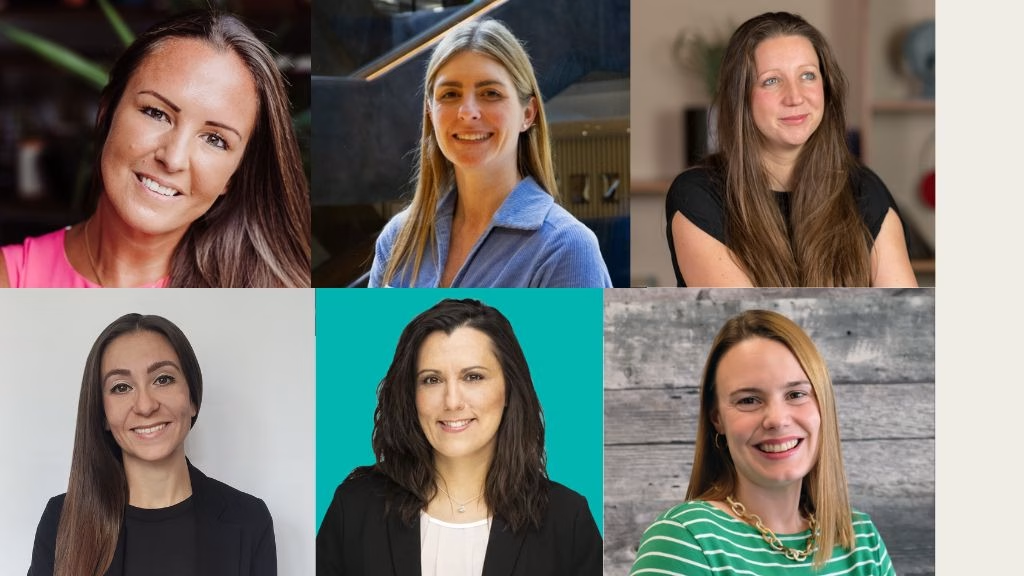
Ahead of International Women’s Day 2026 this weekend, New Digital Age invited women from across the digital media industry to comment on the ongoing importance of the day…
Georgina Iceton, Senior Vice President, AEG Global Partnerships
“The challenge lies in promoting gender equity without creating an ‘us versus them’ dynamic – it’s all about balance. If you advocate too strongly then you risk alienating yourself or losing your audience, but if you don’t speak up then you’re doing a disservice to yourself and the next generation of females.
“Positioning inclusion as a shared organisational goal benefits everyone, and everyone should have the opportunity to be heard. Collaborating across the organisation is essential for identifying changes that can create a more consistent, supportive, inclusive environment for different communities that ultimately make the organisation a great place to work and improves retention.”
Hannah Snoeck, General Manager, Gekko
“The more we talk about the barriers to female progression in the workplace – and establish an environment that enables open conversations – the easier it is to address them and provoke real change. Females remain subject to judgement in many workplaces, with preconceived notions that are often disconnected from performance and tangible results. Embedding a merit-focused culture ensures that delivery overshadows bias. As part of the leadership team at Gekko, it is our duty to ensure that every person has a voice, and that all team members are valued based on merit. That laser-focus on results and outputs levels the playing field.
“True growth happens when we move as a collective. My advice is to be brave, listen to your gut instinct, and believe in the work you are doing. That conviction engenders resilience to face any challenge that comes your way. It starts with you as an individual: stand up for what you believe in and you can make a difference.”
Natalie Cramp, Partner, JMAN Group
“According to a recent study almost a quarter of a million mothers with young children have left their jobs because of difficulties with balancing work and childcare. At the same time, we have the lowest birth rate in the UK since records began.
“While deeply concerning, these findings are not entirely unexpected. Women continue to bear the majority of childcare responsibilities, which often makes navigating career and personal obligations more difficult. Despite significant progress in workplace equality, the ‘motherhood penalty’ persists. All too often, working mums are stuck in roles that are below their capabilities, earn far less than their male and non-mother counterparts, and miss out on progression opportunities. At the same time, childcare is incredibly expensive, often inflexible and that sits against a context of an increasing cost of living and the majority no longer living close to their ‘village’. Really, it’s no wonder that people are opting out of this life decision.
“Having recently returned from maternity leave, I know first-hand how daunting that transition can be. Fortunately for me, I was returning to a culture where my founders truly believe in having both a family and a career and are thoughtful about how they support you to do that. In contrast to many mothers in my network, and to my partner, whose employer is far less supportive and has created unnecessary stress, I have benefited from one of the most comprehensive and thoughtful maternity packages. This level of support has been truly game-changing. I still feel some days like I am barely still standing, and I cannot imagine how I could have made this transition without JMAN’s considered support which is led from the top with the two founders.
“It has enabled me to return to work with confidence, continue contributing at a high level and do so in a way that feels aligned with my responsibilities at home. In the male-dominated private equity and data industry, this level of support is far from the norm and I’m incredibly proud to be part of an organisation that truly challenges it. As we look to the future, it is my hope that more companies take up the mantle to do more to help parents, particularly women, to balance their work and caring responsibilities.”
Belma Ibrahimović, Head of AI, SaaS.group
“The global share of women in AI roles remains alarmingly low – about 20% – and drops sharply as seniority increases. Despite what feels like decades of discussion and debate, we have yet to see concerted change. Indeed, since the explosion in hype around AI a few years ago, the situation has in some ways got a lot worse. Many young women appear to be actively put off pursuing a career in AI in particular.
“Instead of framing the gender gap in terms of a moral or equitable necessity, we should perhaps focus on reframing it as a societal and economic requirement if we are to ensure that some of the most serious risks surrounding AI are mitigated. This is because every algorithm is only as good as the people who built it, how it’s developed and how it’s used. This means that if an algorithm is, say, developed by a group of males of similar ages with similar backgrounds, it will most likely integrate some form of unintentional bias based on their commonalities. When those same groups also control how outputs are interpreted and used, the risk of structural bias increases. These structural biases could grow exponentially to create grave threats to businesses and individuals across society.
“There is also a lot more tech businesses, especially those operating in the AI space, can do to help tackle the gender imbalance. From equitable hiring practices and mentorship programs to promoting inclusive workplace cultures and policies that support career advancement, there are a range of tools companies can use to create an environment where women and all underrepresented groups. Among these efforts, visible female role models are crucial for making a career in AI feel attainable. By placing more women in senior technical and leadership roles, creating opportunities for them to speak at industry events and share their personal success stories, companies can challenge entrenched norms and inspire the next generation to pursue careers in tech.
“AI may define the future. But if it continues to be shaped predominantly by men, it risks becoming a future designed without fully reflecting the needs and perspectives of half the global population. For businesses building AI systems then, diversity must be viewed not just as a ‘nice to have’ but as fundamental for relevance, fairness and long-term innovation.
“At saas.group we operate in both SaaS technology and finance services, two industries that have historically had longstanding gender imbalances. Yet, we have created a diverse and inclusive workforce, with over a third (34%) of the group – far above the average – female. If it is achievable here, there isn’t any reason it can’t be achievable elsewhere.”
Marisa Pereira, VP of People & Organization, Storyblok
“When it comes to International Women’s Day, or any other ‘celebration’ day, we’re often under pressure to come up with a corporate slogan or social media post to show that we’re either observing or taking the day seriously. However, for us in leadership, the real work is found in the operational DNA of our companies. In the tech sector, ‘diversity’ has been a popular topic for a very long time and as a metric to be tracked, yet we often overlook the day-to-day friction that actually prevents women from thriving. If we want to move the needle, we have to stop treating inclusion as an HR initiative and start treating it as a basic requirement of our technology and our culture.
“At Storyblok, we’ve learnt that gender equality is linked to how we work. In a remote-first environment, technology can level the playing field, but only if it’s designed to reduce exhaustion rather than add to it. For many women, particularly those balancing caregiving roles or navigating the ‘double burden’ of domestic and professional life, the wrong tools act as a barrier. When systems are clunky, repetitive, or demand constant ‘always-on’ presence, we are actively draining the joy and creativity out of our most talented people.
“We have to start measuring what we truly value. In business, we track growth and efficiency, but I believe ‘joy’ should be a KPI for every operations and HR leader. A joyful workplace isn’t only about office perks but also about providing the autonomy and the right digital infrastructure so that work fits into life, not the other way around. When we remove the ‘digital friction’, the endless admin and the broken workflows, we create a space where merit actually outweighs proximity. A culture where your contribution is measured by the quality of your ideas and your impact, not by the hours you spend tethered to a desk, is where true equity lives.
“As we look toward the impact of AI and automation, we have an opportunity to redesign the employee experience. We must ensure these tools are used to free women from mundane tasks, allowing them to focus on the high-level, innovative work they were hired to do. My challenge to the industry is to look past the checkboxes. Don’t just ask how many women you have in the building; ask if the systems you’ve built are actually designed for them to lead, to grow and to find genuine satisfaction in their work.”
Kathy Hrach, Senior Vice President Product Management, Ivans
“International Women’s Day is a reminder that the future of technology is something we have the power to build. In the fast-evolving worlds of B2B SaaS and insurance tech, we are at a critical ‘0 to 1’ phase with AI and automation, and the biggest hurdle many women face isn’t a lack of opportunity, but the internal pressure to wait for an invitation. Most people, but especially women, often hold themselves back due to negative mental talk. However, real progress happens when we stop waiting to be invited to the table and instead trust our own expertise to design the table itself: setting the strategy, making the hard decisions, and defining what growth looks like.
Jenny Burns, CEO, Magnetic
This International Women’s Day, the theme ‘give to gain’ feels particularly powerful. I’ve learnt that leadership isn’t about the big speeches. It’s built from the simple moments given without expecting anything in return that people replay in their heads – a quick thank you, a note of encouragement or a reassuring nod. Because when you give a little of your time, you gain the trust and confidence of your team.
Those same principles apply to our industry. At Magnetic I’m proud that women hold the majority of our senior roles. But sadly, the consultancy sector as a whole still has lots to do, with women only comprising 23% of top management roles in consulting last year.
As leaders it’s our responsibility to build supportive, diverse and human-centred workplaces where everyone’s strengths are allowed to flourish. And a major part of creating that workplace is encouraging the next generation of female leaders to enter the industry.
With AI disproportionately more likely to take a woman’s job, employers should implement a “NewHuman” approach that redesigns learning pathways. By creating roles where creativity, experimentation and failure still exist, employers give young people starting out in their career a chance. And in return, they gain the leaders of the future.