By Chris Kleinschmidt, VP, EMEA Advertising Sales, TiVo
Sports is one of the main reasons people watch TV. Despite a relatively slow initial rate of transition from linear TV, sports has now become prominent on a variety of streaming platforms around the world. And yet, this progress is not without obstacles, even today. Back in January, Disney, Fox and Warner Bros. scuttled plans for the US launch of an all-in-one bundled sports streaming app they were calling Venu Sports. Also, Disney bought an ownership stake in the sports streaming service Fubo, which it plans to merge with its Hulu service.
It is logical to anticipate that sports will become more prominent in streaming, particularly in the FAST model. FAST — the acronym for Free Ad-Supported TV — is a natural fit for sports broadcasting, because sports have natural breaks in the action and sports viewers tend not to expect an ad-free experience the way movie audiences do.
Slower FAST Growth in Europe
In Europe, there are some places where FAST is gaining traction, but there isn’t much FAST for marquee sports yet. While things are more advanced in the US, this has caused some to wonder: could this start to take off in Europe? The dream of an all-in-one sports streaming app seems far off. Will that dream ever become real?
In certain ways, Europe is an even more conservative market than the US. Which could mean that a “Super Sports App” (like what was envisioned for Venu or Fubo) may never happen in Europe. If that’s the case, it ultimately means that the power will be held by the handful of apps that own sports rights. There are only so many of those rights available, it’s a finite market. Those apps will likely use those sports rights to help reinforce their dominant positions in terms of paid subscribers, at least in the short term.
Will the other apps combine their resources to try to compete? While theoretically possible, it seems unlikely given the complexity of the agreements that would need to be put in place.
OEM Opportunities
So what other FAST opportunities are there for sports? There are a number of standalone apps that offer a plethora of FAST channels. Other OEMs have their own FAST services, which in essence are content aggregation sources. These players bring content from all sorts of different places. Unlike the SVODs (such as Netflix and Amazon Prime), these relatively niche FAST players aren’t the ones creating their own content. They are just aggregating it, so the FAST channels are become ubiquitous despite the OEM.
Through such an OEM-centric model, these TV makers communicate to their customers that the experience will be fragmented. Sure, they can get their free content from the OEM, but they will have to pay for sports through the sports apps, and buy specialty content movies and TV from an SVOD like Netflix. Over time, sports rights are only going to get more expensive, which will only create more disparity between the various apps themselves. There must be a better way.
Frustration for Advertisers
Sports streaming is often quite frustrating for consumers. My colleague Tyler Winton wrote about this last year. As frustrating as this can be for sports fans, the advertisers spending money on sports find it even more so. Audiences are increasingly fragmented across a growing number of apps. In fact, the number of sports-focused FAST channels has more than doubled in the past year.
This fragmentation means that advertisers have a hard time reaching and tracking their viewers across multiple platforms. This fragmentation, combined with the ongoing but slow shift from linear TV to streaming has left advertisers eager to shift to new platforms but often unable to completely focus their efforts on the future, at the risk of neglecting the legacy linear TV viewers.
Over time, however, the trends all point toward streaming and away from linear TV. This will eventually have the effect of helping to streamline the ad buying and targeting process for the buyers, while simplifying the viewing process for viewers. We just aren’t yet in that promised land of common ground in terms of solutions that can help ease the frustrations of both the consumer and the advertiser.
Enter: The CTV OS
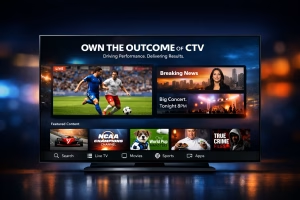
When this does eventually happen, it will have the effect of leading to more content aggregation in the FAST world, which is a natural place for the CTV OS provider to step in. A CTV OS is a natural place to center the aggregation and content navigation and discovery. The CTV OS isn’t a content producer, so it’s not motivated by the desire to push its own content to consumers.
The CTV OS is motivated by helping its customers get to the content they want to watch quickly and easily. If that’s sports content, great. If it’s new movies and TV shows from an SVOD, that’s fine too. From a CTV OS provider’s point of view, FAST content is really no different from SVOD content or any other type of streaming content. The CTV OS provider is in the unique position of helping the consumer find the content they want to watch, regardless of which provider it is coming from, and independent of whether or not the stream contains ads.
FAST Opportunities for Advertisers
Things are starting to change now that FAST is proliferating, because it is more of a “lean-back” TV viewing experience that’s more like how people used to watch linear TV. A lot of people don’t necessarily know what they want to watch, and so they now have the option of being able to put on a niche FAST channel that shows them familiar content, and maybe they just have it on in the background. Either way, advertisers see an opportunity here.
In the early days, CTV began to hint at this sort of Holy Grail for advertisers: that they would be able to target individual consumers with relevant advertising, which was something that linear TV could never do. That promise wasn’t really fulfilled, predominantly because of how siloed the ad-buying experience is for advertisers.
As FAST becomes bigger, in certain ways it becomes more like linear TV, but with a clear bonus for the advertisers: the viewer data that CTV is capable of providing. The CTV can track what FAST channels and specific content people are watching, when they are watching it and for how long. The quality of this data is much better than it ever was for linear TV, where the viewership statistics were based on a model, based on and extrapolated from sampled data taken from a ratings organization like Barb (in the UK) or Nielsen (in the US). The data from the CTV is not modeled, it’s much more accurate because it is actual reporting on what the TVs were streaming.
For sports to become more prominent in the FAST world means that the FAST audiences need to reach a point where the demand is big enough to justify it, so that from the advertiser’s perspective they can cover the cost of paying for the rights to get the sport’s stream. It’s not there yet, and it’s a bit of a chicken and egg issue as well: which comes first, the audience or the advertisers?
Will The Dream Become Real?
Unfortunately, as it stands right now, certain apps are only available on CTVs made by certain manufacturers. As this market develops, a key challenge will be to make sure that all of these FAST channels are available on all devices, because no one wants a situation where you have to buy a specific brand of TV in order to watch a particular sporting event.
For advertisers, the dream would probably be for there to eventually be one FAST app that exists on every TV. That app would have all the same channels regardless of whether your TV cost £10,000 or £300. As simple as this would make things for both advertisers and consumers, it’s unlikely we will ever get to a situation where there’s just one app for FAST content. Something like that would essentially rival linear TV, so it probably won’t happen. In addition, certain OEMs want to carry exclusive content in order to help drive TV sales. Because of all this, over time we will likely see a series of sports-focused providers who each have rights to stream particular sports or particular leagues. Consumers will use the apps that carry the sports they are interested in, and will largely ignore the rest.