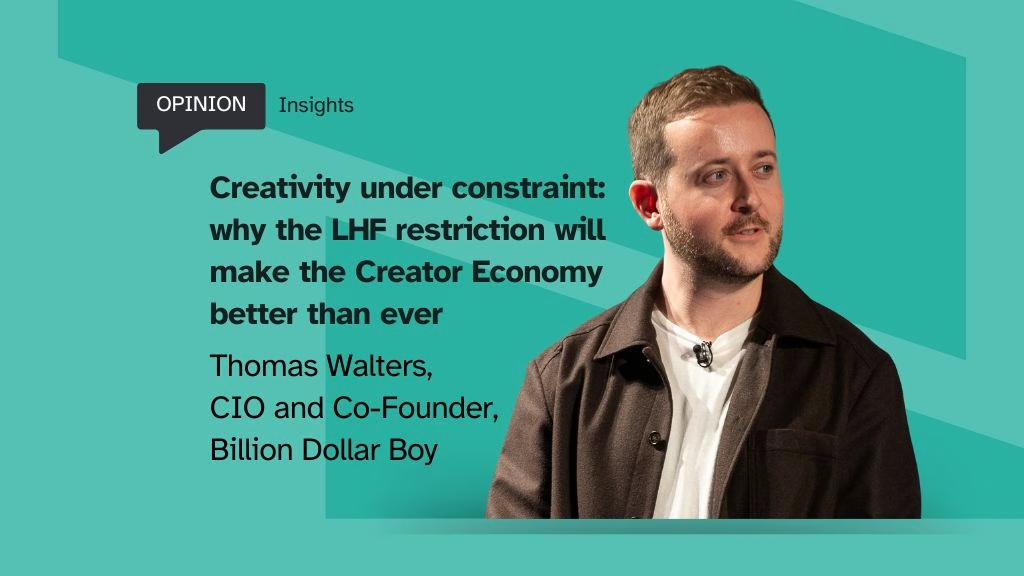
By Thomas Walters, Chief Innovation Officer and co-founder of Billion Dollar Boy
At first glance, the UK’s upcoming Less Healthy Food (LHF) advertising restrictions feel like they’re clipping the industry’s creative wings. In creator marketing especially, the headline impact is: paid LHF promotions on creators’ own channels will be banned, removing one of the most familiar and scalable digital tools brands have relied on for years.
But this isn’t a decisive blow. It’s a recalibration. And if history tells us anything, it’s that constraints don’t kill creativity – they sharpen it.
Do the new rules scupper or inspire creativity?
On the surface, these rules disproportionately affect digital and creator-led advertising, while TV and out-of-home retain more flexibility. That imbalance raises legitimate questions about whether regulation has kept pace with how modern audiences actually consume media.
But we shouldn’t confuse disruption with decline. We’re already in an era where consumers actively reject transactional, product-first advertising. Creative assets built around “showmanship” – entertainment and storytelling – deliver a 39% higher lift in ad memory than those built around “salesmanship”. That’s not a future trend; it’s the current reality.
Why do so many of us still remember Cadbury’s Gorilla ad, but struggle to recall countless product-led FMCG campaigns? Because people don’t want one blunt brand message, repeated endlessly in different cut-downs. They want value: entertainment, cultural relevance, humour, education. LHF simply accelerates a shift the industry was already making.
Remove the pack shot, and you force brands to think bigger. That’s not a loss; it’s a creative unlock.
From product-first to brand-world building
We’ve seen this play out before. Alcohol advertising restrictions haven’t weakened the category – they strengthened it. Guinness gave us a blueprint with their famous 1999 “Surfer” ad – proving you don’t have to be literal to be memorable. Surfer didn’t show a pint being poured; it built a world based on an emotional narrative. The result was some of the most iconic advertising ever made.
LHF will trigger the same renaissance in FMCG. At Billion Dollar Boy, we’ve experienced this first-hand. When Nordic regulations prevented Garnier from using filters, we pivoted away from conventional creator content and built an immersive AR experience instead – delivering both compliance and impact.
This is what happens when creativity is forced upstream.
Advertising without the product
When you take the product out of the frame, everything else has to work harder. That’s where brand identity becomes invaluable.
Distinctive brand assets – colour, sound, typography, characters and tone – now do the heavy lifting. Sonic branding in particular will surge, because sound is one of the most powerful cues for brand memory when visuals are constrained. Ipsos research shows distinctive brand assets can drive up to 34% of a brand’s short-term sales effect by improving recognition and recall.
Storytelling also becomes non-negotiable. Instead of “here’s the product, here’s someone eating it,” brands need narratives, rituals and moments that express who they are. Creators still play a central role here, but with more structured, brand-first briefs that prioritise consistency and emotional resonance over product demonstration.
Do the rules favour bigger brands?
Established brands have a head start. If you’ve spent decades embedding a particular brand colour, a jingle or a tone of voice into culture, the shift away from product show-and-tell will be less painful.
But that advantage isn’t insurmountable. Challengers can build brand codes faster because they’re nimbler. In the social era, consistency compounds quickly. Choose one bold colour, one sonic cue, one attitude – and commit to it everywhere.
Crucially, SMEs are also exempt from LHF rules, giving many challenger brands breathing room to balance product-led activity with longer-term brand building.
The future of creativity post-LHF
LHF will fundamentally reshape advertising – and for the better. We’ll move from product-first marketing to true brand-world building. Creators will evolve from product demonstrators into storytellers and culture-shapers. Sonic branding, characters, humour and ritual will rise in importance.
We’ll also see greater investment in owned channels, where brands can show products organically while building entertainment-driven communities. Technologies like generative AI and AR will help scale these worlds – but human creativity will remain the engine.
If the last decade was about performance and product, the next will be about imagination, emotion and distinctiveness. Brands that embrace that shift early won’t just survive LHF – they’ll define the next era of creativity.