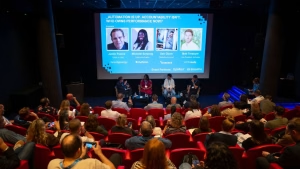
Bluestripe Group and New Digital Age brought together a group of senior sales leaders from the digital advertising industry at the Union Club this month for the first Selling the Sellers roundtable, a companion piece to the long-running Marketing the Marketers series. Where that initiative focused on helping marketers in our industry, this one turned the lens on the sales side of the business, and on the gap that too often opens up between what marketing produces and what sales can actually use.
The conversation, hosted by Andy Oakes, CEO, Bluestripe Group, ranged widely, but two themes kept resurfacing: the need for PR and commercial teams to work closer together, and the increasingly fraught calculation around which industry events are actually worth the money.
A disconnect that costs revenue
The starting premise, as Oakes put it to the room, is that there is a structural gap between the story marketing tells and the story sales hears back from clients and prospects, a gap he said he had witnessed firsthand on a call where a head of commercial and a marketing director from the same company sounded as though they worked at two entirely different organisations.
That gap was echoed from several angles around the table. Dominic Woolfe, UK country lead at TapTap Digital, framed it as a mismatch of incentives as much as messaging.
“There’s a real misalignment between revenue, which is based on sales, and marketing or PR, which might be based on coverage,” he said, arguing that the two sides are often optimising for entirely different outcomes even when they sit in the same building.
Woolfe illustrated what happens when that gap closes, recalling a colleague who moved from a commercial role into marketing. “He got the commercial side of things really, really well. He then got moved into a marketing role. Sales felt really comfortable that he was going to help them. Marketing and the whole business was aligned, and it was like poetry in motion.”
When alignment breaks down, he added, the effect is immediate and visible across the business.
Phil Action, country manager at Adform UK, offered a more optimistic counterpoint, describing two employers, Adobe and Adform, where he felt marketing and commercial leadership genuinely worked together.
“My experience in the last twelve to thirteen years is working for two companies that were very positive by having commercial and marketing working closely together,” he said, crediting leadership from the top for setting that approach. At Adform specifically, he said PR was never treated as an afterthought. “It’s always on our marketing plan, it’s always on global plans, and it’s not just about thought leadership, it’s about how you help us with events, networking, brand building and ultimately how this can turn into tangible sales opportunities.”
Positioning, not features
A recurring frustration was how easily sales decks collapse into feature lists that mean nothing to a buyer who has heard the same pitch from five competitors. Woolfe was blunt about the scale of the problem in a crowded ad tech market.
“Positioning, not product specification, is what actually cuts through. Without a clearly understood identity,” he argued, sales teams end up selling into features nobody outside the industry cares about.
Oakes picked up the same thread from the agency side, warning against clients who insist their offer is entirely without comparison. “Don’t tell us you’re all unique,” he said is the advice Bluestripe routinely gives clients. “Tell us you’re good.” The honest starting point, he argued, produces messaging sales teams can actually stand behind in a pitch.
Cannes, cost and the case for saying no
If there was one topic that generated genuine debate rather than consensus, it was the industry events calendar, and Cannes Lions in particular. Becky McKinlay, managing director at Oystercatchers, was among the more sceptical voices in the room, having sat out the festival entirely this year.
“I chose not to go to Cannes this year, which was a bit of a surprise,” she told the table. “But we, as a business, won’t win or lose work as a result of being there.” She went further, questioning whether the spectacle of the event has drifted away from anything commercially useful for companies like hers, noting that “the vulgarity of it is a problem” when clients see suppliers spending lavishly on entertainment rather than on their behalf.
That decision did not go unnoticed by her network. “I was getting messages on the day saying “oh Becky, we’re in Cannes, can we see you?,” she said, describing a genuinely productive week in London instead, while acknowledging that for the right meeting, in the right context, the softer, more relaxed atmosphere of a festival can still open doors that a boardroom cannot.
A shared conclusion
For all the different vantage points around the table, the roundtable converged on a simple point, made explicit by Oakes as he wrapped up the session: PR, marketing and sales only work when they are built around the same story, told to the same audience, at the same time. Selling the Sellers will return to test whether that alignment is improving.