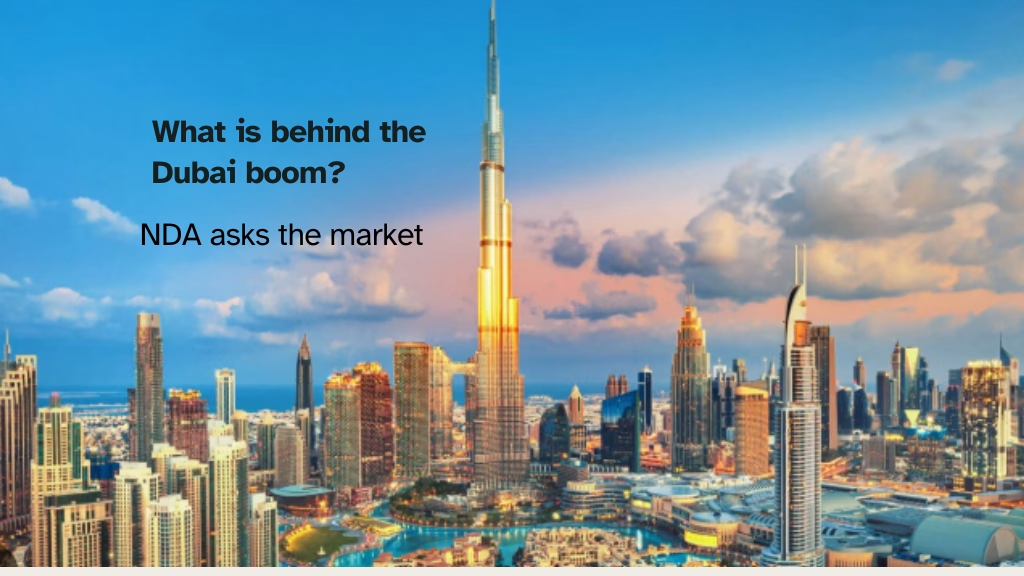
Dubai’s digital media scene is booming due to what seems to be a unique perfect storm of world-class infrastructure, aggressive government policy, and one of the most hyper-connected populations on Earth. As of 2026, Dubai has firmly established itself as the digital bridge between the East and West. NDA will be covering the region a lot more in the coming year and asked those in market for their views.
“Dubai’s Adtech and media ecosystem is booming right now because it sits at the intersection of capital, ambition, and execution speed. Global brands, regional-scale players, and fast-moving startups are operating in the same compressed market, with far fewer legacy constraints than in Europe or the US. What’s different this time is that AI has moved from experimentation to deployment, and Dubai is unusually pragmatic about that shift. Decisions get made quickly, regulation is clearer than people assume, and there’s a growing willingness to rebuild media, marketing, and customer engagement stacks from first principles. In many other markets, people are still debating AI strategy. In Dubai, they’re already dealing with the consequences of using it.”
Demetri Papazissis, Co-Founder & CEO, Superbo AI
“When it comes to innovation, very few cities can rival Dubai. Renowned for its swift embrace of cutting-edge technologies, the city has become a global hub for immersive experiences that seamlessly fuse technology with culture. This meteoric rise is not a coincidence but rather a natural extension of the city’s commitment to staying at the forefront of technological advancements.
“What’s changed more recently is the way immersive is being commissioned. In Dubai, it is no longer treated as a short-term marketing layer, but as part of the core experience of retail, hospitality, and cultural destinations. Destinations and brands across the city are investing in permanent immersive environments designed to evolve over time, rather than one-off spectacles that peak quickly and fade.
“This reflects a more mature understanding of what immersive is capable of delivering. Audiences now expect experiences that feel considered and integrated, while developers and operators are focused on longevity, repeat visitation and measurable value. As we move into 2026, the momentum will come from projects where physical architecture, digital content and live interaction are conceived together from the outset. The most successful immersive environments will be those built as long-term platforms—able to adapt, refresh and remain relevant—rather than moments designed purely to capture attention at launch.”
Alex Apthorpe, Managing Director Middle East, Pixel Artworks
“Dubai is fantastic for capital, talent and technology. From our perspective on the ground there’s a growing sense of confidence among brands and vendors alike, supported by strong government backing, clear regulatory frameworks and a steady influx of international companies using Dubai as their regional hub.
We’re also seeing a shift in how advertisers approach digital media in the region. Clients are increasingly data-driven and performance-focused, prioritising measurable outcomes over vanity metrics.
Publishers and agencies that understand how to connect content, data and conversion are gaining ground.
In terms of who’s making waves, it’s a mix of global adtech platforms establishing serious regional operations and agile local players innovating around AI, analytics and optimisation.
We try to blend strategy, media, creative and consultancy in the region. Looking ahead, key trends to watch include AI-led media planning, evolving data and identity solutions, and hybrid campaigns that combine digital reach with real-world experiences.”
Simon Corbett, Founder, The Jargon Group
“Six months into my MENA adventure, I’ve learned that this market has its own rhythm. It can sit still for months, then suddenly everything moves at once. You’ll pitch a new programmatic concept in January, hear nothing, but then get a call in September asking if you can launch it tomorrow. Welcome to Dubai.
But what is really exciting is that ‘new media’ channels are having their moment. Let’s take programmatic DOOH (pDOOH). Today, 30% of OOH spend goes to digital screens, but only 1-5% is bought programmatically depending on the market. But rather than being a problem, that gap is an opportunity the size of Sheikh Zayed Road.
We recently ran a campaign for fragrance house Maison El Nabil that combined AI-powered pDOOH with mobile retargeting. After six days we saw 41% purchase intent uplift and 46% ad recall. These are the kind of results that make European clients raise an eyebrow and MENA clients say ‘let’s scale it next week’; the beauty of this market is that when it decides to move, it moves fast.
CTV is gaining serious traction with 17% of UAE digital time now spent on connected TV. Gaming remains the sleeping giant -72 million gamers in the region and a $4.5 billion market (forecast to double by 2030), yet it is barely scratched by advertisers. And digital audio? With 62% of UAE residents listening to podcasts weekly versus 44% globally, it’s the engagement channel hiding in plain sight.
What makes Dubai unique isn’t just the infrastructure or the budgets. It’s the appetite for experimentation. Clients here will greenlight activations that would take three rounds of approval anywhere else. At the same time the market also has its own pace, its own codes, and a healthy scepticism toward the latest ‘revolutionary’ platform from Europe.
The real opportunity isn’t replacing what works. It’s applying channels that amplify each other. pDOOH doesn’t kill direct sales, CTV doesn’t replace linear, audio enhances everything. The brands winning here understand that omnichannel isn’t a buzzword. It’s how you navigate a market that can go from ‘let’s discuss next quarter’ to ‘we need this live by Sunday’ in a single WhatsApp conversation.”
Mehdi Aroussi, head of MENA region at Azerion