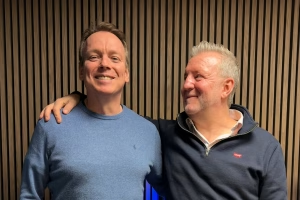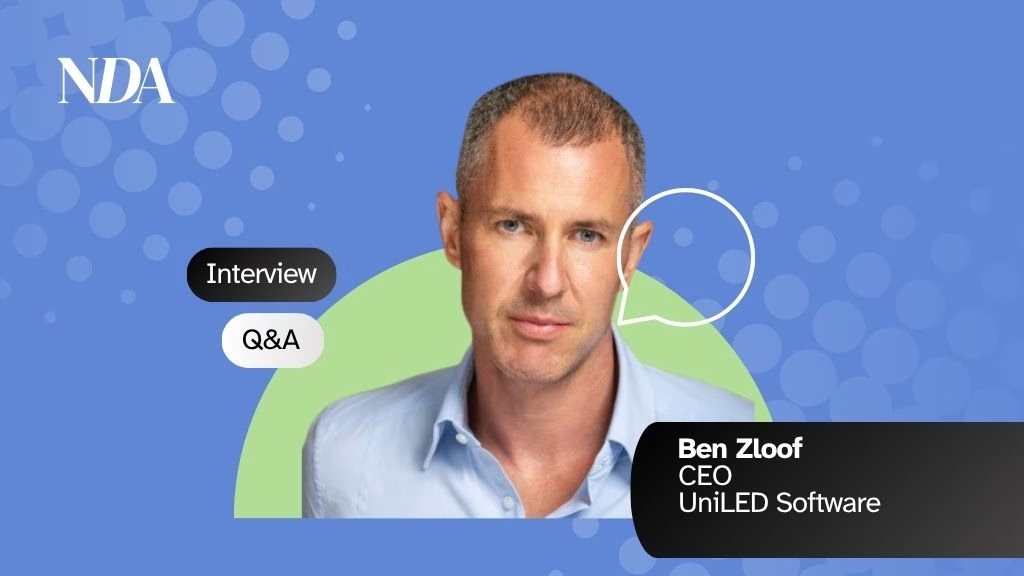
NDA Editor-in-Chief Justin Pearse sat down with UniLED Software’s CEO Ben Zloof to find out how the company is bringing greater transparency and accountability to Digital OOH.
Can you start by telling us a bit about UniLED’s background and how it evolved into the business it is today?
UniLED began life as a screen maintenance company back in 2012. I recognised early on that while maintaining digital screens was important, there was a bigger challenge facing advertisers and agencies – knowing that their ads were running and delivered as booked.
That insight led to the development and launch of UniLED Software, and our third-party verification platform designed to provide impartial, accurate and transparent assurance that DOOH ad campaigns have run and delivered as planned.
Our UniLIVE platform verifies every play of a campaign, 24/7. This play data is then captured in a verification dashboard and cross-referenced against the campaign booking information. The reports provided give an accurate picture of the actual delivery – this includes both under and over delivery.
What are the main capabilities of the UniLIVE platform?
.There are three key pillars: deliver, verify, and optimise.
First of all, we simplify creative delivery by providing a central hub that connects agencies and media owners.
Secondly, we provide agencies with verification that ads played where, when and how they were supposed to.
Finally, the rich data insights and intelligent analytics provided by the UniLIVE platform can help agencies to optimise DOOH ad campaigns inflight as well as support future campaign planning.
By validating audience delivery against booking targets and industry benchmarks (with in-depth analysis of DSP impression multipliers), we provide agencies with insights and full transparency and accountability into campaign performance. It’s not just what was planned, it’s what really happened.
How big a problem is verification in digital out-of-home compared with online media?
Third-party verification (TPV) is not a new concept; it has been used in the world of online advertising for several years. Following its digitalisation, the OOH industry followed suit, and the adoption of TPV is growing exponentially. This is evidenced with an increase in the number of verification partners there now are – we were the first to introduce the concept in the UK.
The principle is the same. Advertisers want to know what they’ve paid for has been delivered, and DOOH needs to offer the same level of accountability that digital media does.
Unlike online environments, DOOH doesn’t face brand safety concerns around harmful content. However, the growing sophistication of targeting, from weather and time triggers to data-driven buying, creates new demands for accuracy.
If you’re buying based on something as specific as pollen count, you want to be sure those parameters were followed. Unless you stand outside 1,000 screens yourself, you wouldn’t know, and that’s what our platform tells you.
So what’s the incentive for advertisers to verify their campaigns?
Over the last year, the DOOH campaigns we verified over-delivered on average by 34%.
That means advertisers got more value for their investment than they realised. Without verification, they’d never know.
We see this as a way to strengthen confidence in the medium. Agencies can show clients they’ve delivered even more than expected, which is a powerful story.
Verified delivery data is also critical for accurate econometric modelling and marketing mix modelling. If brands are making investment decisions based on planned data, they risk underestimating the real impact of DOOH. By using actual delivery data, advertisers can feed their models with a true picture of what ran – when, where and how often. This leads to more reliable insights and more informed media planning. Without it, there’s a real risk that DOOH is undervalued in the marketing mix.
How do agencies use UniLIVE, and what are they looking for from the platform?
At present we work with several agencies across the UK and the US.
The platform saves them huge amounts of time by automating post-campaign reporting and providing a single dashboard view of every campaign.
It’s also about helping planners and buyers focus more on strategy and less on admin. If you’re managing multiple campaigns across different regions, you’d normally get spreadsheets from several media owners and must pull them all together manually. UniLIVE does all that automatically.
But it’s more than just reporting automation. Agencies use UniLIVE to give their clients greater confidence in their DOOH investment. It can uncover millions in additional media value, help spot and resolve issues in-flight, and build trust in the channel by providing the transparency and accountability advertisers increasingly expect.
Sustainability is a big topic across the industry right now. How does UniLED support that agenda?
We’ve been working with the OOH sector to understand the energy consumption of DOOH campaigns. If you don’t know where or how often your ads have run, you can’t measure their carbon footprint. We’ve also started to look at how creative elements, such as colour or brightness, affect screen energy use.
Each screen is different, so we’re helping develop more accurate models for measuring campaign impact and energy consumption. It’s an area people are talking about a lot, but not everyone is investing properly in yet.
Do you think verification will soon become standard practice in digital out-of-home?
Absolutely. In fact, something we’ve been hearing in the wider industry is that 2025 was the year of programmatic, and 2026 will be the year of TPV.
The growth in TPV is being driven by a broader recognition of how important verification is to ensure transparency and accountability, but also, due to the rise of programmatic DOOH.
As programmatic buying expands, verification will become essential. Programmatic allows for much more flexible, targeted campaigns, but that also means advertisers need oversight. We’ve seen examples of ads running at three in the morning instead of commuter hours. Verification gives you the data to fix that inflight.
If we want digital-out-of-home to be seen as a true digital medium, it has to offer the same transparency and accountability advertisers expect from online channels. That’s what we’re building.