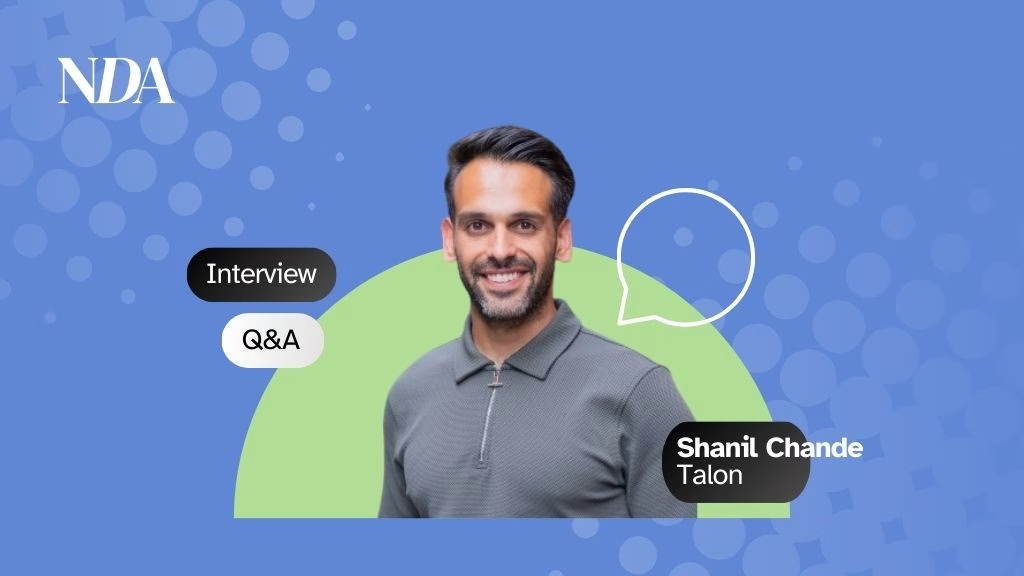
Shanil Chande recently joined Talon as its first Chief Programmatic Officer, a newly created role that signals the independent OOH specialist’s growing ambition in data, automation, and digital trading. With programmatic DOOH at a clear inflection point, and nearly half of UK brands now running programmatic-only campaigns, Talon wants to boost its presence in the market.
Chande brings more than a decade of experience across programmatic, digital strategy, and commercial partnerships, most recently as Commercial & Partnerships Director at Hawk. His appointment completes Talon’s UK leadership team and underlines the agency’s commitment to scaling programmatic OOH.
In conversation with Justin Pearse, Editor-in-Chief of New Digital Age, Chande explains why Talon stood out, why programmatic OOH is entering its most important phase yet, and what needs to happen next for the channel to fulfil its potential.
Why did you decide to join Talon, and why does now feel like the right moment?
Talon is one of the few remaining truly independent OOH businesses that is completely focused on pushing the channel forward. There are lots of new businesses entering OOH, many of them are omni-channel by design, which is positive for the sector overall.
More people talking about OOH is always a good thing. But for many of those businesses, OOH is just one part of a much broader mix.
What really attracted me to Talon is that singular focus on delivering best-in-class work in OOH. The business is deeply invested in driving progress for media owners, data partners, and the wider ecosystem, not just in using the channel as another line item.
That focus, combined with the independence of the business, makes this a very exciting place to be.
In terms of timing, programmatic OOH is at a genuine inflection point.
The channel has been on a significant journey over the last three to four years, particularly following Covid. At the moment, roughly 10% of digital OOH is traded programmatically, but industry forecasts suggest that could triple or even quadruple over the next four to five years. We are right at the point where more advertisers are entering the space and starting to see what is possible.
Growth is clear, but challenges remain
With that growth comes complexity, what do you see as the biggest challenges ahead?
One of the biggest challenges is structural. There is still some uncertainty around where programmatic OOH should sit within agency structures. Other channels have been through similar journeys, AV and CTV are good examples. CTV can now be bought by AV teams, digital teams, or trading desks, depending on the agency.
As an industry, we need to make sure programmatic OOH is transacted in the most efficient place possible, without duplicating effort or creating unnecessary complexity.
The key for us is working closely and collaboratively with agency partners so that programmatic activity is genuinely additive to existing strategies, not a repetition of the same plan in multiple places.
Education is another important challenge. As OOH moves into new teams within agencies, there is a need to build understanding of how the channel really works. Programmatic OOH operates differently from many other programmatic channels.
Buying chains are often simpler, but measurement and effectiveness look different, and those nuances need to be properly understood.
Measurement is probably the third big area. From a modelling perspective, many of the frameworks in use today were not designed with OOH in mind. They are effective for what they were built to do, but there is work to be done in refining how OOH is quantified.
That means collaboration with agency partners, effectiveness teams, and industry bodies like the IAB. It’s an area we’re advancing in partnership with our internal effectiveness team, and we’re already seeing meaningful progress.
Media owners and market momentum
How are media owners responding to this shift towards programmatic?
The journey media owners have been on over the last few years has been huge, and we are in a strong position because of our long-standing relationships with them. We genuinely couldn’t do what we do without them and their collaboration. Much of the new inventory going into the ground is digital and increasingly programmatically enabled, which shows how aligned media owners are with this direction of travel.
For media owners, programmatic growth often brings incremental advertisers into the channel, brands that may not have used OOH before. That is incredibly positive. One of the key differences with Talon is that we combine technology with people.
We have experienced buyers speaking directly to media owners every day, looking to transact in the smartest possible way. That human layer really matters.
Programmatic lowers the barrier to entry. Lead times are shorter, budgets can be smaller, and that democratises access to OOH. Over time, that creates a healthier, more diverse advertiser base, which benefits everyone.
We are seeing digital OOH screens appear in increasingly diverse spaces, how do you view that expansion?
It is an exciting time. New screens mean new environments, new mindsets, and new contexts for brands to connect with audiences.
Retail media, transport hubs, concourses, and other emerging spaces are opening up opportunities that simply did not exist before.
There are sometimes questions about sustainability, but OOH has consistently proven itself to be one of the most sustainable channels. Despite the increase in digital infrastructure, the medium remains inherently efficient and environmentally responsible.
Seeing that expansion, while maintaining strong sustainability credentials, is a real positive.
Creatively, what excites you most about programmatic OOH right now?
Three-dimensional creative is obviously exciting, but I actually think we are still underutilising dynamic creative. Dynamic has been around for a while, but now we have more data, more APIs, and more opportunity to use it properly.
Most marketers want to do dynamic creative optimisation, but only a small percentage are actually doing it in practice.
OOH is uniquely well placed to deliver personalisation at scale, without relying on personal identifiers. That makes it a very privacy-safe environment. To unlock that potential, dynamic needs to be part of the conversation much earlier in the planning process, not something that is bolted on at the end.
Collaboration is key. Media agencies, creative agencies, and specialists like us need to be working together from the start. Dynamic should never be used for its own sake. It has to be right for the brief.
There is also a misconception that dynamic is expensive, but when you look at the effectiveness it can deliver, it often pays for itself.