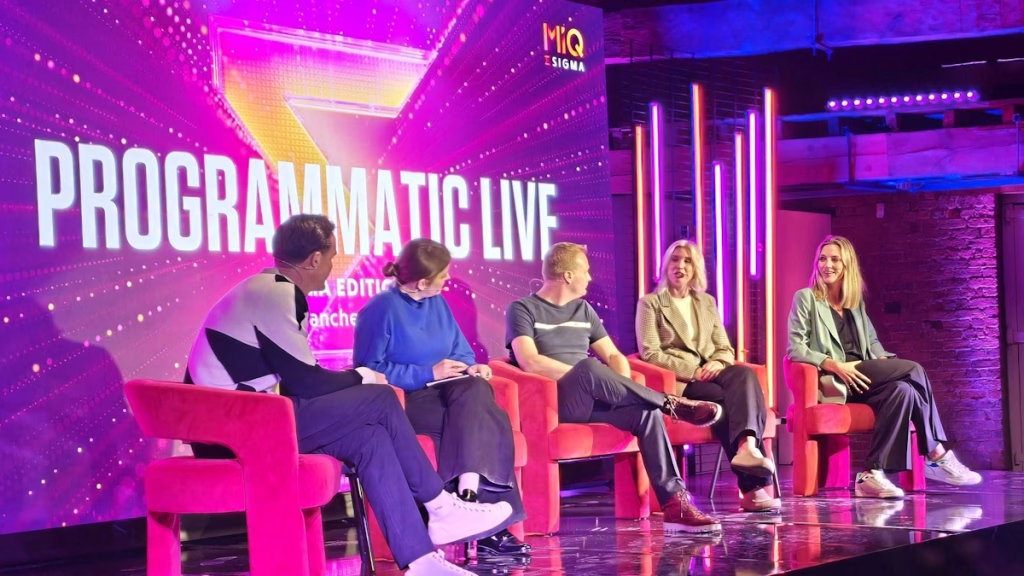
At Programmatic Live Manchester: MiQ Sigma Edition, leaders from Dentsu, Blank Space Content, and MiQ explored how artificial intelligence (AI) is transforming the industry, and why the human touch still matters more than ever.
AI is no longer a futuristic concept. It’s already reshaping how media agencies, brands, and consumers interact. But, while the technology offers speed, precision and scale, the biggest question remains: how do we preserve human creativity and judgment in an increasingly automated world?
That question sat at the heart of the discussion, moderated by Jack Sullivan, Business Development Lead at MiQ.
Finding the human signal
The AI conversation has become “saturated,” according to Vanessa Eagle, Head of Investment for iProspect and Dentsu X, making discernment more important than ever.
“We’ve all got to be conscious of what goes in, because what comes out will reflect that,” she said. “If we want to evolve as an industry, we have to think about the data we’re feeding in and the biases that might live there.”
Eagle said Dentsu is using AI to streamline operations and support employees in new ways. “If you’re not detail-oriented, AI can help there. If you’re not creative, it can support that too. We’re still learning its capabilities before we can move as fast as we’d like.”
For Katy Leeson, Co-founder of Blank Space Content Studios and former CEO of Gary Neville’s Relentless Group, AI’s real power is in helping brands understand audiences. But with that also comes creative risks.
“It enables us to create content that resonates at speed,” she said. “But, because it learns from past data, it risks echoing voices that have already been heard.”
Her advice: treat AI as “a mirror, not a map.” Authenticity, she argued, is still what separates great brands from forgettable ones.
“The real test is whether your content feels the same as spending an hour with your brand. If it doesn’t, you’ve probably relied too much on AI.”
Cutting through the noise
Representing MiQ, Global Product Director Kaltrina Brahimi focused on how AI is reshaping discovery. “For the first time, AI is in the hands of customers,” she said. “It’s changing how people search, shop, and decide. That’s a huge shift.”
At MiQ, her team is already seeing how tools like large language models are altering the “research phase” of the buying journey.
“Consumers are using AI not just to find products, but to understand them,” she said. “That means brands need to think differently about how they show up during that process.”
Meanwhile, Eagle explained how predictive modelling is already changing client conversations. “We can model media mixes, forecast outcomes and speak in the CFO’s language,” she said. “That’s powerful when proving where value lies.”
AI’s lasting impact
When asked to predict AI’s biggest impact, Leeson pointed to its ability to analyse and leverage data in real-time. She said: “It’s about getting minute-by-minute, real data insight. We used to have to wait years. I remember when I first started out and I was working on surveys that were six months old when I was planning magazine campaigns. Now, you get that insight straight away.”
And Eagle looked further ahead: “The new generation coming through will have a whole different set of expectations around media and how they consume it. I would expect there to be a bit of human authenticity in there. But I don’t think they’ll expect that anymore. So, we’ll have to do more to stand out.”
As the panel wrapped, Sullivan noted how each speaker returned to the same theme: AI is a tool, not a replacement. It can surface patterns and possibilities, but it’s human judgment that gives them meaning.
Or, as Brahimi put it: “AI is not fantasy. It’s not going to solve everything. If you’re asking the wrong question, or if you’re just using it to funnel those old data formats, it’s not going to make them better.”