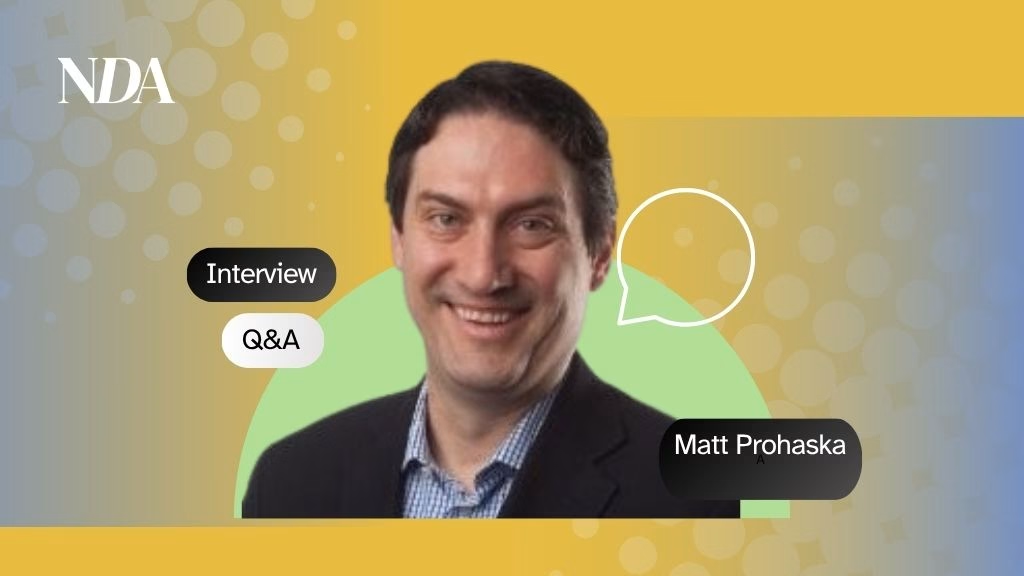
Matt Prohaska is Founder and Chief Eecutive of Prohaska Consulting, the independent advisory business working across publishers, brands, agencies and ad tech. In conversation with New Digital Age he shares his view on the biggest shifts shaping media and marketing, from AI disruption to measurement reform and the future of publishers.
You work across every part of the ecosystem. What are the biggest industry shifts you are seeing right now?
The biggest theme is that long-running structural issues are finally becoming impossible to ignore. Measurement is one of them, publisher sustainability is another, and AI has accelerated the urgency around both.
For years, too much of digital advertising has relied on blunt measures such as last-click and last-touch attribution. At the same time, television and video have leaned heavily on panel-based systems. Those approaches were tolerated when markets were more stable, but they are under much greater pressure now.
As streaming grows, audiences fragment and budgets tighten, marketers need clearer evidence of what is working. That means more accurate, more connected and fairer measurement models.
Why has measurement become such a critical issue now?
Because money follows the scoreboard. If the way we measure performance is flawed, then investment decisions become flawed too.
A lot of channels and partners have been under-credited for years, while others have benefited from systems that flatter their contribution. We are now seeing a healthy clash between old methods and the need for something better.
The real opportunity is not just better data. It is creating confidence. If advertisers trust the scorekeeping, they are more likely to invest across a broader range of media.
Publishers continue to face enormous pressure. How do you assess their position today?
There are challenges, but there are also signs of progress.
The strongest publishers recognised early that display advertising alone was never going to be enough. They invested in events, subscriptions, ecommerce, first-party data and direct audience relationships. Those businesses are in a healthier position today.
The wider publisher market is still under pressure, particularly where legacy models have been slow to change. But I do think there is a growing realism now. More publishers understand they need diversified revenue, better use of data and stronger commercial strategies.
How important is collective action for publishers when dealing with platforms and AI companies?
It is hugely important.
No healthy democracy or healthy media economy depends on only a handful of publishers. Trade bodies and coalitions matter because they help create standards, leverage and shared learning.
We have seen meaningful progress where publishers have worked together, whether on platform negotiations, brand safety issues or protecting the value of journalism.
With AI, publishers are moving from a purely defensive position, trying to stop unauthorised use of content, to a more strategic one. The question is no longer only how to block misuse, but how to build sustainable commercial models around licensing, discovery and audience growth.
Brand safety has often hurt news publishers. Is that changing?
Slowly, yes.
For years, blunt brand safety tools have overblocked quality journalism, treating trusted news environments as risk rather than value. That has deprived publishers of revenue they deserved.
The good news is there is now much better understanding of the problem. Smarter tools, improved contextual approaches and more industry pressure are helping. It is not solved, but it is better than it was.
What are you seeing in AI right now?
“We as a collective industry have moved very quickly through the fear cycle and into the hype cycle.
A year ago, many conversations were dominated by anxiety. Now some businesses are behaving as if every process can be automated overnight. The truth is somewhere in the middle.
AI will improve many parts of media and marketing, from planning and audience discovery to optimisation, workflow and creative production. But there is still a lot more noise than signal in the market. Some products are real, some are little more than polished sales decks.
That is normal in any new technology wave.
What does that mean for jobs and talent?
There will be disruption, and some of it will be painful. But I would be cautious about claims that large parts of the workforce are suddenly unnecessary.
In many cases, AI is more likely to make someone 25% better at their job than eliminate the need for that person entirely.
The bigger issue for employment is not AI alone. It is revenue concentration. If a small number of companies continue taking the majority of ad spend, then fewer jobs will exist across the rest of the ecosystem.
That is why I talk about the need for a stronger middle class in media. You need healthy mid-sized businesses, publishers and technology companies to sustain innovation and opportunity.
Where do you see the biggest growth opportunities?
Three stand out.
First, self-service creative tools for video and audio, especially for smaller advertisers who need easier ways to compete.
Second, digital out of home, which still has significant upside as automation and measurement improve.
Third, businesses that combine technology with service. The industry has learned repeatedly that software alone does not transform organisations. Companies that help clients adopt tools properly, train teams and deliver outcomes will create the most value.
Are you optimistic about the future of the industry?
Yes, but selectively.
There will be more disruption, more false starts and more uncomfortable adjustments. But there is also huge opportunity for businesses willing to rethink old assumptions.
The companies that win will be the ones that combine innovation with realism, and technology with people.