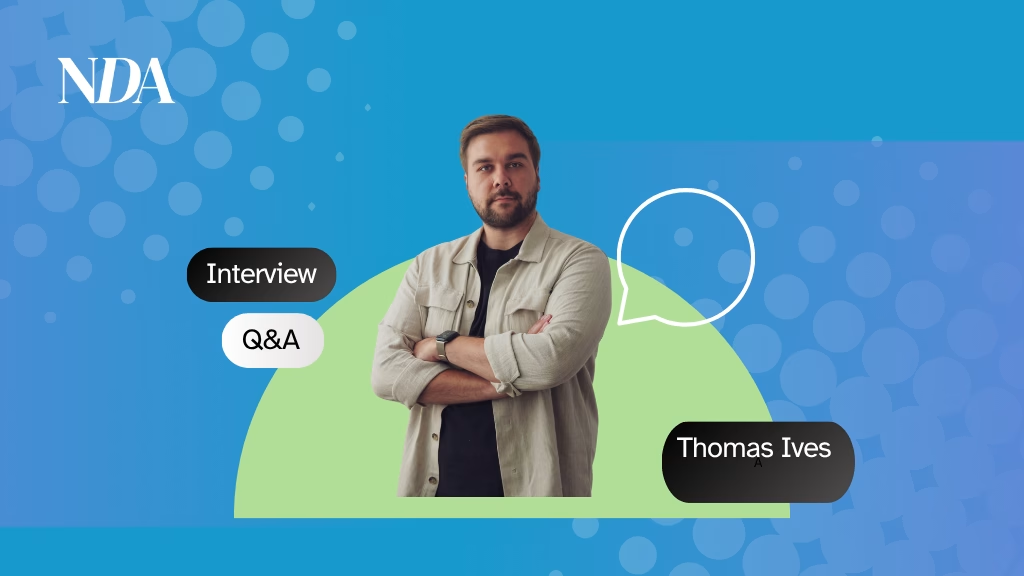
Display advertising has faced a gradual decline in effectiveness over recent years, driven by an industry-wide race to the bottom for cheap inventory and unhelpful optimisation practices. Speaking to NDA at the Programmatic Pioneers Summit, Thomas Ives, Co-Founder and Managing Director at RAAS LAB, was clear and direct about the state of the industry and how to fix it.
We discussed ditching vanity metrics, breaking the cookie addiction and keeping humans at the steering wheel of AI.
Why has display advertising become so broken, and how do we fix it?
Display advertising has slowly become fragmented over the years, largely because of a continuous push for the cheapest possible inventory. This race to the bottom created industry practices that ultimately served neither the ad format nor the consumer. However, people aren’t entirely anti-advertising. Ives pointed to EMARKETER data, which shows that 80% of adults in France, the UK, and the US say well-integrated, non-disruptive ads are important factors in a high-quality media experience.
Addressing this gap requires a shift toward deeper contextual understanding. Through the deployment of Relevance agents, technology can analyse page content alongside ad creative in real time, placing messages within moments that genuinely align with consumer intent.
If relevance is key, what metrics should the industry stop relying on?
For too long, the programmatic industry has relied on click-through rate (CTR) as its default benchmark, despite the metric being widely gamed and failing to reflect genuine value.
Measuring performance requires looking far deeper than a simple click, focusing instead on whether an exposure represented quality engagement in the right mindset.
Adopting more advanced solutions allows advertisers to evaluate true post-exposure behaviour. Brands need to ask what a person really did after seeing an ad: “Did they come to me later? Did they come through to my site, and how long did they spend there?”
By elevating measurement practices, display advertising as a whole becomes significantly more effective.
What is the biggest challenge in convincing advertisers to shift away from legacy targeting?
The biggest hurdle is pure habit.
Since the late 2000s, the digital advertising ecosystem has depended heavily on third-party cookies for audience targeting. While cookies provided rapid scale in their early days, years of regulatory shifts, including GDPR, alongside device-level restrictions, have severely fragmented the landscape. According to Ives, that legacy system has “fallen apart so much that it’s not reliable anymore.”
The AI approach flips this on its head. Instead of chasing a fragmented profile of a user across the web, AI looks for moments. It represents a massive opportunity to hit an audience “in the moment they’ve got the highest level of intent,” effectively negating the need for third-party cookies entirely.
How does this relevance-first approach work in practice across campaign stages?
It’s not just theory. Ives points to RAAS LAB’s ongoing work with B&Q, a partnership that has been running since 2022. They’ve run everything from top-of-funnel brand awareness to bottom-of-funnel conversion campaigns.
RAAS LAB’s Relevance Score is the core of this approach. “What we’ve been able to empirically show is that when you get higher Relevance, we see all of your key performance indicators improve,” Ives says. Whether it’s brand lift, attention, dwell time or raw conversions, getting the context right makes display advertising “actually viable again for advertisers.”
With agentic AI gaining ground, is advertising fully automated now?
Ives identified that the industry is on an “interesting change curve where people know that something’s coming, but they’re nervous about what it is.’
His advice is to remember the human element. “Humans are still the most important thing when it comes to using AI,” he notes. “At the end of the day, it’s just a tool. And without talented people feeding into agents, directing it to where it should go and what it should do, it falls apart.”
The goal isn’t to replace people, but to embrace a level of human adoption where AI simply “enhances them, makes their work better, and gets better outcomes.”