As AI and automated decision-making sweep through media planning, trading, and campaign management, the question arises, when algorithms drive execution, where does the responsibility lie?
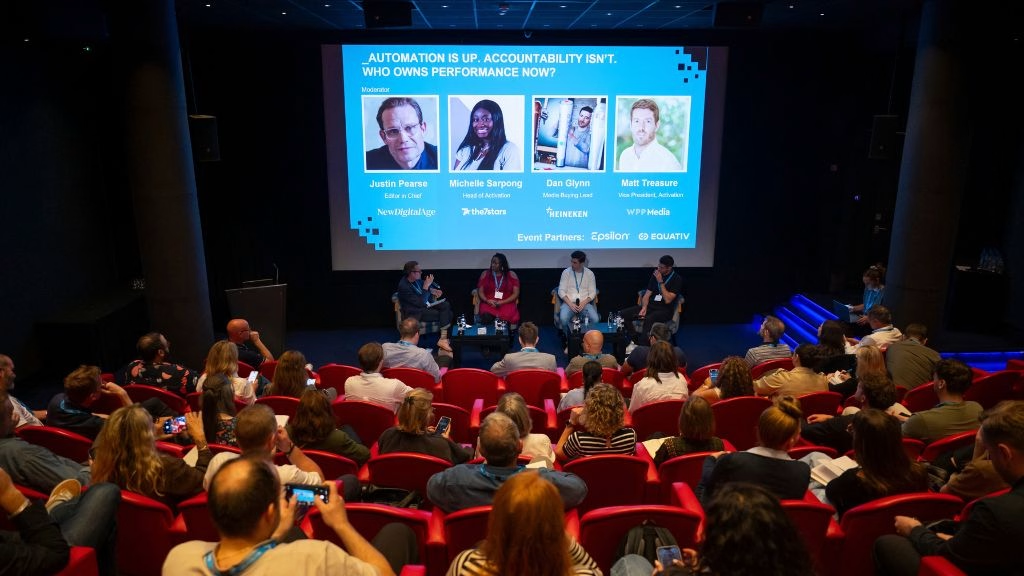
At New Digital Age’s Foresight event, Editor-in-Chief Justin Pearse sat down with industry leaders to explore how accountability, agency-client relationships, and workforce dynamics are evolving in an automated media ecosystem.
When campaigns are executed through machine learning and automated trading, identifying who holds the responsibility for final performance can easily become blurred. However, the consensus among panellists was clear: automation is a tool, not an excuse.
Michelle Sarpong, Head of Activation at The7Stars, argued that regardless of the software involved, agencies must step up and own campaign delivery.
“Accountability lies with the agency. No matter how we use AI in the process, ultimately we are the governors of a campaign and the delivery, so we are ultimately responsible. I can’t turn around and blame the machines, because someone has to operate the platforms, someone has to set the guardrails.”
Sarpong said that setting these parameters is already standard practice in programmatic environments where machine learning optimises toward specific CPA goals or target audiences. Instead of creating chaos, AI’s chief benefit is driving efficiency across increasingly compressed campaign lifecycles.
“It used to be that you had three months to build a Q4 campaign; now you have three hours. AI is there to drive those efficiencies and help us move quicker,” Sarpong added.
Shared responsibility across the board
From a brand perspective, the picture involves shared ownership rather than passing blame down the line. Dan Glynn, Media Buying Lead at The Heineken Company, emphasised that accountability must span the entire ecosystem.
“It is very easy to blame the last line of defence if things go wrong,” Glynn said. “It tends to be with the specialists, the operators, and the executionists. But what we all need to be learning is accountability across the board.
AI can be an assistance model, but it can never necessarily build the ideas, the creativity, and the strategic way of thinking, which is what a human mindset needs to do.”
Glynn highlighted that while automated algorithms excel at rapid micro-optimisations, they lack broad commercial context. He pointed to examples where AI algorithms optimised strictly toward on-platform conversion metrics without considering broader off-trade business outcomes, demonstrating why human oversight is non-negotiable.
“That is where a human touch is needed to make sure that we are putting the right parameters in place,” Glynn explained.
Duty of care and changing roles
As automated tools take on tasks previously handled by humans, agencies and businesses face a shift in how their internal teams operate. Matt Treasure, Vice President of Activation at WPP Media, said that managing AI systems requires a distinct form of responsibility.
“We’ve seen a seismic change in our activation team in the last year to 18 months in our usage of automation tools and AI,” Treasure said. “What we really need to focus on as an organisation and a business is how clear we are about where that accountability lies. Organisations have a duty of care when rolling out these tools.”
Treasure pointed out that automation is shifting junior roles away from manual execution toward managing AI platforms.
“Some of that decisioning is being taken away and put into the hands of AI, so we are accountable for that tool, making sure we are using the right tool, using it in the right way, and optimising toward the right outcome,” Treasure said. “Ultimately, it sits with the humans, with the organisation, with the teams that are running the campaign.”
Rather than replacing entry-level positions, panellists agreed that automation offers an opportunity to upskill junior talent faster and direct focus back toward overarching business strategy.
“There is a lot of talk in the industry about AI getting rid of junior roles, which I think is 100% the wrong way to go,” Sarpong said. “All we want to do is remove some of those mundane tasks that they were doing and get them upskilled and developing a lot quicker. By getting rid of day-to-day manual tasks that don’t add significant value, it gives people the opportunity to think broader and more strategically.”
Treasure supported this view, saying that automated media optimisation frees up capacity for activation teams to align more closely with high-level commercial targets.
“Where we have automated a lot of media optimisation, that is freeing up time for teams to get closer to overarching business objectives, to think on wider strategy pieces, and start refining these processes,” Treasure explained.
However, panellists cautioned against assuming AI can replace human intuition or genuine brand strategy. Sarpong warned of the risk of creating generic, “cookie-cutter” campaigns if agencies rely entirely on automated processes without human intervention.
“We forget that we are all consumers in this room,” Sarpong said. “We can’t always just rely on AI systems or platforms to add that extra bit of magic that comes out in a client brainstorm session. No one can replicate our life experiences, and those insights add great creativity to a campaign.”
The path forward: guardrails, testing, and human oversight
Looking ahead, the panellists identified clear strategies for navigating the automated landscape over the coming year: stronger industry guardrails, realistic expectations around AI capabilities, and continuous investment in workforce development.
Glynn emphasised the necessity of regulatory clarity and sensible frameworks, particularly for regulated sectors like alcohol advertising. He also stressed that adopting AI requires accepting a degree of trial and error.
“Failure is something that we need to accept, and it’s something that we have to learn from as well,” Glynn said. “That’s where the combination of utilising AI alongside human thought is going to be really essential.”
Concluding the panel, Treasure reiterated that maintaining a clear focus on people remains the core requirement for success.
“It’s around people, making sure that we are looking after our people, developing them, and bringing in people with different types of skillsets now,” Treasure said. “The human element is something that we need to ensure remains focus number one.”