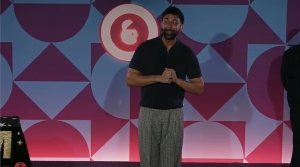
At Advertising Economic Forum in New York, industry leaders gathered at the AI & Adtech Founder Showcase with Shinka to discuss how emerging technology is reshaping out-of-home advertising and digital media infrastructure. The panel, featuring Bob Lord, President of Horizon Media Holdings, and Kieran Greene, CEO of Shinka, explored how independent technology layers can unlock value in sectors long hampered by legacy systems.
Digital out-of-home (DOOH) remains one of the most under-utilised channels in modern media buying, despite its potential for high-impact brand exposure, the panel argued. Bob Lord highlighted the gap between advertiser demand and DOOH execution: “Digital out-of-home I think is totally under-utilised, especially if you’re working with a brand that has local DMA needs.”
Addressing this challenge, Shinka operates as an agnostic auction and mediation layer designed to connect media screen owners directly with programmatic demand. Kieran Greene explained the fundamental mechanics behind their solution: “Shinka is essentially an agnostic auction and mediation layer. We work in the CTV and digital out-of-home industry.
The request comes into Shinka through one integration, then they’ll have their respective commercial relationships with the SSP and DSP, we push that signal out, the bid comes back in ultimately, and then we’ll run that completely independent auction.”
Overcoming legacy technology with contextual signal enrichment
A core obstacle facing the DOOH market is its reliance on outdated infrastructure that struggles to interface smoothly with modern programmatic buying engines, said Greene. He said that digital screens often suffer from “legacy technology, old technology from the 60s.
To solve this, Shinka focuses on enriching real-time contextual signals so buyers can make informed decisions. “We’ll work closely with the media screen owner to understand what is happening at that moment in time, and then translate those signals into programmatic-capable ones,” said Greene.
When Lord pushed for specific examples, Greene explained that Shinka fills in data gaps in real time. For instance, if an incoming signal contains geographic coordinates but lacks a postcode, Shinka enriches the bid request with that missing location data so advertisers targeting specific post codes can bid. The platform can also pass along context such as what ad or content played immediately beforehand to avoid competitive clashes or to help align with adjacent messaging.
As Greene put it, the goal is to provide “whatever we can factually enrich or make available” to give buyers confidence in what they are buying. Lord acknowledged the value of this approach, saying that providing increased transparency and clearer signal data represents the core value proposition for buyers navigating the complex DOOH ecosystem.
Laying foundations for the agentic future
As the advertising landscape moves towards automated, agentic buying models, laying the proper technical foundations in traditional channels becomes essential. Looking ahead to Shinka’s roadmap, Greene explained that their focus remains on guiding DOOH operators through this transition.
“We’re continuing to expand and work with our digital out-of-home customers on that transition into programmatic, preparing and laying the foundations for them to be able to step into agentic,” Greene said. “Ultimately, when the seller and buyer agents come to an agreement, you still need an outcome and substantive technology to deliver on that.”
While some players in the market are technically advanced and eager to test such new frameworks, Greene said that others are still in the early days. By providing a flexible, independent ad-serving and auction architecture, Shinka aims to support screen owners at every stage of their programmatic evolution.