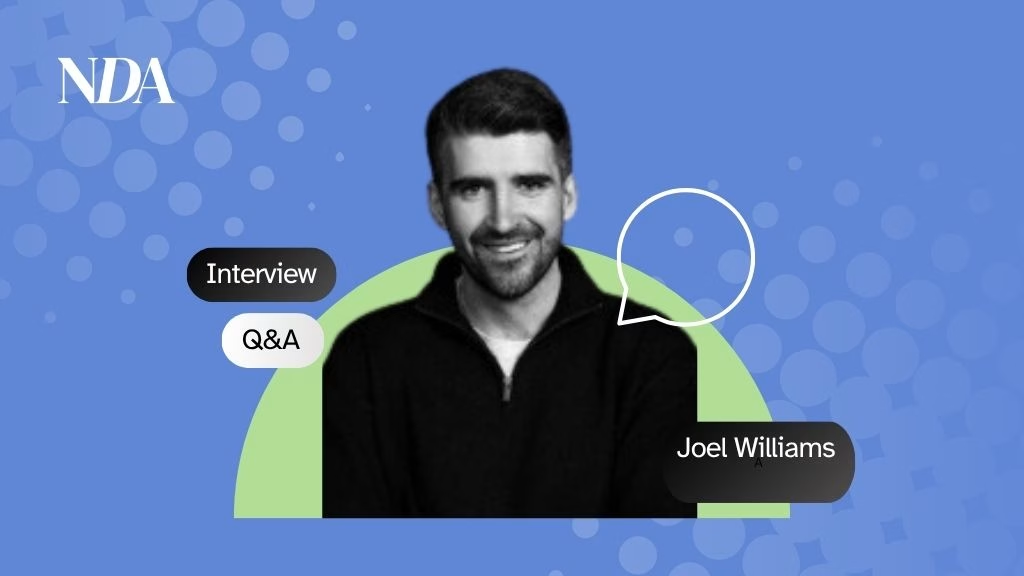
Joel Williams is building a business designed to shift digital advertising away from proxy metrics and towards measurable commercial outcomes. We sat down with him to find out how the model was faring.
How did Transact Media Group come about?
We started building the technology about 18 months ago, really focused on outcome-based marketing and using transactional data to improve it. Early on, we were running campaigns where we would buy media on a CPC or CPM and get paid on a cost per sale.
Sometimes that worked very well, sometimes it did not, but it gave us a huge amount of data. That has allowed us to build benchmarks and really understand what good looks like.
We originally had two businesses, Fair Forecast on the outcome side and Creator Data on the data side, and we merged them into one, which is now Transact Media Group, combining data, measurement and outcomes into a single proposition.
What does the business look like today?
We now have around 500 daily active campaigns across 27 markets on the data and measurement side, across the UK, Europe, North America, APAC, LATAM and the Middle East.
We have built integrations across most of the major platforms, so we can plug our data into programmatic, ecommerce and social environments. We also work in partnership with Mastercard, using transactional signals as a core currency, which allows us to map whether someone exposed to media actually went on to make a purchase.
On the outcomes side, we have about 1,800 brands globally that have agreed to work with us on a performance basis, although we are not active with all of them at once because it is a relatively high risk model.
How do you define outcomes?
For us, an outcome is a sale, a lead or an install. It is a real business metric, not a click or a view. That is a really important distinction.
We are buying media on things like clicks or impressions, but getting paid on outcomes, and to make that work we have built our own attribution models and typically work within a 72-hour window to capture conversions. We also make sure we are integrated properly with things like Google Analytics or existing tracking setups.
Are brands and agencies ready for that shift?
A lot of them want to move in that direction, but they do not always have the infrastructure.
For example, some agencies cannot easily place pixels on sites, so we have built tools that make that easier, or allow us to work off existing UTMs and analytics setups. That is where we add a lot of value.
How are you applying this model across channels?
We are doing it across programmatic display, connected TV, YouTube and audio. The big shift is that you can now buy channels like connected TV on a CPA or return on ad spend model, rather than just paying for impressions or views, which is quite appealing to brands because it ties spend directly to outcomes.
Our goal is to move the industry away from what I would call fluffy metrics and towards something much more commercially grounded.
What are you seeing in terms of market trends?
The market is starting to move towards what we have been talking about for the last 12 months. Our most recent quarter was our biggest and most profitable, even though it has been a tricky period more broadly.
There is definitely more demand from advertisers to understand the real effectiveness of their media, but many do not yet have the tools or processes to do that properly, which creates an opportunity for us.
How are you approaching talent?
We have been quite lucky. We have focused on hiring people who are doers, self starters who want to build something rather than just stay in a defined role.
We have around 20 people in London and about 40 overall including partnerships, and the leadership team comes from places like Omnicom, CNBC, TikTok and Comcast.
Culturally, we have built the business so that people can earn more if they perform, with commission structures built into a lot of roles, which creates a sense of ownership and empowerment across the company.
What are your priorities for the next 12 months?
In the short term, it is about refining our data and measurement processes and continuing to build out the outcomes side of the business. We are also planning to raise investment over the next year to help us scale globally and develop the product further.
The long term goal is to change how media is bought and traded. As more advertisers push for real accountability, I think outcome based models will become the standard, the key is having the infrastructure in place to make that work at scale.