Artificial intelligence is not another shiny object for advertising to briefly obsess over and then discard. It represents a tectonic shift that will fundamentally reshape how the industry operates, how value is created, and who ultimately wins and loses.
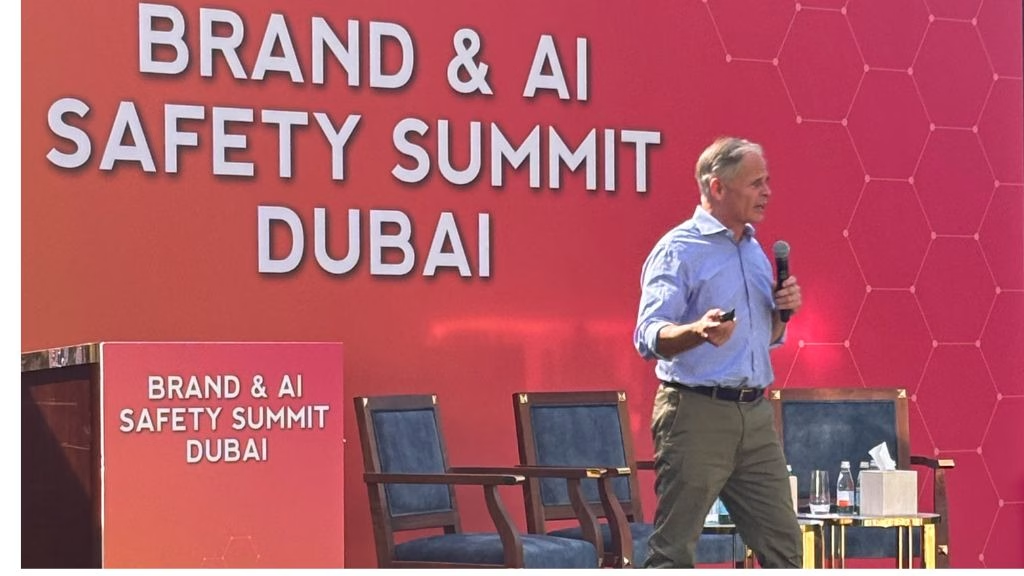
This is according to LUMA Partners founder and CEO Terry Kawaja, delivering the closing talk at Brand Safety Summit Dubai. His message was clear. AI is not another overhyped trend destined for disappointment. It represents a tectonic disruption that will fundamentally reshape how advertising works, how value is created, and which parts of the ecosystem survive.
Unlike past trends that promised much and delivered little, according to Kawaja, AI is different. “This is not 5G, this is not VR, this is not Web3,” he said. “This is something that actually fits advertising, structurally, economically, and culturally.”
Advertising, he explained, is built on massive spend, vast data pools, and binary outcomes. You either convert a customer or you do not, and AI thrives in that environment.
Understanding the hierarchy of AI’s impact
Kawaja laid out a framework to explain where AI will matter most, describing a hierarchy of applications similar to Maslow’s hierarchy of needs. At the base is what he called the operational core of advertising, including workflow, audience data, measurement, media buying, optimisation, and reporting.
According to Kawaja, these processes remain highly manual and serial, but AI will bring them together in real time, creating significant efficiency gains and inevitably reducing the need for human involvement.
The next layer, content, creative, and communications, offers both tactical and strategic opportunities. Kawaja explained, “Above the waterline, AI reduces costs in production, that is efficiency. Below the waterline is where the real value lies, using data to determine which creative actually drives conversion. That is effectiveness, and that is strategic.”
For Kawaja, the most impactful applications of AI in advertising are those that use data to improve performance rather than simply cut costs.
Rethinking advertising logic
Kawaja challenged the conventional logic that has dominated advertising for decades. “For 25 years, we have been finding consumers wherever they are, interrupting them, and forcing them to navigate to a website,” he said, “That makes no sense.”
According to Kawaja, the future will be about taking messages directly to users, wherever they are, and interacting with them in ways that are personal and non-disruptive.
He highlighted social commerce as an early example, noting that when someone buys through an Instagram shopping ad, “The transaction is short and seamless, and when it is complete, the user is still on Instagram. Nothing has been disrupted.”
Kawaja also joked that in the future, he hopes AI agents will have to prove they are not human, rather than users constantly proving they are human.
From blue links to the answers economy
The most transformative change, according to Kawaja, will be in internet navigation itself. He explained that we are moving from search’s blue links to an answers economy, powered by new interfaces, rapid consumer adoption, and massive technological innovation.
The hundreds of billions being invested in large language models will not be recouped through subscriptions alone. “All roads lead to advertising,” he said, saying that AI platforms are already exploring ad solutions.
Intent, Kawaja argued, is the true currency of advertising. He illustrated this with an example: “A Google search for a Beirut divorce lawyer tells you three things, location, life event, and immediate need. That is intent. AI interactions generate even stronger signals, with detailed prompts refined over multiple exchanges. The intent density is higher than traditional search, and that changes everything.”
Outcomes over impressions
A recurring theme in Kawaja’s talk was the shift from proxy metrics to actual outcomes. He emphasised that AI will enable probabilistic measurement to become predictive, linking advertising spend directly to revenue.
According to Kawaja, this could collapse the purchase funnel, with media companies moving down toward commerce, and commerce companies moving up toward media. He cited Amazon as an example of a company that understood the value of full-funnel control, generating extraordinary shareholder value in the process.
“When advertising can be tied directly to revenue, it stops being discretionary and becomes cost of goods sold,” he said. “That fundamentally changes how CMOs and CFOs view marketing investment.”
A reckoning for ad tech
Kawaja warned that AI will also force a long-overdue reckoning across ad tech. According to him, the current landscape has survived on opacity, revenue shares, and inefficiency.
“AI favors the opposite,” he said, “fewer players, greater scale, lower take rates, and higher quality.” He described this rationalisation as inevitable and necessary for the health of the ecosystem.
Kawaja also offered a candid scorecard of winners and losers. Consumers will benefit from powerful, largely free tools, advertisers will gain unprecedented insight and targeting capabilities, and agencies and adtech firms will only succeed if they move quickly. Large, premium publishers may remain steady, but long-tail and news publishers face significant risk, with consequences for journalism and democracy.
The bottom line
AI, Kawaja concluded, is not incremental. Every major leap in advertising has been built on native formats and native infrastructure, from search to social to short-form video.
Legacy assumptions no longer apply, and trust, brand safety, and suitability are more important than ever. Easy, effective solutions will dominate, and the pace of change is accelerating.
According to Kawaja, the biggest risk for businesses today is not moving too fast, it is standing still. For anyone in advertising, his message is simple: adapt, or be left behind.