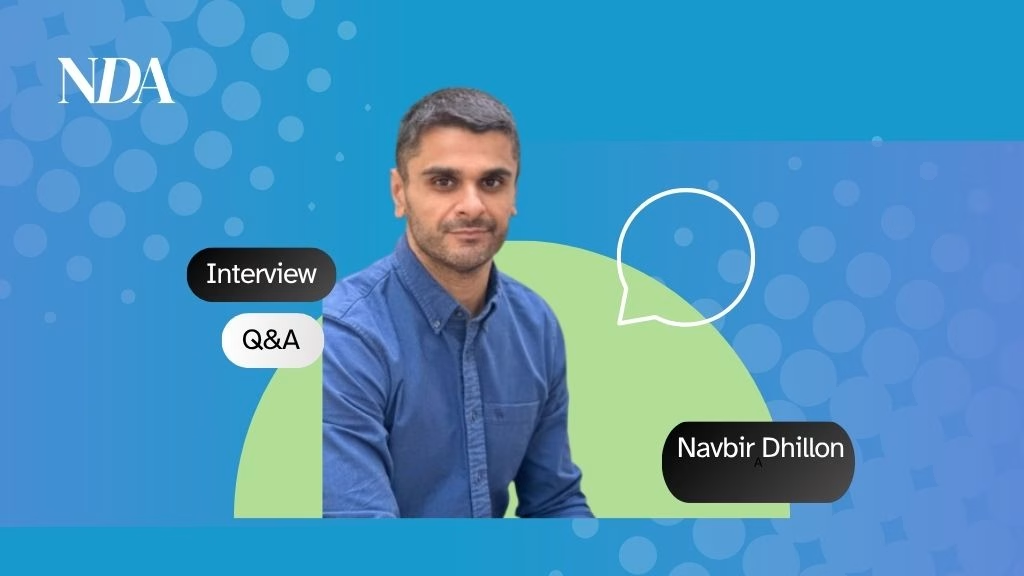
Navbir Dhillon is Head of Advertising at Gumtree, where he oversees revenue across display, partnerships and emerging retail media. He sits at the intersection of classifieds, commerce and media, offering a distinctive view of a changing digital landscape.
What does your role at Gumtree involve today?
My role covers all advertising revenue streams at Gumtree, from traditional banner display through to partnerships and increasingly retail media. While Gumtree is known as a classifieds platform, around 65% of our revenue still comes from advertising, so it remains a core pillar of the business.
At the same time, we are diversifying, with initiatives like pay and ship to generate more transactional revenue. That puts us in an interesting position, we are not a traditional publisher, but we are still competing for the same media budgets.
What are you seeing in the market right now?
There is definitely a shift towards simplification. Over the past few years, digital advertising has become very complex, with consent frameworks, declining programmatic yields, and the rise of social video all adding layers of difficulty.
For publishers like us that historically relied on banner advertising, programmatic revenues have dropped significantly. At the same time, the growth of app usage is changing things, around 60% of our audience is now on app, but monetisation there is much lower than on web.
The industry has been overly focused on tracking and attribution, which has driven some poor practices. Now, with tracking becoming harder, advertisers are starting to question the effectiveness of those approaches.
Does that mean a move away from programmatic?
Not entirely, but there is a clear shift towards more direct relationships and fewer intermediaries. There is more appetite for partnerships and closer collaboration with brands, rather than relying heavily on open marketplace programmatic.
As advertisers focus more on return on investment in a less trackable environment, they are rethinking how they allocate budgets and what channels genuinely deliver impact.
How does retail media fit into your strategy?
Retail media is a natural fit for us because users on Gumtree are already in market to buy. We are evolving from traditional banner ads towards more contextual, retail style placements within the user journey.
For example, if someone searches for a product like a toaster, we can show relevant ads from retailers directly within that experience. This is driven by user intent rather than cookies, which makes it both privacy compliant and highly relevant. It also opens up new revenue streams, whether through direct relationships with retailers or via retail media networks.
Is retail media delivering incremental growth?
It is growing, but it is also offsetting some of the decline in programmatic. Retail media is attractive because it offers clearer measurement, advertisers can directly link spend to sales outcomes.
That makes it appealing in a world where attribution is becoming more difficult. However, it is not yet scaling fast enough to fully replace the revenues being lost elsewhere, so it is part of a broader mix rather than a silver bullet.
How important is video to Gumtree’s advertising strategy?
Video is not a natural fit within our core classified environment, so we are not forcing it into the user experience. Instead, we are exploring ways to make our data available in a compliant way so it can be activated in video environments elsewhere.
That includes audience extension approaches, where in-market segments can be used across platforms like streaming services. It is about ensuring relevance without disrupting the core Gumtree experience.
What is the state of creativity in advertising right now?
Creativity and execution are still evolving. With so much movement in budgets from linear TV to digital and retail environments, many brands and agencies are still adapting their planning structures.
Creative output is at not at its peak yet, partly because the ecosystem is still quite fragmented. Agencies are also under pressure, with restructures and cost cutting, which affects how creativity is prioritised. At the same time, AI is changing how people discover information, which raises questions about whether creative formats are keeping up with consumer behaviour.
How are agencies changing in your experience?
We are spending more time with agencies than before, and there is a stronger focus on innovation and new ideas. The traditional model of trading relationships dominating media plans is less prevalent now.
Today, if a partner has a strong USP, there is a clearer path onto a plan. Transparency has improved, but budgets are tighter, so agencies are being asked to do more with less. Indie agencies in particular are growing, often because they are more flexible and less constrained by legacy structures.
How optimistic are you about the outlook for advertising?
I am quite optimistic. There is a growing recognition that consumer experience has been neglected in pursuit of performance metrics like viewability and CTR.
Many publisher environments have become cluttered as a result. That is not sustainable. The next phase feels more focused on quality, relevance and brand experience, rather than purely scale and tracking. Brands are becoming more strategic about where and how they invest, which I think will ultimately lead to a healthier ecosystem.