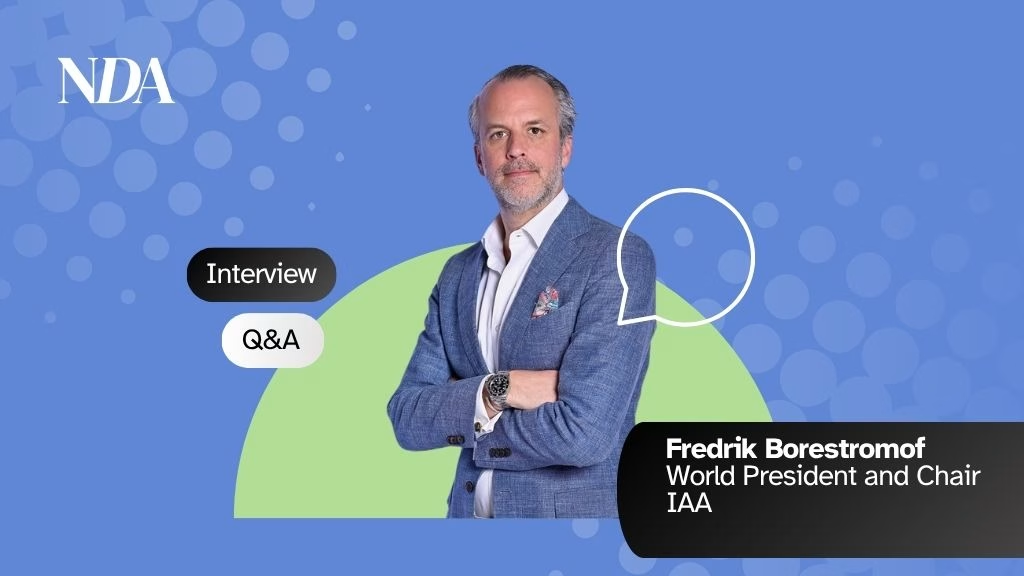
Congratulations on your appointment as IAA World President and Chair. What’s your mission for the trade body?
The International Advertising Association has been around for 87 years and is truly global, with a presence in 56 countries. What sets us apart is that we bring together agencies, brands, media owners and academia under one roof.
Our mission is to be the global compass guiding the marketing and communications industry forward. That means championing responsible, ethical and sustainable marketing that drives good growth, not only for businesses and brands but also for the planet.
We aim to provide a global platform for dialogue, education, networking and advocacy, one that bridges markets and disciplines and ensures inclusivity, diversity and integrity are at the heart of everything we do.
In preparing for this role, I spoke one-to-one with nearly all of our global chapters, from Australia to Brazil, from Mongolia to Spain, to understand what’s working, what’s not, and how we can move forward inclusively. It’s an incredibly diverse organisation and one that gives us a unique opportunity to unite voices across the world.
What themes came through from those global conversations?
The range of issues is vast. Every market has its own challenges, but common threads include sustainability, disinformation and of course AI. We don’t take political positions, but we do want to create a forum where everyone can come together to discuss how we use technology responsibly and sustainably.
Our role is to encourage collaboration and provide a neutral space for different parts of the industry to engage. Because we operate globally, we can help spread ideas and best practices across markets, whether it’s from Singapore to Ghana or from the UK to Brazil.
And how do publishers fit into the IAA’s world?
Publishers are absolutely central. In many markets, such as the UK, the IAA has been driven by media owners, while in others, like Austria, it’s more brand or agency led. But publishers form one of our three core pillars alongside agencies and brands.
They play a critical role in maintaining quality journalism and commercial free speech. Without that, we would only hear what governments want us to hear. A thriving advertising ecosystem supports diverse voices and strong, independent media.
What’s the single biggest issue facing the global advertising industry today?
It’s impossible to name just one. Education and professional development are hugely important. We need to help bring the next generation of marketers into the industry and support them through training and certification programmes, which we run with academic institutions globally.
But beyond that, it’s about driving responsible, sustainable and diverse growth. Diversity of thought and representation is crucial, and that must be built into every chapter of the IAA around the world.
Let’s talk about B2B influencers. What exactly is a B2B influencer and how do they differ from consumer influencers?
They’re similar in some ways but fundamentally different. In consumer marketing, brands often work with influencers to borrow the halo of celebrity and fame. In B2B, the value comes from credibility and authenticity, not celebrity.
We recently published a study called The Business of Influence, which found that 87% of B2B buyers regularly engage with content from credible B2B influencers. These influencers don’t need millions of followers, they just need the right audience.
The key traits are subject-matter expertise, trustworthiness, authenticity and strong engagement with their community. They could be senior leaders, but often they’re mid-level experts or engineers who are deeply respected within their field. Sometimes they’re even more credible than the CEO, who might be seen as having an agenda.
How does remuneration work in B2B influencer marketing?
It’s still evolving, but it will likely follow similar models to consumer marketing as the space matures. Agencies are increasingly investing in B2B creators because they recognise the growth potential.
That said, authenticity is key. In B2B, you’re putting your brand in the hands of someone who represents expertise and trust. If that person missteps, it could have a bigger impact than in B2C. So brands must choose partners whose values and mission align with their own.
A great example is Colin Rocker, a LinkedIn creator who talks about career development. He worked with a pension provider because the subject was personally relevant to him, he wanted to secure his family’s future. His content resonated because it came from a place of genuine experience and credibility. That’s the kind of alignment B2B brands should look for.
How important is transparency for B2B creators?
It’s absolutely essential, probably even more so than in B2C. Every paid post should be clearly labelled. On LinkedIn, for example, we have a format called Thought Leader Ads, which are always marked as “Promoted by…” so users know it’s a paid partnership.
Transparency builds trust, and trust is everything in B2B.
When buying business products, people fear messing up more than missing out. They want to be able to justify their choices. That same logic applies to the creators they follow and the content they consume.