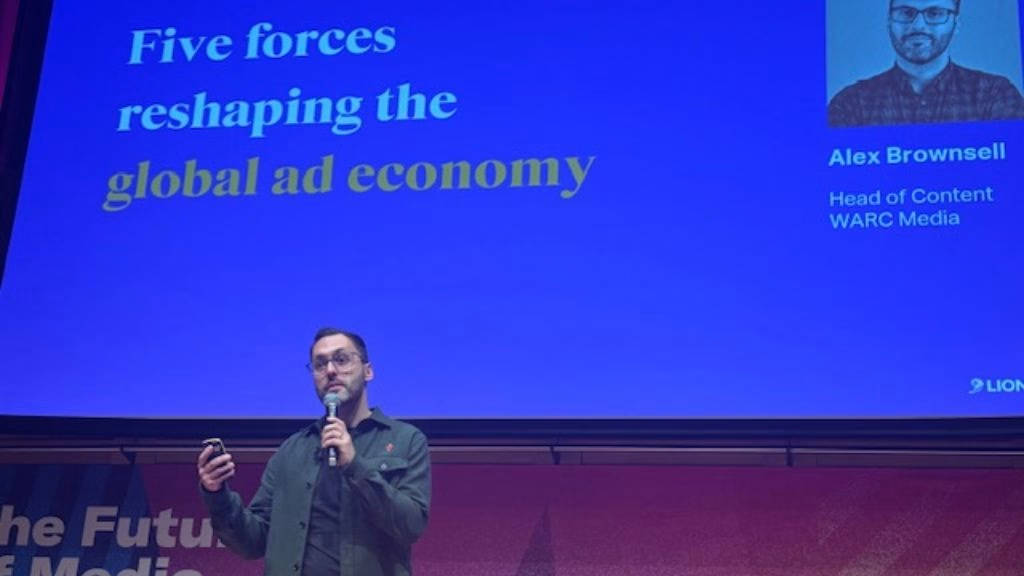
The global advertising market has changed dramatically in just a few short years, reshaping the landscape for media owners, brands, and agencies alike. According to Alex Brownsell, Head of Content at WARC Media, this rapid transformation has not simply been a pandemic blip, it represents a fundamental break with the past. Speaking at The Future of Media event, Brownsell outlined how global ad spend has entered a new era of sustained growth, driven by new players, new money, and changing patterns of consumption.
Breaking with the past
Brownsell began by taking the audience back to the pandemic, a time when almost everything about daily life changed, from how we worked to how we shopped. While many of those behavioural changes have since snapped back to pre-2020 levels, advertising has not.
WARC’s data shows that, since COVID, global ad spend has continued to outpace GDP growth by several percentage points. In the UK, digital channels have driven this divergence, with online advertising growing steadily while traditional media has plateaued.
The result is an industry that is now bigger, faster-moving, and more digitally dominant than ever before.
“In just seven years, the global ad market will have doubled in size to $1.36 trillion by 2027,” Brownsell noted, highlighting that this “sugar rush” of growth does not necessarily translate into prosperity for everyone in the industry. “For many people, it doesn’t feel like a boom time. The money is there, but it’s increasingly concentrated.”
Consumption changes, but habits remain
Despite the endless talk of fragmentation, Brownsell argued that consumer behaviour has not changed as radically as many assume. Using IPA TouchPoints data, he explained that people still spend their time watching, listening, reading, and gaming, just via different platforms and devices.
“The fundamental behaviours haven’t shifted,” he said. “People are doing the same things, but with different media owners.”
What has changed, however, is where the ad money goes. Since 2020, spending has flowed disproportionately toward performance-driven channels, particularly search, social, and retail media—creating an entirely new dynamic between advertisers and media sellers.
New money, new players
One of the defining shifts in recent years has been the influx of “new money” into measurable media. Small and medium-sized businesses, which once spent on local press or door drops, now advertise through digital platforms.
Meanwhile, trade marketing budgets from major consumer goods companies have moved from opaque retail agreements into transparent, performance-based channels.
At a category level, clothing and accessories exemplify this shift. In 2015, global ad spend in the sector stood at $11 billion. Today, it exceeds $58 billion, an increase of nearly $50 billion in under a decade. Yet around 80% of that spend goes to retail media, paid search, and social platforms, with only 20% left for the rest of the media ecosystem.
“This is new money, but it’s flowing to the bottom of the funnel,” Brownsell said. “It’s not being spent in the old ways.”
Retail media’s rapid ascent
Retail media is perhaps the clearest example of this new era. WARC estimates that Walmart’s ad business is now worth over $4 billion a year, double Spotify’s ad revenue and closing in on JCDecaux. Uber’s ad division is nearing $2 billion, and globally, retail media could represent nearly 20% of total ad spend within just a few years.
“These platforms have combined first-party sales data with ad products to create something incredibly powerful,” Brownsell explained. “They’ve effectively built a new ecosystem within advertising.”
Meta’s comeback and the rise of the giants
If one company embodies the new ad economy, it is Meta. Once struggling after Apple’s privacy changes and its misjudged pivot to the metaverse, Meta has reinvented itself around video, AI, and new probabilistic measurement models.
“Reels is now a $50 billion ad product, double the size of TikTok globally,” said Brownsell. “AI now accounts for around $60 billion of Meta’s annual revenues.”
After a tough 2022, Meta’s ad revenue has surged, and WARC forecasts that by 2026 it will be double what it was in 2021. “By the end of the decade, Meta will probably earn one in every five pounds or dollars spent on advertising,” he added.
Together with Alphabet and Amazon, the “big three” now dominate the market. WARC predicts that by 2027, these companies will capture around 60% of all global ad spend outside China.
Effectiveness and attention in a changing market
As more budget flows toward social and user-generated content (UGC), Brownsell warned of new challenges in effectiveness and predictability. Around half of all advertising adjacent to content now sits next to UGC, and by next year it will likely account for the majority.
“There are good reasons for brands to invest in creators and social platforms,” he acknowledged. “But it comes with volatility. The gap between the best and worst influencer ROI is wider than almost any other channel.”
Studies show that advertising in premium environments delivers a 1.5 times performance boost compared to lower-quality contexts. “Media quality matters,” Brownsell emphasised. “Not all social or UGC spaces are premium environments, and that variability carries risk.”
The need for smarter media planning
Brownsell concluded with a call for brands to refocus on rigorous, brand-specific media planning. As spend becomes more concentrated and performance-focused, effectiveness risks becoming harder to maintain.
“The ad market is fundamentally changing,” he said. “That means effectiveness challenges, but also opportunities. Media planning matters more than ever to help brands navigate this complexity.”
In a trillion-dollar industry increasingly defined by a handful of platforms, Brownsell’s message was clear: success in the future of media will depend not on chasing every new channel, but on smarter, more deliberate choices about where and how to invest.