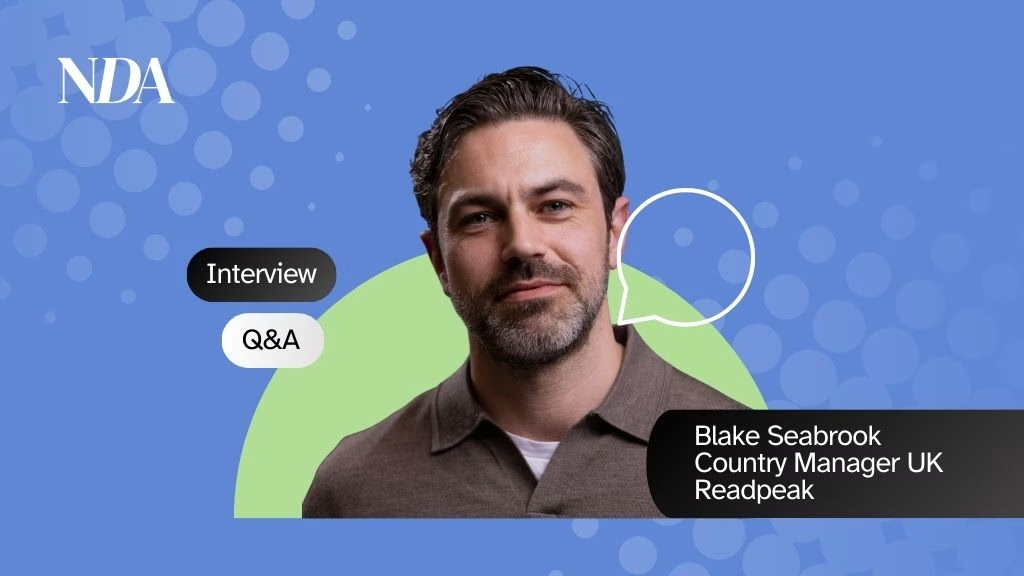
Justin Pearse, Editor-in-Chief, New Digital Age, sits down with Blake Seabrook. Country Manager UK, Readpeak to talk about the future of native advertising.
Tell us about Readpeak’s journey and your role in the UK.
Readpeak is now in its eleventh year, but we’ve only been in the UK for just under two. I joined in early 2023, during what has been a real scale-up phase for the business. We’re a Finnish company, born in the region under our founder and CEO, Tomas Forsbäck, who came from a publishing and print background.
Like many of us who worked in advertorials and content, he saw an opportunity to bring that experience into the digital space, to make digital advertising more premium, transparent, and rooted in storytelling again.
You said the native advertising landscape isn’t in great shape. What do you mean by that?
If you look at some providers in the native space, their formats sit at the bottom of publisher pages surrounded by poor-quality, affiliate-led content. It’s cluttered and not premium. We do things differently.
Rather than using generic widgets, we buy display inventory and transform those placements into native ad units. Our formats are bespoke to each publisher, tailored with the right fonts, colour codes, and design elements.
It’s what native advertising was always supposed to be, content that feels part of the environment rather than something bolted on.
How does your Nordic heritage influence the company’s values and approach?
It’s absolutely core to who we are. If you know the Nordic approach, you’ll know how clean and straightforward everything is. There’s a lack of pretence, people say what they mean. That transparency runs through our DNA.
It’s why we focus so much on premium publisher relationships. Without publishers, we don’t exist, so we make sure they’re paid fairly and treated as partners, not just suppliers. That honesty and mutual respect define everything we do.
What kind of clients and agencies are you working with in the UK and globally?
Globally, we operate across around 10 or 11 countries, mainly in EMEA, and we’re looking to expand into four more early next year, then the US after that. In the UK, we’ll work with anyone who shares our philosophy, but a big part of our effort right now is education.
We’ve been doing great work with WPP, which has been really encouraging. Getting through the door with large holding groups isn’t easy, particularly as many are consolidating partners, but once they see our results and our transparency, the response has been very positive.
You mentioned that clients pay based on outcomes rather than impressions. How does that work?
Exactly, with us, you bid and pay either per click for static and content formats, or per completed view for video. It’s a model that shifts the focus to real engagement, not just served impressions.
It’s about performance, not volume. We’re not chasing cheap clicks, we’re chasing quality engagement, because that’s what benefits our clients and our publishers. And it’s aligned with our values around transparency and fairness in the supply chain.
What interesting campaigns have you run recently?
We worked with Lucid to run brand lift studies on campaigns for Audible, and soon for Amazon. We tested our AI tool, which helps brands quickly generate ad variations by scraping and repurposing their own landing-page content.
What we found was fascinating, by using lifestyle imagery and contextually relevant creative, we doubled CTRs compared with traditional display-style creatives.
Even more importantly, the brand lift results were exceptional, with a 12% increase in ad recall, 17% in brand favourability, 11.5% in awareness, 7% in consideration, and 8% in attribution.
Those numbers show that native, when done right, genuinely builds brand affinity.
How do you work with publishers, and how do you maintain a premium environment?
We’re very deliberate in how we build our network. We’re not a mass network, we currently work with about 116 publishers in the UK, and we’ll probably never go beyond 200. You can’t claim to be premium if you’re working with every site under the sun.
What’s more, buyers can hand-select the specific publishers they want to appear on within our platform. They get full transparency, they can see exactly where traffic is coming from and how each placement performs.
Publishers like it because it improves the user experience and keeps quality high. We only work with premium brands and agencies, not affiliate advertisers, and that’s not going to change.
The industry often talks about supporting premium publishers but continues to pour spend into the major platforms. How do you see that tension?
It’s the biggest challenge we face. CMOs know the value of premium environments, but budgets still end up flowing to social and video platforms because they “just work”. But there’s a growing appetite to diversify spend again, especially as brands get more concerned about the quality of their media environments.
We’re trying to show that by doing things the right way, being transparent, delivering performance, and supporting publishers, we can make premium work at scale. Because if we don’t, and if publishers can’t sustain themselves, it’ll be a dark day for quality journalism and quality advertising alike.
Finally, what’s next for Readpeak in the UK?
For us, it’s about growth, but sustainable growth. We’re scaling, but not at the expense of quality.
We’ll continue to champion premium publishers, deliver performance for brands, and prove that native, when done right, still has huge power to engage audiences. We’re not trying to be everything to everyone, but we do want to be the best at what we do.