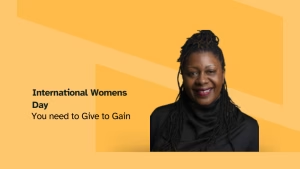
By Angelique Whittaker, UK Head of Sales at Azerion UK
More than one hundred years after International Women’s Day (IWD) started to take shape, it feels more important than ever to mark the occasion. However, it is vital that it cuts far deeper than a marketing tool and is used as a driver for lasting change.
IWD serves as a powerful reminder of why it is critical to celebrate women’s achievements. But while we’ve made significant progress in the 50 years since the United Nations (UN) adopted the event in 1975, there is still work to be done.
Despite the media and advertising industry being relatively progressive when it comes to gender representation, senior leadership remains predominantly male. First and foremost, greater equality is ethically the ‘right’ thing to do – but it is also a major factor in driving strong business performance. Increasing the number of women in senior positions fosters a more level playing field as well as enhancing education around workplace standards and behaviours. After all, how can we challenge norms and define what is and isn’t acceptable without diverse perspectives at the table?
With that in mind, the following practical initiatives should be standard practice for all organisations:
- Female representation: This is a basic first step, but the industry must up the number of women its employs. We need to see more females in leadership teams and around the boardroom table; as well as ensuring there is equal representation, this promotes diverse thinking and ideas – and with that innovation and growth.
- Equal pay: Another, back-to-basics, essential – women and men doing the same job need to be paid the same. End of.
- Leadership development: Mentoring and coaching can help counter imposter syndrome and self-doubt by building confidence. These skills are important across the board but are especially pivotal for women working in male dominated teams and situations.
- Mentorship: Guidance, from both internal and external sources, enriches working environments, encourages learning and underpins career progression. Leading on from the previous point, it also provides support and solutions for females intimidated by being in the minority and helps to ensure their voices are heard.
- Safe working environments: Current policies against workplace bullying and harassment should be reviewed to ensure they are robust and effective – and updated if necessary. Along with creating safe spaces for women to work, female employees need to feel they can report any kind of behaviour that makes them uncomfortable, knowing that their complaint will be handled properly, and they will be provided with the support they need.
- Flexible working: That women are more likely than men to give up their careers to take care of children is no secret. Huge childcare costs and lack of flexible working are big culprits and organisations serious about equality need to make sure they offer work arrangements that accurately reflect the needs of today’s workforce.
- Return to work policies: In tandem with flexible working, return to work policies need to support mothers returning from maternity leave. Recognising that this transition can be tough, employers need to connect with each individual to understand what they need, while also showing them what is available – such as a staggered return, added support from internal stakeholders, and additional training and upskilling programmes.
- Education: More females in leadership roles encourages a more diverse workflow – and with that conversations and discussions that are representative of the world at large. Ingraining this ‘education’ in the day-to-day operations of an organisation helps to create a more inclusive workplace.
There are many enterprises out there that deliver fully on every level and more. But the reality is that there are also those that don’t.
However, a lack of commitment to gender equality is a short-sighted strategy. DEI policies may currently be in a state of flux, but a lack of diversity risks reputational risk. Not getting it right is likely to drive away customers, thereby negatively impacting the bottom line. Just as important, it also makes it more difficult to attract and retain much of the great talent in this industry.
Women need to see concrete evidence that companies are well set up for female leadership; not only does this demonstrate diverse thinking and equality, it shows that they too can achieve senior and influential roles.
IWD must be far more than an annual marketing bandwagon used to flag metrics such as the number of female employees. To be true to its history and heritage, it has to be ingrained in company culture and put into action – every single day.