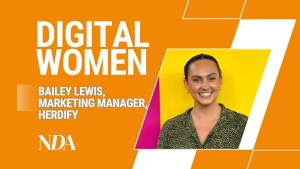
At the NDA Digital Women International Women’s Day lunch, Katie Ingram, Director of Advertising Week Europe, delivered an emotional and thought-provoking keynote on the often-overlooked topic of baby loss. Reflecting on her 25-year career in media and her personal journey through fertility struggles and loss, she urged the industry to break the silence and create spaces for open conversation.
The speech was so powerful and generated such a visceral reaction in the room that we wanted to give all our readers the chance to hear it. So below is her speech in full:
Before I start I am going to flag that there will be some difficult subjects covered today, my story can be tricky to hear and may be triggering for some. Unfortunately the statistics suggest that more than half of you will have some experience in the issues I am going to cover, and it is often incredibly painful.
Over the next 15 minutes or so I am going to cover infertility, miscarriage and still birth.
My hope is that by covering these topics in a forum like this I am able to help some people who feel alone in their own experience realise they are not, help some of you find the language to support friends, family and colleagues and open up a wider conversation about this still very quiet topic.
However I do appreciate that it might be a tough listen for some so please know that if it is too much then I do understand if you need to take a second away from the room.
This is my 25th year in media and if I could look back and tell my 22 year old self what was around the corner I wonder I sometimes if I would even begin to believe it.
There have been some high highs and some extreme lows. Professionally I have made some big twists and turns, found confidence in my abilities, been ambitious, taken control, spoken up and often been told that I have “masculine energy” – whatever that means.
I have also made some pretty big mistakes, some that still give me heart palpitations when I think back to them – you can ask me about those later.
Personally there have also been some highs but also frustration, failure, desperation, trauma and some truly dark days.
The two together make up my experience and yet they sometimes seem so distant from each other.
Thinking back to that 22 year old, sat a desk in Victoria in the summer of 2000 – in many ways pre-dating the sense of a Digital Woman, I remember an afternoon of trying to outsmart Ask Jeeves and ordering in to the office from a delivery business that promised to bring you anything you needed in under an hour. I think we broke the business model as our requests got so ridiculous while we tested the boundaries of possibility way before Amazon Prime was even a twinkle in Bezos eye.
At the same time I was also faxing the entire commercial schedule of all Sky TV channels from Victoria to Osterly every Friday as there wasn’t a server that could be trusted to store it digitally and someone would take reams of paper home for the weekend with a work phone the size of brick in case transmission broke and they would call to ask which video tape they needed for the ad break in the premier league – all very analogue!
During those years I would regularly sit in excruciating pain at my desk. My monthly cycle causing me such discomfort that I would often feel incredibly ill.
This was not something that I would talk about. Doctors had told me it was normal. In retrospect I was continually gaslit into believing that I should stop looking for answers, that this was just the way it is.
It shouldn’t have been.
I am from a generation of women who have been told we can have it all. Our Mothers were allowed to have careers, not just jobs. Many still paused or halted them to bring up their families, but they believed it was possible and passed that belief on to their daughters.
I watched the pregnant Neneh Cherry and Melanie Blatt on Top of the Pops with their impending motherhood proudly displayed for all to see, it shocked many but also sent a signal that you could be super successful and still be a mother.
I saw Janet Elis, mother of Sophie Elis Bextor for the younger members of the audience, on Blue Peter having an ultrasound scan – she was on the TV, having a baby, and telling us all about it.
You can have it all.
It never occurred to me that maybe I wouldn’t actually be physically able to do that myself.
As I approached my 40th Birthday it started to dawn on me that as much as I had been able to control my decisions in my career, problem solve, rely on my instincts and make stuff happen – I needed to admit to myself that I was no longer able to ignore what felt like a massive personal failing.
I needed help to have a baby.
The crushing realisation that this was something that I couldn’t just make happen was tough. But, like all successful people I made a plan and worked out how to execute it.
I did the research, found the IVF clinic, made the appointments, did the tests and went through the motions.
On the night before my first egg collection I was at the Advertising Week Europe closing gala dinner, which as Director of the event now feels like a strange synergy. I was swollen and sore and just keeping on going as both work and motherhood really mattered.
I had the eternal optimism of a woman who can have it all. This is just another project that I will complete to get to where I wanted to be.
Except I had no control, The cycle failed and I had to go back to the start without ever getting to the next stage. Apparently, I was told by an embryologist that my eggs were “dark and grainy” – as you might imagine that isn’t how they are meant to be. If yours are white and pearlescent then you are good to go – but I am assuming that there aren’t many of you in the room that would know what your eggs look like either!
There were further cycles and transfers and then, in the summer of 2018 I fell pregnant.
It was incredible, science, love, persistence and sheer hope had got us to this point.
I could have it all after all.
Except I couldn’t.
As I approached my due date there were appointments and extra monitoring, I was a “geriatric mother” thanks for that, with an IVF baby so I was closely watched. There were plans in place and a cut off time that I would be induced at should baby not arrive before then.
As we approached Easter it was decided that date should be brought forward, at 39 weeks I was told to go home and come back in the morning for induction. There were a few small red flags so better to be safe than sorry.
The next morning the bag was packed, the car seat assembled and at 7 am we arrived at the hospital. At 7.30 am I was scanned at the bedside, there was a confused, unreadable look on the face of the Dr and the midwife. They went away and came back a few minutes later asking us to pop into a side room on the ward. As I walked towards it I knew that nothing good was going to happen in a side room.
By 7.40 I heard the words “I am sorry, your baby doesn’t have a heartbeat”
I couldn’t work out why no one was pressing a big red button and rushing to help us. Why was there no emergency here?
And then I realised it was too late.
My baby had died.
The next few hours and days are a blur.
There were phone calls that you can never imagine having to make. Decisions I can’t fathom on post mortems, outfits, how much time to spend with our precious daughter, when to leave the hospital, what to do with the nursery that wouldn’t be used, how to tell our friends and family.
Ottilie Eve Ingram was born that evening. The medical care was incredible, the staff were amazing but very quickly I realised that no one knew what to say.
Even the Doctors and nurses who are trained to cope were often lost for words.
There was simply no language around the topic of baby loss.
In the coming weeks I had so many messages of hope and support, many of them stating that “there are no words”
My entire sense of identity was blown apart – and not only were people lost for words there was no word for me.
A mother without her child.
We know Widow and Orphan but there is nothing for a parent who outlives their child, we are simply too painful to assign a name to. It isn’t meant to happen, and yet it does.
The stats are shocking.
According to Tommy’s, the pregnancy and baby charity , half of all UK adults have been directly affected by baby loss, or know someone who has been.
Every day 13 babies day die before, during or shortly after birth.
Here, in the UK.
And yet we have no name for the parents that survive them.
15 out of every 100 pregnancies end in miscarriage – but it is impossible to truly know because many are either not known about or not reported.
Shockingly as a white, middle-class woman, this was less likely to happen to me.
Babies of black ethnicity are twice as likely to be stillborn, 3 times as likely in the most deprived areas of the UK.
And, like me many parents will never know why. The cause of death is not known in a third of still births. The medical knowledge is simply not there.
Perhaps, just like my painful periods, it is just another woman’s problem that hasn’t been a priority to research yet.
Unless we are talking about baby loss this will never change.
There is a cycle of conversation that raises awareness, that opens up funding, that supports research that reduces the numbers.
The only way we can accelerate action in this space is to have the conversation.
Since Ottilie died I have had many conversations with women who have never talked about their own losses.
Women from many generations, including a family neighbour who by hearing about my daughter was moved to remember her own still born son. He had been born in the 70s and she had never told her subsequent children about his birth, never having recovered from not being allowed to see him, been informed of what had happened or the way that people had crossed the street to avoid having to talk to her. That boy now, thanks to Ottilie, has a star on a tree of remembrance and his family have begun to address their grief for him.
But I have also spoken to women with much more recent losses, women who simply sat at their desks knowing that they were miscarrying because they were too scared to tell their boss what was happening.
This week the announcement that parents will be able to access 2 weeks bereavement leave after miscarrying before 24 weeks is progress – but for me until any birthing person feels secure in explaining to their boss that they have had a miscarriage without fearing that they are opening themselves up to discrimination in the work place we are not living in an equal world.
If you would rather bleed at your desk than admit that you intend to have a family then there is a very long way to go.
Before I move on to how everyone in this room can play a part in accelerating action for women and birthing people I’d like to lighten the mood a little with a happy ending.
After Ottilie was born there was time for immediate physical and mental healing but the hope that we could be a family was still there. There were further losses during a global pandemic that resulted in hours alone in a hospital wearing a mask, many procedures and intrusive investigations but in July 2021 Noa Iris, a donor egg, IVF baby was born and she is pure joy.
She will undoubtably have a very different understanding of “Digital Women” than I can even begin to comprehend.
As to whether you can have it all – that’s probably a whole other key note, but I do get to tuck Noa in at night and that is incredible special.
So back to the theme – accelerate action.
In this space the action will always start with conversation.
I am immensely heartened to see the brands that are making changes to acknowledge that loss is a part of many people’s parenting journey. That might be opt out emails (although it is also possible that we get so many of those now that we are more reminded than we would be otherwise) representing the many paths to parenthood in commercial content and the brilliant collaborations like that of Mamas and Papas and Tommy’s where retail staff are being trained by Tommy’s advisors to handle encounters with customers that may be returning items after a loss or having a last minute panic when it feels like a pregnancy after loss might just result in a living baby but they are too scared to commit.
From soap operas to entertainment shows we are seeing more conversations on our screens too. When The Great British Bake Off sees two contestants in the latest series talking about miscarriage and still birth then we are making progress.
Public figures such as Mylene Klass who has campaigned for more awareness and policy change, Paloma Faith, Lily Allen, Chrissy Tiegen and John Legend, Beyonce, Amanda Holden, Michelle and Barrack Obama have all spoken publicly about their grief – it is brave and it really helps.
These public conversations are brilliant ways to support the breaking down of the walls of silence.
But we can all do our bit to make the conversation a little bit easier.
I am often asked by people what to say when they encounter someone in their personal or professional community that has suffered a loss.
So here are some tips to take away with you today to help.
Firstly say something.
Any silence, diversion or avoidance of the topic is more painful than acknowledgement.
You can be led by them. Simply ask “would you like to talk about your baby?”
If they say no then you both know where you stand.
If it is a yes then acknowledge how they are feeling, say you are sorry for their loss, listen to their thoughts and offer emotional and practical support.
Anyone who has had a baby, living or not, may be grateful for practical help, food, childcare for their living children or a lift somewhere. Be clear with your offer of help and let them take it up in their own time.
Ask if they have named their baby and if they have then use it – many people will name a baby lost at any stage of pregnancy.
You might not always get it right and that is ok – I can promise you that your choice of words won’t be as painful as the position the parent has found themselves in but make an effort to show you care.
However – never start a sentence with “at least” There is no silver lining to this cloud.
There are many resources available through both Tommy’s and Sands and I highly recommend seeking their advice, especially if you have someone returning to work as there are some specific workplace courses that are expertly prepared. Even just knowing that you have done some research to support their return will make a huge difference.
Say something – as long as it doesn’t start with at least.
But next time you find yourself in a small talk moment, think about the can of worms you might be opening with what feel like simple questions – “Do you have kids, is she your first, will you have any more?”
The answer might be more than you bargained for.
At this point I would like to highlight that I was exceptionally well supported by The Evening Standard where I was employed at the time. The care and support that I received from the business and my colleagues was second to none and I will be forever grateful for that. But it isn’t always the case.
Many businesses can do better – and we should all make sure that our own are doing the best that they can to support all parents who have experienced a loss.
As Ottilie’s legacy I truly hope I can smooth the path of those who will sadly walk behind me,
Thank you so much for your attention and the time for me to talk about something that is not only deeply personal for me but sadly is likely to be a feature in your own life in some way too.
Together we can accelerate action by finding the words.