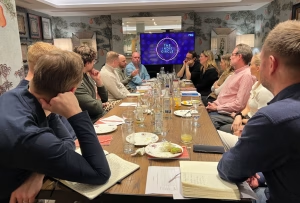
At a recent roundtable hosted by New Digital Age in partnership with Outra, senior leaders from across the UK media landscape explored how marketers are adapting and which signals and strategies are emerging as vital for targeting, measurement and planning.
Charles Crotty, Managing Partner at Digitas, opened the session with a reminder of just how long the industry has been preparing. “Everyone with a global remit has had a ‘cookieless’ workstream running for years,” he said. “Agencies have been leading from the front, and now that some platforms still hesitate, the industry has effectively moved on.”
Chris Appleton, Head of Programmatic at PHD, pointed to fragmentation: “We moved from fragmented cookie-based targeting to fragmented cookieless targeting. There’s no single answer, so we’re relying more on third-party data and leveraging AI to scale our approach.”
Strategies beyond cookies are gaining ground
Many guests agreed that cookie deprecation had already become a catalyst for innovation. Billy Brett, Head of Product at Walk-In Media, said: “Good advertisers are using a three-layered measurement approach, real-time optimisation, causality testing, and econometrics. None of these rely solely on cookies.”
Oliver Williams, Head of Digital Performance at Mediaplus UK, added: “We’ve had clients asking us to prepare for a cookieless world for years. If you’re still dependent on cookies now, you’re behind.”
However, that transition is not without challenges. Emma Glenn, Head of Programmatic UK at Spark Foundry, highlighted the pressure: “Day-to-day optimisation still leans on data such ad server post-impression numbers, which often rely on cookies. There’s still a gap between long-term strategic measurement and short-term campaign delivery.”
The role of DSPs and systemic gaps
One recurring issue was platform dependency. Layla Malki, Director of Programmatic at Havas Media UK, said: “DSPs still favour impressions with identifiers. This makes it difficult to tap into cookieless inventory at scale, even when we want to.”
David Ayre, Managing Partner, Programmatic at Dentsu, agreed: “”not all platforms clearly break out cookieless versus cookie-based inventory when reporting on delivery and performance, providing brands less insight on their current cookie reliance during a key period of transitions away from cookies.”
Enter location and household data
The conversation soon turned to what could realistically fill the targeting and measurement vacuum left by cookies. Location and household-level data emerged as the strongest contenders.
Ilona Spilker, VP, Head of Partnerships at Choreograph, stressed location’s dual role in bridging online and offline: “Clients want a complete view of consumer journeys. Location data is one of the most robust privacy-safe signals that helps connect digital and physical behaviours.”
Oli Bello, Head of Growth at Outra, described the importance of identifying life moments: “Moving house, for example, triggers tens of thousands of pounds in spend. Location and household data let us anticipate these moments and act with relevance.”
Beyond intrusive: using context for value
As concern around privacy continues, the group highlighted how location can help deliver contextual, timely marketing without triggering user discomfort.
Lina Angelides, Managing Partner, Head of Digital Planning at OMD UK, said: “Contextual location targeting can reduce the risk of user discomfort. It enables planning based on behavioural phases, from awareness to action, while respecting privacy.”
Charles Crotty added: “Location helps us enrich central strategies, especially when planning across markets. For global clients, it’s a layer that helps deliver relevance at scale.”
Planning and activation must align
Graham Field, Chief Revenue Officer at Outra, pointed out a common pitfall: “There’s often a disconnect between a client’s strategic data intent and how that gets executed. Someone builds a brilliant segmentation, and then it ends up only being applied to 15 houses in Swindon.”
Lina Angelides said that greater collaboration is essential.
“Planning and activation teams must come together earlier. Otherwise, we risk losing the potential that these insights offer when they hit siloed teams.”
Closing the loop: from insight to outcome
Everyone agreed that location and household data must be more than a plug-in signal. It needs to guide end-to-end strategies. Emma Glenn called for deeper integration: “It should sit upstream in the planning phase. Used correctly, it drives better performance across every channel.”
Ilona Spilker concluded: “When you use location data as a thread from planning through measurement, it doesn’t just fill the gap left by cookies. It builds a more accurate model of the customer journey.”
As cookies fade into the background, the conversation underscored an optimistic truth: the future of data-driven marketing is already here, and it may be more accurate, scalable and human than the one being left behind.
Parts two and three of this writeup will be published soon.