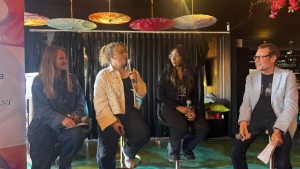
At New Digital Age’s annual Media Pride event, Editor-in-Chief Justin Pearse brought together four leading voices from the LGBTQIA+ community to explore how media and advertising can continue advancing inclusion in an era of increasing cultural tension. The panel featured Jerry Daykin, WFA Inclusion Ambassador & Head of International Media at Restaurant Brands International, Chloe Davies, CEO of It Takes A Village Collective, Marty Davies, Founder and CEO of Trans+ History Week, and Hannah March, Co-Commercial Director at Outvertising and Chief Growth Officer at Fold7.
Opening the discussion, Marty Davies set a serious but hopeful tone. “We have seen a lot of progress in the past few years, and maybe we were a little surprised by how quickly that progress started to reverse,” she said. “The Institute for Genocide Prevention even issued a red flag warning about how transgender and intersex people are being treated in the UK. That is the level of seriousness we are talking about.”
Despite that grim reality, Marty pointed to signs of hope. “The All In survey this year separated trans and non-binary people for the first time, and it showed that their mental health is suffering and that they are more likely to leave the industry,” she said. “That is painful to read, but it is also progress because now we know what needs to change.”
For her, data is the key to improvement. “We discovered that only around half of agencies have policies to support someone transitioning at work, and only about a third offer private healthcare that could save lives. We did not know that before. That knowledge gives us something to work from.”
Hannah March agreed that inclusion has reached a challenging moment. “Battles we thought had been won are being fought again,” she said. “Axios data shows an 82% drop in mentions of DE&I on US corporate earnings calls since 2021, which tells you how much it has fallen down the agenda.”
She believes that companies need to focus on reassurance and clarity.
“Inside organisations, people still care deeply about inclusion,” she said. “What they want is reassurance that leadership still values it. The best way to do that is to use data and speak in business terms.”
She highlighted that three quarters of consumers prefer brands with a reputation for diversity and inclusion, and that 63 percent of employees say DE&I is a factor when choosing where to work.
“Those are figures every CEO should care about,” she said. “You cannot argue with the business case.” Hannah also reminded the audience that inclusion need not always require a big budget.
“Small acts matter,” she said. “Adding pronouns to email signatures, having gender-neutral bathrooms, flexible working policies. These things cost almost nothing but send a huge signal of respect and reassurance.”
Chloe Davies brought a wider social perspective, drawing on her long experience in advocacy and leadership. “We have seen cycles of visibility before,” she said. “I was Black in 2019 before the re-emergence of the Black Lives Matter movement in 2020. It was then the world suddenly realised we (Black people) existed and then over the last two years the attention has faded. The organisations that built inclusion into their strategy rather than treating it as a HR function are the ones still holding the line now.”
She urged businesses to stay realistic but united. “The world really is on fire, but that has forced more collaboration,” she said. “Everyone is being attacked under the inclusion umbrella, and that has brought unity. Communities that never worked together before are now standing side by side, because they know none of us can afford to be divided.”
For Chloe, progress starts from within. “Get your house in order,” she said. “The better united you are internally, the more your work will have an impact externally. Do not get distracted by headlines. Build community and collaborate. One and one makes two, two and two makes four, that is how we win.”
She described this as “stealth mode progress.” “The loud campaigns are great, but the real change happens quietly,” she said. “It is about slow, steady wins done consistently.”
Jerry Daykin added a global marketing perspective, describing a business environment where brands must balance commercial realities with moral leadership.
“It is a weird time,” he said. “Everyone I speak to wants to do the right thing, but they still have to deal with business realities.”
He cited a telling example from the United States. “One of the WFA’s diversity task force members shared recently that if they want to sell to the US government and on military bases, they effectively are not allowed to have formal DE&I policies. So they have had to change the language and approach, but they have not stopped the work. Especially because they know in their business that appealing to diverse audiences, and creating products for them, is driving business results. That shows how adaptable inclusion teams have become.”
He also reminded the audience that public discourse can exaggerate negativity. “If you read social media, you might think everything is falling apart,” he said. “But across the EU, legislation is still advancing that requires companies to deliver and report on diversity, and in actual marketing meeting rooms in the UK, the tone is far less hostile than it looks from the outside.”
Jerry ended his point on a personal note. “I am a middle-class white man, and yes, I am gay, but I can more or less put that away in a box if I need to,” he said. “But this is a critical time for allies and those who may not be directly affected to step up. If they take rights and safety away from one group, they come for others next.”
Fear, backlash and the business of holding firm
When asked whether the fear of backlash is getting worse, Marty was quick to respond. “Yes, definitely,” she said. “We are seeing more caution. Brands that used to sponsor Trans+ History Week now prefer to support behind the scenes. They still want to help, but they are afraid to be visible.”
Yet, she also found a silver lining. “We are having more meaningful conversations,” she said. “Instead of asking, ‘What do we get from sponsoring this?’ brands are asking, ‘What do you need us to do?’ That change is progress.”
Hannah agreed that fear is real but argued that it can be managed. “You will never avoid backlash, but you can prepare for it,” she said. “The North Face knew they would get criticism for working with drag artist Pattie Gonia, but they prepared their staff, stood firm, and came out stronger.”
Jerry challenged the assumption that inclusion always carries risk. “Backlash terrifies marketers, but it rarely causes real business damage,” he said. “It is very hard to find examples where it has had measurable impact. The Bud Light case is one, but that was a double boycott. Both sides walked away because the brand handled it so badly.”
Marty agreed, saying, “Bud Light suffered because it did not stand firm. The queer community felt betrayed, and that was what really hurt them.”
Chloe added that there are many similar examples that never make headlines. “There are dozens of Bud Light stories we never hear about,” she said. “Brands do not talk about them, so we do not learn. But the pattern is the same. The mistakes come when words are not matched with action.”
She pointed to her experience with UK Black Pride. “We attract 25,000 people every year, but sponsorship is still a fraction of what Pride in London receives,” she said. “Everyone says they support us, but few put real investment behind their words.”
To close the discussion, Chloe shared an example of inclusion done right, the Virgin Atlantic ‘See the World Differently’ campaign, created with Lucky Generals. “We checked their homework first,” she said. “What are your internal policies? What do your employee groups think? We wanted to make sure internal change was happening alongside the campaign.”
The result spoke for itself. “It became Virgin Atlantic’s most successful campaign ever, with a 16% uplift in sales,” she said. “That proves you can do good and do well at the same time. When inclusion is authentic, it delivers commercially too.”
As the panel wrapped up, the tone was one of cautious optimism. Across every voice, from Marty’s data-led hope to Hannah’s pragmatic reassurance, from Jerry’s call for allyship to Chloe’s insistence on unity, one message stood out: progress must now be an act of perseverance.
*Our partners for this year’s Media Pride lunch, to which huge thanks are due, were The Independent, 59a, Outvertising and Publicis.