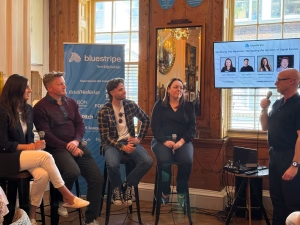
At the latest ‘Marketing the Marketers’ lunch event, Bluestripe Group hosted an expert panel discussion on how digital media and ad tech companies can turn the spotlight on their own brands.
Chaired by New Digital Age Editor-in-Chief Justin Pearse, the panel featured Emily Hanson, Head of Industry Marketing, EMEA, Uber Advertising; Lydia Oakes, Co-founder and Head of PR, Bluestripe Group; James Longhurst, Content Director, The Media Leader, Adwanted Group; Zuzanna Gierlinska, Panel Power Coach, Bluestripe Group; James Jones, Fractional CMO.
The brief for this session was deceptively simple. In a market drowning in options, how should B2B marketers choose, integrate and measure the channels that actually deliver commercial results? And, with budgets under pressure, what does good look like when you are stitching PR, events, content and sales enablement into one coherent marketing plan?
The conversation that followed, led by New Digital Age’s Justin Pearse, was a masterclass in commercial clarity over theatre, with the panel consistently bringing it back to objectives, orchestration and outcomes.
Start with business goals, not marketing tactics
Every panellist began at the same place. Strategy first, tactics second. James Jones was unequivocal about anchoring activity in the realities of the business. “Marketing planning should never happen in a vacuum,” he said. “Understand the commercial priorities, align your plan, then accept you will have to pivot as those priorities evolve.” The plan is the starting gun, not the finish line.
That commercial spine matters when the wish-list starts to grow. As Zuzanna Gierlinska put it, marketers need to hold themselves to the same standard as their CFOs. “Be really clear on the results you are going to deliver and how they ladder to growth,” she said. “If you want more resource, show the impact. How will you shift the commercial needle?”
This is also where transparency with partners pays off. Too often, agencies and media owners are asked to operate blind. Lydia Oakes urged marketers to share the whole brief.
“We are just here to help,” she said. “The more explicit you can be about your business objectives, the better the partnership. If the goal is expansion into a new vertical, a funding round, or preparing for acquisition, it completely focuses the plan.”
Events: design for before, during and after
No surprise that events dominated the debate. They are expensive, plentiful and, when done well, unequalled in creating results. But the panel was adamant that most of the value is won or lost outside the room.
James Longhurst offered a neat operating model. “We live by a 30, 40, 30 rule,” he said. “Put 30 percent of effort and budget into pre-event build up, 40 percent into the event itself, then 30 percent into post-event follow through. Too many teams drop the sponsorship, show up, then move on, and all that value is left on the table.”
Emily Hanson agreed, stressing the importance of selling the plan internally, especially to sales.
“Make sure the commercial team knows exactly what the business is trying to get out of the event,” she said. “Have measurable points afterwards, whether that is opportunities in Salesforce or agreed influence metrics. Scanning badges is not success. Getting the right message in front of the right buyers is.”
Measurement begins with choosing the right yardsticks. Zuzanna was pragmatic. “Align the KPIs at the start,” she said. “If the goal is lead generation, define what good looks like and who is responsible for making it happen. If your investment involves speakers, invest in their readiness too. You get maximum runway when your people are prepped to land the messages with confidence.”
Just as important are the secondary benefits, according to James Longhurst. “Sometimes you put someone on a panel because it matters for their career,” he said. “Sometimes your audience is literally the person sat next to you on stage. Be honest about those tertiary objectives. Developing people, creating advocacy, having fun. We are a people industry. Those things matter.”
The panel were asked how marketers can best prioritise in a sea of events. Lydia recommended a structured approach. “Build a calendar that combines the tent-poles you must be seen at with the smaller forums that match your goals,” she said. “We have used detailed decision criteria with clients to judge fit by audience, message pillar, speaking role and the depth of engagement possible.”
Segment your audiences first, then map events to them. Zuzanna was blunt.
“Be crystal clear on your ideal client profiles,” she said. “If you sell brand-direct, a room that is majority agency might not be where you invest.” That clarity helps when the internal requests start flooding in. As James Jones added, over-communicate the why of where you will and will not show up, and get out to events yourself to sense the reality rather than manage only by spreadsheet.
Niche can out-perform scale when the fit is right. Emily gave a practical example from Uber Advertising. “We tried a very specific travel retail forum this year because the decision makers were exactly who we needed,” she said. “It was smaller than the usual big industry tent-pole events, but laser focused, and incredibly effective for our objectives.”
Owned events: fewer slides, more experience
Running your own event gives you control, though it also puts the burden of audience and experience on your team. Emily’s advice was to be ruthless about purpose and participation.
“We have clear objectives, a programme that supports them, and rules of engagement,” she said. “Our sales team is not attending unless their clients are in the room. Owned events are time intensive. If you are not clear on the value you will generate, question whether you should do it.”
Do less, better, said Longhurst.
“Everyone puts too much in,” he said. “Do less, make space to connect, and do not forget the social time. Educate and entertain. If you can do both, brilliant, but be honest about which you are aiming for and design accordingly.”
Format innovation matters here. Zuzanna cautioned against defaulting to a day of keynotes.
“That format is dead for many audiences,” she said. “Curate, keep it moving, deliver one or two big messages rather than twenty small ones.”
Lydia echoed the point with a favourite case study. “We turned a research deck into a game-show event hosted by Rob Mayhew to engage media planners,” she said. “It communicated the insights far better than a 30-page PDF ever would.”
Content remains the connective tissue across PR, events and sales. The bar for quality keeps rising, and the panel agreed that generic whitepapers will increasingly be ignored.
“Tell me something useful and new,” said James Jones. “Translate your capability into my outcome.” That demands editorial discipline, variety of format and a paid, earned, shared, owned mindset.
Lydia framed it around audience and endorsement. “Earned media gives you third-party validation,” she said. “Paid can go deeper on the sales message that earned cannot. Use both, and make sure your owned channels are telling the story the market needs to hear.”
Measuring serendipity, intentionally
One of the most resonant threads was about the value of unscripted moments. Jones argued that leaders need space in their diaries to let chance do its work.
“Most of my best results have come from luck,” he said. “Who you share a cab with, who you sit next to at lunch. If your C-suite is back-to-back all week, you are starving the programme of those moments. Plan for them, do not hope for them.”
“There is real value in the unscheduled. Be intentional about where you are, but leave room for the encounters that build your network,” said Hanson.
This is not a plea for vagueness, it is a case for designing serendipity into the operating model.
Zuzanna suggested making it a measurable behaviour. “At Cannes we set a target for the sales team to make new connections outside their usual circles,” she said. “Not everything has to be a client breakfast. Expanding the network was an explicit KPI, and it changed how people used the week.”
James Longhurst’s earlier point about purpose applies doubly here. If the goal is thought leadership, measure it that way, rather than trying to reverse-engineer it into a lead-gen campaign afterwards. As he put it, “Confusing your objectives is rubbish for you, for your media partners and for your stakeholders.”
Given the subject and the room, the conversation inevitably returned to panels themselves, and how to make them worth the sponsorship. Zuzanna’s new panel training programme with Bluestripe is aimed squarely at this problem. “There is a lot of money going into panels, yet too little thought about delivery,” she said. “Give people the training and the confidence to land the right messages in the room. You will multiply the value of the spend.”