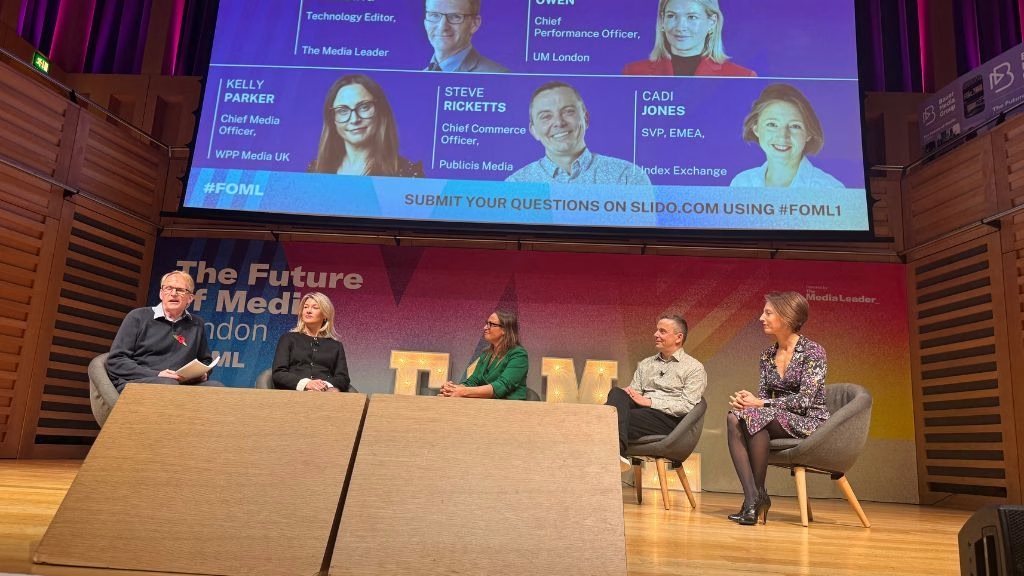
The ‘If channels and funnels are dead, what replaces them?‘ panel discussion at the Future of Media event featured Louise Owen, Chief Performance Officer, UM London; Kelly Parker, Chief Media Officer, WPP Media UK; Steve Ricketts, Chief Commercial Officer UK and International, Publicis Media; Cadi Jones, SVP EMEA, Index Exchange. The session was moderated by John Moulding, Technology Editor, The Media Leader.
The funnel still matters, but it looks very different
Louise Owen, Chief Performance Officer at UM London, set the tone early on. “The funnel is collapsing from an audience perspective,” she said. “But the way agency models and client measurement systems are set up means we still have a long way to go before it disappears.”
For her, the tension lies between how consumers actually behave and how organisations still plan and measure campaigns. The structures remain, even if the behaviours have changed
Kelly Parker, Chief Media Officer at WPP Media UK, agreed that the funnel has evolved rather than vanished. “There are bits of the funnel that are collapsing and getting faster through technology, algorithms and AI,” she said. “But we still need the concept to organise ourselves, to measure things, to know why things are planned.” In other words, even if the funnel no longer reflects real-world journeys, it remains the organising principle that keeps marketing departments and agencies aligned.
Steve Ricketts, Chief Commercial Officer UK and International at Publicis Media, took the idea further, suggesting that both channels and funnels were always simplifications.
“They make it easier to have conversations about complexity,” he said. “But we need to move towards understanding connected consumer experiences, and how we get the right things in front of the right people at the right time.”
For Cadi Jones, SVP EMEA at Index Exchange, the pace of change is evident from a technology perspective, but adoption varies. “Some partners still structure campaigns entirely around the funnel,” she said. “Others are already using AI-driven optimisation and custom algorithms to redefine how activation happens. It will take time before that shift filters into everyday planning.”
Retail media and the rise of the fast funnel
The conversation turned to retail media. As Ricketts pointed out, “Retail media now accounts for roughly 10 percent of total media spend, and it is being driven by behaviour. People have always discovered products while shopping in store, and now they are doing the same thing online, only faster.”
This acceleration is not limited to impulse buys. “Half of TVs are bought in less than a week,” Ricketts said. “Seventy percent of those searches do not start with a brand keyword. When your TV breaks before a big match, you will search, compare and buy quickly. Availability and convenience win.”
For Parker, this behaviour shows that while journeys have compressed, they have not disappeared entirely. “If people are researching products on their phones in store, that points to there still being a funnel,” she said. “There is still awareness, research and consideration, but it is happening more fluidly and more quickly.”
Owen agreed, stressing that speed does not negate the need for trust. “If you move down the funnel that fast, it is because you trust the brand,” she said. “That trust allows consumers to skip steps.”
Why strong brands still matter
The panel was united in its view that, in a world of instant transactions and endless choice, brand remains a critical shortcut for consumers. Parker described brands as “signals that help people navigate”. “They tell you why a product is different, or why you should be paying that much for it,” she said. “Even when AI or digital agents start buying on our behalf, we will still need strong brands, for robots as much as for humans.”
Owen warned that too many challenger brands underestimate that truth. “We see disruptor brands pop up and then disappear,” she said. “Their business model is wrong, or they have grown through heavy discounting. Without building trust and recognition, they cannot sustain momentum.”
Ricketts agreed that brand strength is inseparable from delivery. “It is not just about the advertising experience,” he said. “Trust comes from whether the product does what it promised. Media cannot be viewed in isolation from the total experience.”
Technology, measurement and the quest for clarity
The discussion naturally turned to how technology, data and measurement are reshaping planning. Jones spoke about how programmatic technology now allows real-time responsiveness that was unthinkable even a few years ago. “If a product goes out of stock in a certain area, your media plan can now adjust instantly,” she explained. “That sophistication makes campaigns far more efficient, but it also raises the bar for everyone.”
Owen noted that despite technical progress, measurement remains the industry’s biggest headache. “We have been talking about measurement for over ten years and still have not cracked it,” she said. “As consumer journeys become less linear, unified measurement is more important than ever.”
Parker agreed, arguing that too many brands are still tracking the wrong things. “We are measuring media metrics instead of business metrics,” she said. “The real question is whether you have sold more, at the price you wanted to sell it. That is what matters.”
Agentic AI and the future of decision-making
Looking ahead, Moulding asked the panel to consider how AI-driven agents might reshape marketing altogether. Owen predicted a “stacked” model of specialised AI systems working together. “It will be an AI stack, connecting different layers of specialism,” she said. “The key will be ensuring intelligence across impressions, context and consumer intent.”
Parker, however, doubted that consumers would easily hand over purchasing power. “I do not trust a robot to buy me a car,” she said. “Humans will still be involved for a long time. There will be categories suited to automation, but others where people will always want control.”
Ricketts imagined a gradual transition, with AI handling low-risk decisions first. “Agentic AI will start with simple purchases where trust is high,” he said. “It will evolve through shortlisting and recommendations before taking on more complex, emotional buying decisions.”
Will all media become retail media?
The conversation then shifted towards Ther IAB’s prediction: that by 2030, all media could effectively become retail media. Owen believed the direction of travel was clear, but the reality would be nuanced. “It depends on how your brand exists within its ecosystem,” she said. “A single platform with end-to-end data and measurement can make sense, but it is not for everyone.”
Parker added that it always comes back to understanding audiences and their intent. “Not every media owner has to be full funnel,” she said. “A cinema or TV ad can still drive impact through every stage. What matters is how you use it and what role it plays in your overall plan.”
For Ricketts, the shift is not about adding a buy button to every channel, but about creating seamless journeys. “All media should be shoppable in the sense that consumers know what to do next,” he said. “That might be clicking through, visiting a store or simply remembering your message when the need arises.”
Jones saw the boundaries blurring already. “Performance advertisers are moving into CTV to drive sales,” she said. “The harder move is retail media specialists trying to build brands, because their audiences arrive with a purchasing mindset.”
Why the old labels still hold value
Even with technology and AI redrawing the map, the panel agreed that traditional channel definitions still serve a practical role inside organisations. Parker explained why: “The funnel language exists because it simplifies. CFOs still have to sign off budgets, and they understand what a TV or digital plan means. It keeps processes clear.”
Owen agreed, pointing to the accountability that those labels provide. “Budget structures and regulations still require distinctions,” she said. “We cannot dismantle them overnight.”
Jones noted that technology is already starting to blend these categories in practice. “Custom algorithms can now move budget between mobile and desktop in real time,” she said. “It is an early sign of the fluidity to come.”
Ricketts ended the session by bringing the conversation back to the heart of marketing. “Start with the consumer,” he said. “Understand where they spend time, how they make choices, and what matters to them. The funnel may be evolving, but the fundamentals of good marketing remain the same.”