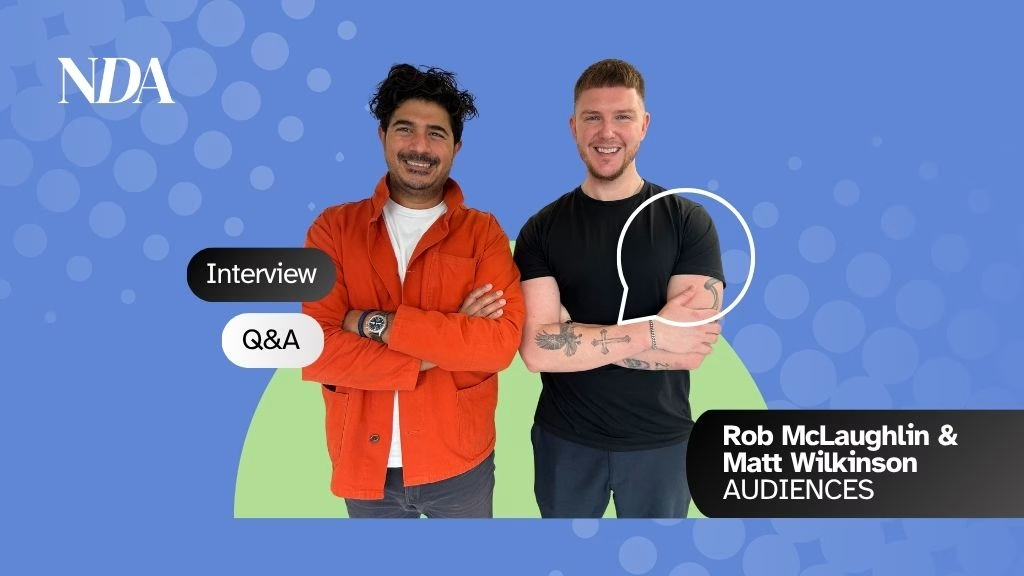
New Digital Age Editor-in-Chief Justin Pearse spoke to AUDIENCES co-founders Rob McLaughlin and Matt Wilkinson to discuss their plans to lead a revolution in first-party data use by brands.
AUDIENCES is pitching a very different way of activating first-party data, one that lives inside the advertiser’s own cloud environment rather than in a third-party platform. Here, they explain what that really means, why they think the current model is “not fit for purpose”, and how it could change the relationship between brands, data owners, agencies and their data.
For anyone who is not familiar with AUDIENCES, how would you describe what you do?
Rob McLaughlin, co-founder and CEO, starts with his own background as Head of Data at Sky, working across both the buy side, driving growth for Sky and Now, and the sell side, powering Sky Media’s advertising business with data from 11 million UK households.
That experience, he says, convinced him there had to be a better way to get customer data into the ad ecosystem.
“At Sky we were early into the cloud, putting our customer data into Google Cloud back in 2016,” he explains. “That gave us the chance to build a modern data stack for advertising. Later, when Matt and I were consulting for big brands, we realised we were writing the same prescription again and again, move your data into cloud infrastructure, then work out how to connect it to media.
Out of that came AUDIENCES, described as a cloud-native application that sits inside the advertiser’s own cloud environment, whether that is Google Cloud, AWS or Azure, and pipes first-party data directly into the ad platforms that need it, without that data ever leaving the brand’s infrastructure.
Further, thanks to data warehouses such as Snowflake, DataBricks & BigQuery brands and data owners are better prepared for activation than ever before.”
What is fundamentally different about your model compared with traditional CDPs and onboarding platforms?
Wilkinson frames the problem very simply. “Today, most solutions tell brands, if you want to use your data, you have to copy it out of your own cloud, into our cloud, then we send it on to Meta, Google or whoever,” he says. “We call it my cloud, middle cloud, activation. That middle cloud is why so little first-party data is actually used.”
Wilkinson believes the problem is that traditional CDPs and onboarding platforms all run as hosted services on their own cloud infrastructure, they all require brands to send them copies of data, and they typically charge on volumetric models where the more data that flows through the pipes, the more the client pays.
“We are not a data processor, we are an application that the client installs into their own cloud,” Wilkinson says. “We take the activation to the data, not the data to the activation. That is the disruptive idea for us.”
Why is keeping the data inside the brand’s own cloud so important?
McLaughlin talks about a “trinity of value” that falls out of this approach.
“First, zero data privacy risk, because all the customer data stays inside the brand’s own infrastructure and is only used in the ways customers have consented to, AUDIENCES is not a data processor as per GDPR” he says. “Second, complete data security.
You preserve all the work the organisation has already done to keep data safe, there is no extra exposure. Third, no tax on activation of first party data.”
Because AUDIENCESudiences runs inside the advertiser’s cloud, the brand uses its own storage and processing, which it has already paid for. Every other player in the market charges back for that storage and processingprocessin. They rely on volumetric pricing, more data means more revenue. In the era of cloud adoption that feels perverse, most brands now have incredibly powerful cloud infrastructure already.”
If the benefits are so clear, why is nobody else doing it this way?
McLaughlinWilkinson believes the industry is “drunk” on software- as- a- service.
“Since Salesforce, the pattern has been, build software, host it yourself, rent it back to clients,” he says. “That made perfect sense when clients did not have serious cloud infrastructure of their own. Now they do, the idea that they still need to rent somebody else’s is out of date.”
Founders, investors and boards are heavily locked into these hosted, volumetric models, he argues, because that is what has driven shareholder value for decades. Moving away from that is extremely difficult.
“Antitrust is the elephant in the room,” McLaughlin says. “Google, Amazon and Microsoft are both huge cloud businesses and huge advertising businesses. They are constrained in how tightly they can connect the two, we are very happy to sit in that gap.”
How do agencies fit into this picture, and does this change their relationship with clients?
“When we started, I thought agencies would not care about this,” Wilkinson admits. “I was completely wrong. Because agencies see first hand how little first party data powers digital campaigns, they have become important partners and referrers for us”.
The key point, McLaughlin says, is that the commercial relationship, and the technology itself, always sit with the data owner, the brand.
“The brand is the centre of gravity, their first-party data lives in their cloud,” he says. “Agencies benefit because they can finally get compliant access to powerful first-party signals, without ever taking ownership of that data.”
AUDIENCESAudiences is keen not to be seen as disruptive to the media supply chain. “No agency should see us as a threat, no DSP or media owner either,” McLaughlin says. “We want to be the infrastructure that helps every pound of media work harder.”
Your commercial model is also different, how do you charge?
Instead of charging on the amount of data processed or activated, AUDIENCESAudiences licences its software on a flat fee.
“You lease the software for a fixed annual amount,” Wilkinson says. “As much data as you want to read, as many segments as you want to create, as much activation as you want across the ecosystem.”
He contrasts that with activation taxes where, every time a brand wants to bring more first-party data into advertising, it pays more.
“That is one of the reasons so little first-party data is used,” McLaughlin argues. “It is too hard and too expensive. We believe there should be no tax on the activation of first-partyfirst0party data. If the industry can remove duplicated storage and processing in the cloud, everyone will win, brands, agencies, platforms and, ultimately, consumers.”