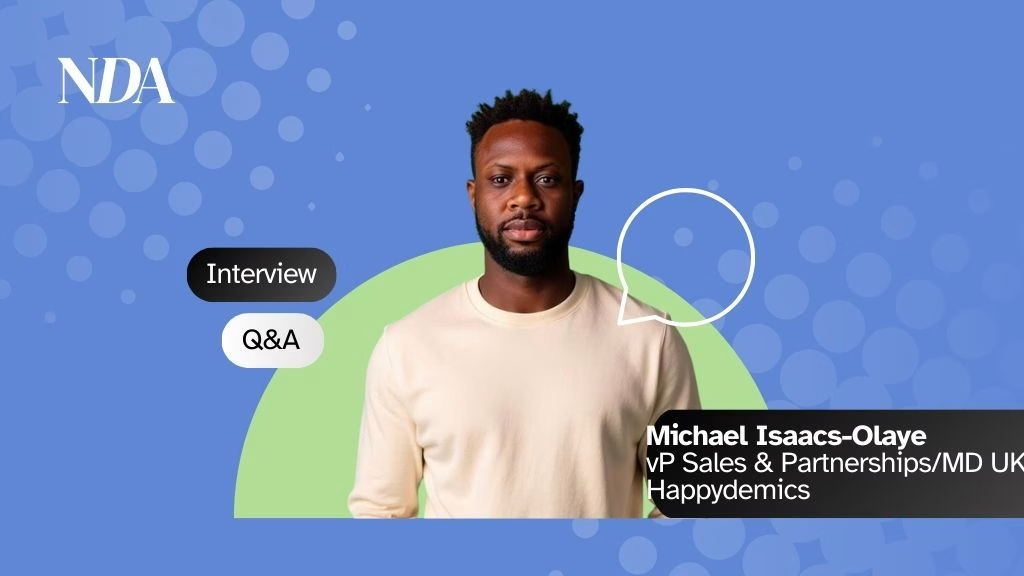
NDA Editor-in-Chief Justin Pearse sits down with Michael Isaacs-Olaye, VP of Sales & Partnerships / MD UK, Happydemics to find out how he is building Happydermics UK business.
Can you start by giving an overview of Happydemics and the UK story so far?
Happydemics has been in market for more than a decade, although the last three years have been the most transformative. The company shifted from being heavily research focused to becoming the plug and play measurement partner that it is today, which helped fuel strong momentum in the UK.
With major partnerships already in place across adtech, TV platforms, and large holding companies, the UK became a natural centre point of the company’s expansion, especially following a €14 million Series B funding round.
What are the plans for growing the UK operation?
The company already has its London office, and the focus now is on expanding the team across acquisition, account management, and enterprise sales. We’ve just hired a new enterprise sales director who will help open conversations that the
Success in the UK requires both experienced talent and targeted outreach to priority partners, rather than trying to work with everyone at once.
Which partners or sectors are the biggest priorities for you right now?
The key focus is on deepening relationships with social platforms and the major streaming networks, including Netflix, Disney, and Amazon Prime. At the same time, Happydemics wants to activate existing partnerships more widely through platforms such as The Trade Desk, Magnite, and Adform, expanding access to a larger pool of advertisers.
Our strategy is about working with the right partners and ensuring that the company scales in a thoughtful way.
You operate in a crowded measurement market, so what makes Happydemics different?
The main distinction is that Happydemics does not rely on panels, which gives us greater flexibility and ensures responses come from real people rather than paid panelists. By programmatically targeting surveys within ad slots, we gather instant and authentic feedback from real users, which is increasingly important in a world shaped by generative AI.
Our technology combines exposure probability and contextual ad recall to give advertisers a clear view of what worked, supported by robust benchmarking across channels.
What are the biggest challenges in measurement today?
Fragmentation remains the biggest obstacle for brands, since the mix of channels and walled gardens makes it difficult to compare performance fairly. This is where we deliver the most value, offering an agnostic approach that provides insights across every environment.
For publishers, attribution remains the toughest challenge, particularly when distinguishing between conversions that would have happened anyway and those driven by advertising.
Are you seeing any interesting trends in how channels combine to drive effectiveness?
CTV is the clearest example of a channel that amplifies performance when used alongside others. It brings the brand impact traditionally associated with linear TV, combined with the precision targeting of digital, giving marketers new creative and tactical options such as home screen placements, pause ads, and QR codes.
Effectiveness comes from testing and refining, since even ideas that seem unlikely to work can sometimes deliver surprising results when measured properly.
How do you work with publishers, brands, and agencies?
Happydemics sits at the intersection of research, media, and technology, which means the relationship flexes depending on the partner. For agencies, we provide the intelligence layer for pitches and planning, delivering rapid insights that support strategy and prove effectiveness.
For brands, we help connect media investment to real-world impact across the full funnel, and for tech partners, we integrate directly into ecosystems to validate the effectiveness of new formats across channels.
What role does AI play in your approach to measurement?
AI is most valuable for its predictive capabilities, using data from more than 10k past campaigns to help forecast what should deliver strong results based on specifics KPIs.
While benchmarking and reporting performance remain essential, predictive guidance is what will help advertisers plan smarter campaigns.
We’re currently working on using AI to scale these predictive models so that advertisers can understand likely outcomes in advance.
You’re building a company in the UK, what are the challenges and opportunities around talent in the current market?
The landscape is extremely competitive, particularly when hiring younger talent whose expectations of the workplace differ significantly from earlier generations.
Redundancies across major adtech players mean there are many strong candidates, although attracting them requires a compelling narrative and clear momentum.
Our priority is hiring the right people rather than hiring fast, and we’re willing to be patient to ensure every new team member fully buys into its story and long-term vision.