The Middle East and North Africa (MENA) has rapidly evolved into one of the world’s most dynamic arenas for media and marketing innovation. With youthful populations, high social media penetration and an appetite for digital storytelling, cities such as Dubai and Riyadh have become fertile ground for new media models that blend local insight with global formats.
In this context, Augustus Media has emerged as one of the region’s most influential digital media companies, scaling across multiple markets with brands such as Lovin Dubai, Lovin Saudi and the Smashi network of vertical content platforms.
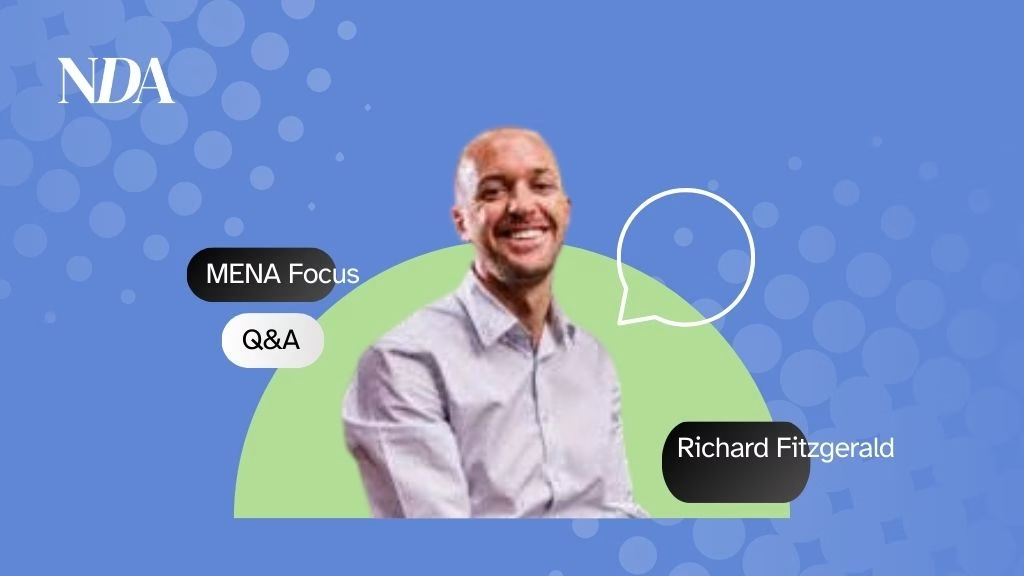
At the helm is Richard Fitzgerald, CEO and Founder , whose career spans agency leadership roles at Mindshare MENA through to building his own media group that now operates across more than a dozen countries, employs more than 100 people and reaches millions of consumers with local and regional content. Prior to founding Augustus, he led social media operations for global media networks.
In the following interview, Fitzgerald discusses the evolution of modern media in the MENA region, the business model that has driven Augustus’ growth and what Dubai represents for media professionals looking at the region.
How did the business start, and what was the original inspiration behind it?
The company began with a simple yet ambitious idea: build a local media brand that combined highly shareable social content with a clear commercial model. Inspired by early publishers such as BuzzFeed but adapted for a Middle Eastern audience, the original focus was on city-level content delivered via social platforms and monetised through branded content.
Unlike many digital ventures, the strategy was deliberately conservative with finance. No venture capital was raised and there was no rush into costly original formats. Instead, the team focused on what worked locally and built from there.
What does the company look like today in terms of scale and structure?
Ten years on, the business has grown into a multi-market media operation.
With over 120 employees and offices in cities from Dubai to Karachi, Augustus Media generates annual revenues in the mid-teens of millions and has maintained profitability throughout most of its history. The Gulf states remain the commercial core of the business, while editorial operations extend across the Levant and broader MENA markets.
How do the different brands within the group serve different audiences?
Augustus operates both horizontal, city-focused brands and vertically aligned channels aimed at specific interests such as business and sport. The city brands offer broad lifestyle and cultural content, while the vertical brands have evolved into standalone platforms that include newsletters, social video and even licensed sports streaming.
This dual strategy allows the company to engage mass audiences at scale while developing deeper niche vertical expertise.
How important is independence in a region with complex media regulation?
Independence is essential. In many MENA markets, media outlets are directly linked to governments or ruling families, which can restrict cross-border operation and editorial freedom.
By remaining independently owned and locally staffed, the company has been able to operate in multiple territories without being perceived as aligned to a single political interest. Local office profit and loss autonomy also allows each market to adapt organically to regional differences.
Where does the majority of revenue come from today?
Branded content remains the largest revenue generator. While programmatic and platform monetisation contribute, the bulk of the business comes from direct partnerships with brands and advertisers.
Around 30% of revenue is routed through media agencies, with the remainder booked directly via client engagements ranging from food and beverage to regional long-tail advertisers.
How do advertisers view influencer marketing and measurement in the region?
Measurement frameworks in the MENA region lag behind those in more established markets. While overall digital ad spend has grown significantly, much of it flows to global platforms such as Google and Meta, leaving local measurement of influencer and branded content performance challenging.
The company’s scale allows advertisers to access coordinated, multi-city campaigns with guaranteed reach across a network of millions of followers, effectively commoditising the influencer model in a scalable way.
How would you characterise Dubai as a media market compared to the UK?
Dubai is globally positioned and fast-paced, but structurally less developed than markets such as London. Long-range planning cycles are shorter and there is a stronger emphasis on rapid execution.
That said, high digital penetration, consumer engagement and substantial branding budgets make it an attractive market. Developers and major brands are willing to spend on spectacle and large-scale activations that would be unusual elsewhere.
What advice would you give to UK media professionals considering a move to Dubai?
A soft landing via an international organisation or familiar network is often the best entry point. While specialised expertise is valuable, generalist skills are frequently more useful in a market that moves quickly.
Cultural fluency and local market knowledge are crucial. Understanding local brands, references and audience behaviour will distinguish successful candidates from those who struggle to adapt.