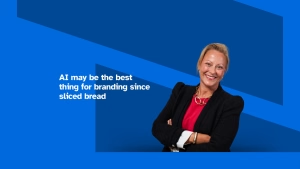
Mario Lamaa is Managing Director, Data & Revenue Operations at Immediate Media and NDA’s new monthly columnist.
Why leaning in is the best way to combat AI anxiety
The start of 2026 has seen the doubling down on a trend that defined 2025. A narrative of persistent, fear-driven anxiety over AI’s disruption of media. But by fixating on the risks, we fall into a defensive mindset. In reality, the technology is as much a powerful enabler as a threat, if we choose to lead its implementation.
To understand the roots of this fear, you only need to look at the data. The impact of AI overviews on ad revenue is a well-documented reality, Chartbeat data reveals that ‘zero-click’ search has triggered a 33% year-on-year fall in global traffic across 2,500 news sites.
Meanwhile, as AI begins to automate traditional workflows, it’s raising urgent questions about the long-term viability of entry-level roles. From LinkedIn to industry events, we’ve seen the polarising debate between those championing AI’s potential and those worried about the potential human cost.
However, fear often clouds judgment. As any psychologist will tell you, the most effective way to manage fear is to confront it directly. Rather than casting ourselves as victims of a maturing force, we need to embrace this change. This involves becoming active architects, rather than passive observers, shaping how the technology evolves.
From anxiety to agency
At Immediate, our journey from anxiety to agency began three years ago. During the initial ChatGPT hype, over 50% of our workforce expressed significant anxiety regarding generative AI. In response, we embraced AI, encouraging an adopt and experiment approach to help to demystify it.
Internal initiatives ranged from informative AI Days, to hands-on hackathons. We focused on demonstrating how AI could handle mundane, repetitive tasks, thereby liberating human creativity rather than replacing it. This practical use encouraged further use across all areas of company.
By giving people training, permission and the tools to experiment, we replaced uncertainty with practical utility. Doing rather than fretting. The result has been a dramatic shift in sentiment. Anxiety levels have plummeted from over 50% to just 5%, while 58% of our people now proactively use AI on a weekly basis. We’ve shown that when people understand the “how”, they lose their fear of the “what”.
Reframing AI as a tool rather than a threat has democratised innovation across the company. By removing traditional technical barriers, and highlighting how it can enhance human creativity we’ve shortened development cycles from months to just weeks. We currently have 20+ AI projects & process improvements in development across the company as a result.
Building the “brain”
With an empowered workforce, AI will play a crucial part in our strategic move to develop a true single customer view. For the past 18 months, we have focused on meticulously standardising diverse data sources – from e-commerce signals to audience behaviour – into a unified customer data platform. As a multi-platform company, this will be essential to our future growth. After all, an AI strategy is only as good as the data that feeds it.
Doing this will allow us to target our audiences with deeper precision and the right marketing messages, to deepen engagement and help convert more users into subscribers.
These capabilities are also transforming our commercial offering. With AI search overviews impacting new website traffic it is becoming more crucial for publishers to maximise the value of our existing first party data. AI allows us to extract this at scale and continue to build on Prism, our end-to-end data offering. By layering AI agents over standardised data, we can respond to briefs faster and help brands reach passionate consumers in premium, brand-safe environments.
The Agentic future
The proactive mindset toward AI recognises that things never stand still and innovation is constant. The next step is the transition to agentic systems. Unlike single-task tools, these coordinated networks of AI agents can manage complex, multi-step workflows.
By also understanding the holistic value of a user, these systems will allow us to predict churn and incentivise the specific habitual behaviours that drive long-term retention.
AI also offers a unique opportunity to unlock the accumulated human craft stored within our archives. For traditional media companies, repurposing decades of trusted content has historically been a manual challenge. We’ve developed a tool called First Draft, allowing our editorial teams to rediscover, revitalise and reference our rich digital archive to create new, quality content that can reach new audiences and platforms in the formats they want to consume, freeing up teams to work on other creative content.
Human creation and input remain at the heart of all our editorial output – our teams’ knowledge and expertise provides our competitive advantage
Creating an environment where everyone in the company is comfortable and competent, allowing AI to handle the “heavy lifting”, is vital.
Fear of AI stems from a sense of powerlessness, yet the antidote is participation. By building the tools they can trust and that can enhance our IP, this has helped us move from being the “disrupted” to being the “disruptors”.
The goal is not for AI to think for us, but to provide the clean data and efficient systems that allow human talent to flourish. We remain a business powered by data but defined by human craft. This year, let’s not shrink from our fears; let’s lean in and design the future we want to inhabit.